
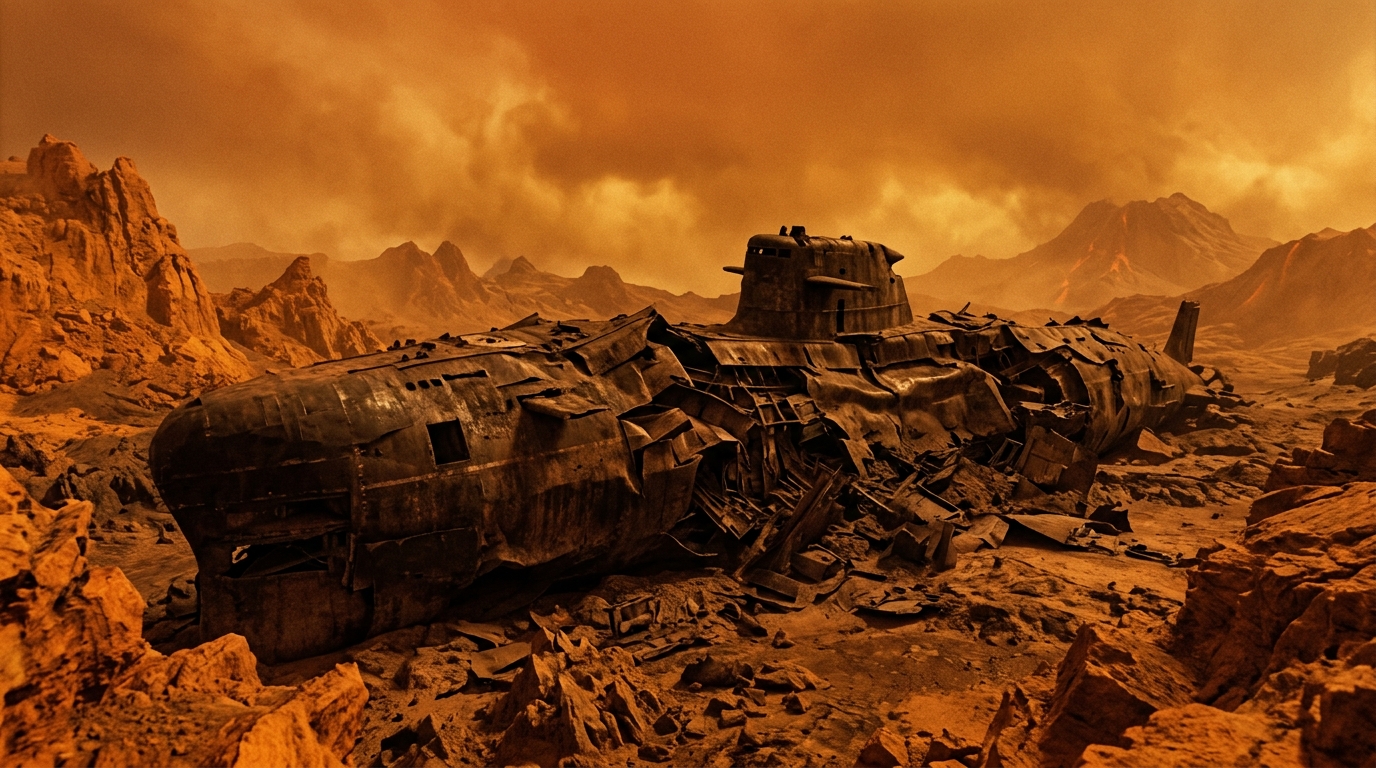
Many still imagine that if one day we discovered a world in the Solar System almost identical to ours, simply setting foot on it would make us feel at home. That is precisely the mistake we too often make with Venus, a planet long dubbed Earth’s twin, without asking what truly lies beneath its veil of clouds. Behind this façade of similarity—comparable size, nearly the same mass, a rocky composition close to ours—lurks a hellish realm that even our most robust technologies struggle to confront. At Venus’s surface, the air itself would become a weapon capable of crushing a military submarine as easily as a tin can.
- The surface pressure on Venus reaches about 92 times that of Earth, equivalent to a dive to roughly 900 meters depth.
- With an average surface temperature of 462°C, Venus is the hottest planet in the Solar System, ahead of even Mercury.
- The Soviet probe Venera 13 holds the record for surviving on Venus, enduring 127 minutes in 1982.
- Why Venus has a twin in name only
- 92 times Earth’s pressure: a reality beyond imagination
- When Soviet probes were crushed in minutes
- What this infernal pressure teaches us about rocky worlds
Why Venus Has a Twin in Name Only
On paper, everything seems to line up. Venus displays a diameter only slightly smaller than Earth’s, a mass very close to ours, and an internal structure built from the same broad families of rocks. This has fed, for decades, a flattering image of a sister planet. Yet this kinship ends the moment we look at what lies around its surface. While our atmosphere remains breathable and temperate, Venus’s atmosphere is a chemical nightmare made up of more than 96 % carbon dioxide, topped by thick clouds of sulfuric acid that prevent any direct observation of the ground from space.
This radical difference explains why scientists had to abandon the idea of a simple aerial photograph to map Venus’s relief. They now rely on radar imaging, the only technique capable of piercing the permanent cloud cover. Thanks to it, we now know that Venus has mountains, volcanic plains, and even a peak, Maxwell Mountain, that rises above 10,000 meters in altitude. A summit where, notably, pressure and temperature drop significantly compared to ground level, proof that even on this infernal planet, altitude affords a small reprieve.
92 times Earth’s Pressure: a Reality Beyond Imagination
This is where the true scale of Venus’s trap becomes apparent. At the planet’s surface, atmospheric pressure reaches roughly 92 times what we experience on Earth. To grasp what that means in concrete terms, imagine a submarine descending to nearly 900 meters of depth—a chasm that even the most capable military submersibles cannot reach without highly specialized shielding. Under such a constraint, a conventional submarine would be literally crushed like a soda can, as astrophysicists put it to illustrate the phenomenon.
This colossal pressure is largely explained by the total mass of Venus’s atmosphere, about 93 times that of Earth’s gaseous envelope. Add to that a surface temperature around 462 degrees Celsius, making Venus the hottest planet in the Solar System, even hotter than Mercury despite its greater distance from the Sun. In these extreme conditions, carbon dioxide changes state: it ceases to behave as a normal gas and becomes a supercritical fluid, a hybrid between liquid and gas that further elevates the density and destructive power of this atmosphere.
When Soviet Probes Were Crushed in Minutes
The history of Venus exploration resembles a race against time, where every minute gained against the local hell counted as a victory. The Venera missions, launched by the Soviet Union, were the first to manage to transmit images from this scorching surface before succumbing, in mere tens of minutes, to the lethal combination of heat and pressure. These craft, though built with reinforced armor worthy of military vehicles, simply had no chance of lasting long.
The absolute survival record on Venus goes to the Venera 13 probe, which endured 127 minutes in 1982 before finally being destroyed by the forces it faced. An achievement still unequaled to this day, illustrating how the Venusian surface remains one of the most hostile environments ever approached by human technology. This performance, though brief, yielded valuable data and unique photographs of a rocky landscape bathed in an orange light, the sole direct testimony of what the ground of our supposed twin truly looks like.
What This Infernal Pressure Teaches Us About Rocky Worlds
Beyond its spectacular aspect, the Venusian example provides a powerful terrain for studying the evolution of rocky planets. Venus and Earth share a common origin, a similar size, and a closely related composition, yet their fates diverged dramatically. This divergence raises a fundamental question: what allowed our planet to maintain a temperate climate while its neighbor slid into an irreversible thermal runaway?
By examining the density, composition, and behavior of Venus’s atmosphere, researchers refine their understanding of extreme greenhouse effects and the conditions that render a planet habitable or, conversely, completely inhospitable. Venus thus acts as a valuable counterexample, a distorted mirror reminding us that physical similarity between two worlds does not guarantee a similar destiny. This insight also informs reflections on other rocky planets discovered beyond our Solar System, some of which may face a fate just as extreme as that of our neighbor.
Venus continues to fascinate as much as it intimidates, reminding us that space exploration is not limited to seeking welcoming worlds but also to understanding why certain environments become so unforgiving. Between crushing pressure, suffocating heat, and corrosive chemistry, this neighboring planet may teach us more about the fragility of our own climatic balance than about any possibility of one day establishing human presence there. The lingering question remains: how many other apparent twins hide equally inexorable realities somewhere else in the universe?
