
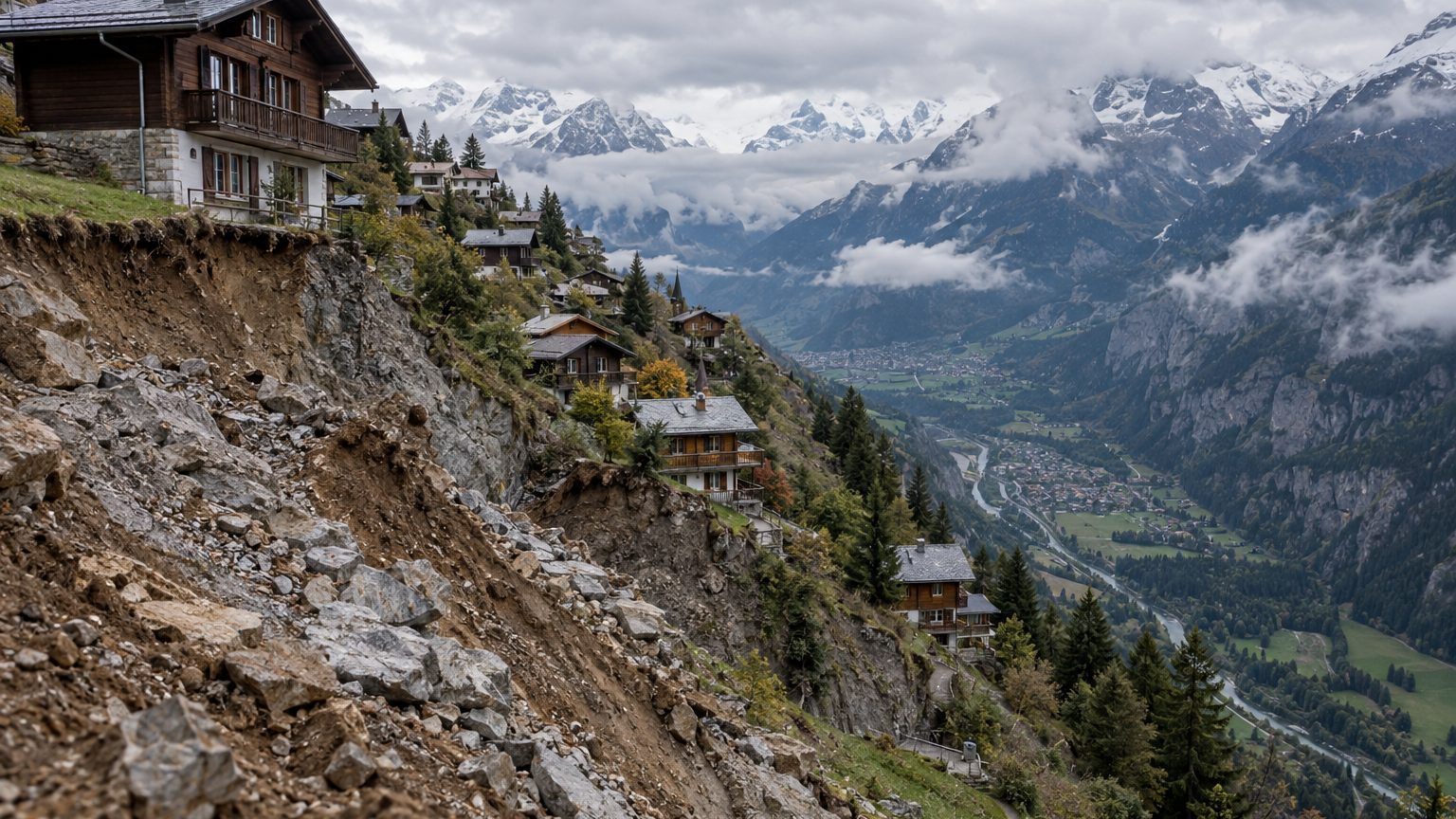
A village sliding two and a half meters per year toward the valley’s depths. An underground gallery that managed to stop it. And yet, the canton of Grisons is about to pay a portion of its residents to leave anyway, on the condition that they demolish their house behind them.
Welcome to Brienz/Brinzauls, a hamlet of about a hundred souls clinging to an unstable slope in the municipality of Albula/Alvra. For years, this Grisons village has lived to the rhythm of landslides, evacuations, and pharaonic construction projects meant to save it. The story could have ended there, on a technical win. It takes on an almost paradoxical turn.
- The village of Brienz/Brinzauls slid 2.4 meters per year toward the valley before the drainage tunnel was built.
- A two-kilometer underground gallery drains the water-saturated rock layers and reduced movement to a few centimeters annually.
- The canton pays 82.56 million francs to relocate residents, provided they raze their houses before leaving.
- Vazerol, the preferred relocation hamlet, remains blocked by landowners reluctant to sell their building rights.
A hillside that nearly swallowed the village
On May 12, 2023, authorities ordered the evacuation of the village. A month later, in the night of June 15–16, 2023, about 1.2 million cubic meters of rock tumbled down the slope in a massive flow. The mass stopped just a few meters from the first houses, narrowly sparing the hamlet. The residents returned home in early July 2023, but the respite would prove short-lived.
The reprieve lasts a little over a year. In November 2024, the situation becomes critical again: the entire village then slides at 2.4 meters per year toward the valley, and several houses show significant damage. A new evacuation is triggered, effective no later than 1:00 p.m. on November 17, 2024. It lasts 62 weeks, until the official lifting of the access ban on Monday, January 26, 2026.
The tunnel that calmed the mountain
Faced with a slope that threatened to wipe the village off the map, the Grisons authorities bet on a solution carved right beneath the residents’ feet: a Y-shaped drainage gallery, over two kilometers long, designed to dry out the water-filled shale and flysch layers that drive the mountain downward. The project, budgeted at around 40 million francs, is due to be completed by the end of 2027.
The results are spectacular. In May 2026, the village moved only a few centimeters per year, compared with about two and a half meters two years earlier. On the Rhätische Bahn line that runs through the area, trains continue to operate at reduced speeds, 30 km/h, as a precaution.
Nevertheless, the village remains classified as a red zone. Five to ten more years of study will be necessary before any move to lift this status might be contemplated.
82.56 million francs to relocate
The tunnel has stabilized the mountain. It has not reassured everyone. On July 9, 2026, the municipal assembly of Albula/Alvra approved, by 41 votes to 3, a gross credit of 82.56 million francs intended to allow all those who wish to leave the threatened village to find new housing. A decisive vote, nearly unanimous.
The financial mechanism is generous. The 82.56 million francs are largely covered by the Grisons canton and the Confederation, which assume 90% of relocation costs, the remaining 10% to be borne by the people who choose to leave. concretely, this represents 42 preventive relocation applications filed to date, covering about 95 primary and secondary residences.
A firm condition accompanies the aid: the house left behind must be demolished. Once the green light is obtained, the buildings are razed, the land returns to the commune, and the owners receive compensation. It is therefore impossible to obtain public funds while keeping the house as a second residence or selling it as is. Those who leave will have five years, once the project is definitively approved, to organize their relocation.
Vazerol, the dream blocked by a few landowners
The question remained where to relocate. A neighboring hamlet, Vazerol, was the population’s preferred option: 80% of those surveyed said they wanted to settle there, drawn by its sun exposure and its views, similar to those of Brienz. But this plan ran into an unexpected obstacle.
The blockage stems from some landowners’ reluctance to sell their building rights, stemming from a 1980s land consolidation. The municipality regrets the situation but cannot move forward without the agreement of all the rightful owners on that parcel. Acquiring all those rights was an essential condition to using the site as a relocation zone.
Meanwhile, a study has been launched with the Swiss Federal Institute of Technology in Zurich to imagine what Brienz will look like once part of its population has left. Two buildings destroyed by the 2023 slide are set for imminent demolition, and thirteen more demolitions are already planned, with signed plans in hand. The village breathes, the mountain has calmed, but its future remains to be written, somewhere between the houses that remain standing and those about to be razed.
Sources: suedostschweiz.ch | watson.ch | nau.ch
