
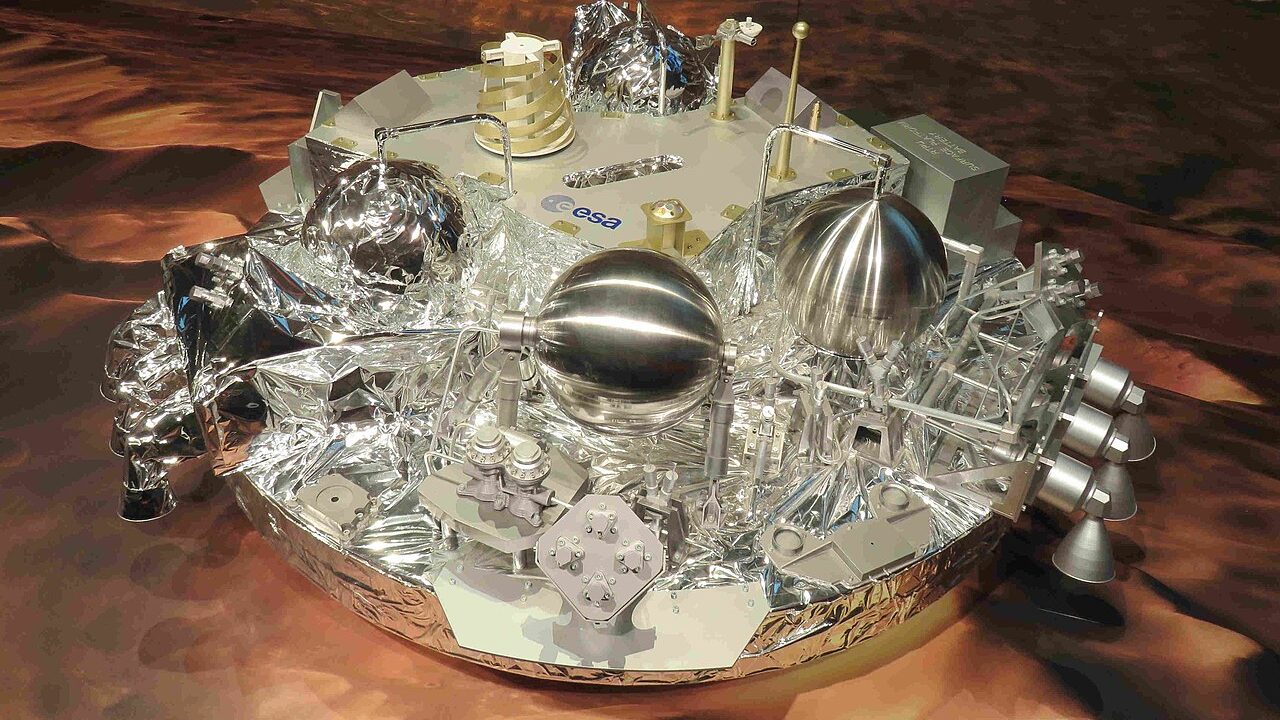
In the control room of the European Space Agency, screens display an obligation to wait that drags on. The signal that should confirm the Mars landing does not arrive. Engineers scrutinize the latest data received, looking for any clue about what happened millions of kilometers away, as silence settles on their faces.
This lander has only one objective: to test a descent method designed to prepare for a later, more ambitious Martian mission. No major scientific collection, no drilling planned for that day. Just the demonstration that a European machine can slow its fall, traverse a hostile atmosphere, and land without a hitch on the red dust.
- An aberrant rotation measurement misled the lander’s computer for one second.
- The system believed it had reached the ground and shut down its retrorockets while it was still in free fall.
- The absence of a filter to doubt sensor readings turned a temporary anomaly into an irreversible cascade.
- The data recorded before the crash allowed a precise understanding of the sequence of events.
A choreography with no margin for error
Landing on Mars resembles a sequence of gestures that cannot be repeated. The heat shield first absorbs the brutal friction of atmospheric entry, then a massive parachute deploys to slow the descent. Next comes the most delicate phase: the craft must jettison the parachute at the right moment, then ignite its retrorockets to cushion the final moments before contact with the ground.
Each step locks in the next.
Once the parachute is released, there is no turning back. Once the retrorockets are cut, there is no margin left. Everything rests on an onboard computer that must interpret, in a fraction of a second, measurements of speed, rotation, and altitude, to decide the exact moment to trigger each action.
The descent begins, however, without a hitch. The heat shield does its job, the parachute opens as planned. The lander begins its final approach toward the surface, and nothing at this stage suggests a problem.
A datum that should not exist
That is where it all tilts. For about one second, the vehicle’s inertial reference system measures a rotation speed that exceeds what the software considers physically possible. An aberrant value, in short, a figure the system should never have trusted as gospel.
Yet the computer accepts it without argument.
From this impossible measurement, it recalculates its position and concludes that it is much lower than it actually is, nearly at ground level. The machine deduces, logically but wrongly, that the landing is already being completed. It then releases the parachute, ignites its retrorockets, and then cuts them, persuaded that it has already touched the Martian surface. In reality, the lander is still at a much higher altitude, left to free fall with no way to slow its descent.
The Original Sin: not knowing how to doubt
A flight-control software does not merely measure. It must also recognize when a measurement does not fit the physical reality of the flight, and treat it as suspect rather than as an absolute truth. Without this safeguard, a transient anomaly, which should have been filtered or ignored, became operational certainty.
That is the paradox of spaceborne embedded computing.
The more autonomous a system becomes, the more it must be able to question its own sensors. A simple plausibility test, a rule that would have rejected a value outside the expected physical limits, would have sufficed to prevent this one-second anomaly from triggering an irreversible cascade. It is precisely this kind of filter that engineers strengthened for future developments.
What the failure nonetheless transmitted
The lander never reached the Martian surface smoothly. But the bulk of the flight data was indeed recorded and transmitted before the signal interruption, covering almost the entire descent—from atmospheric braking to parachute deployment.
This mass of information made it possible to understand precisely the chain of events, from the aberrant measurement to the premature jettison. It also fed corrections to the flight software intended for the agency’s subsequent Martian missions. A failed test can thus become, almost despite itself, the best possible preparation for the next attempt.
Sources: next.ink | foxnews.com
