
No scientist has ever witnessed an eel spawning in the wild.
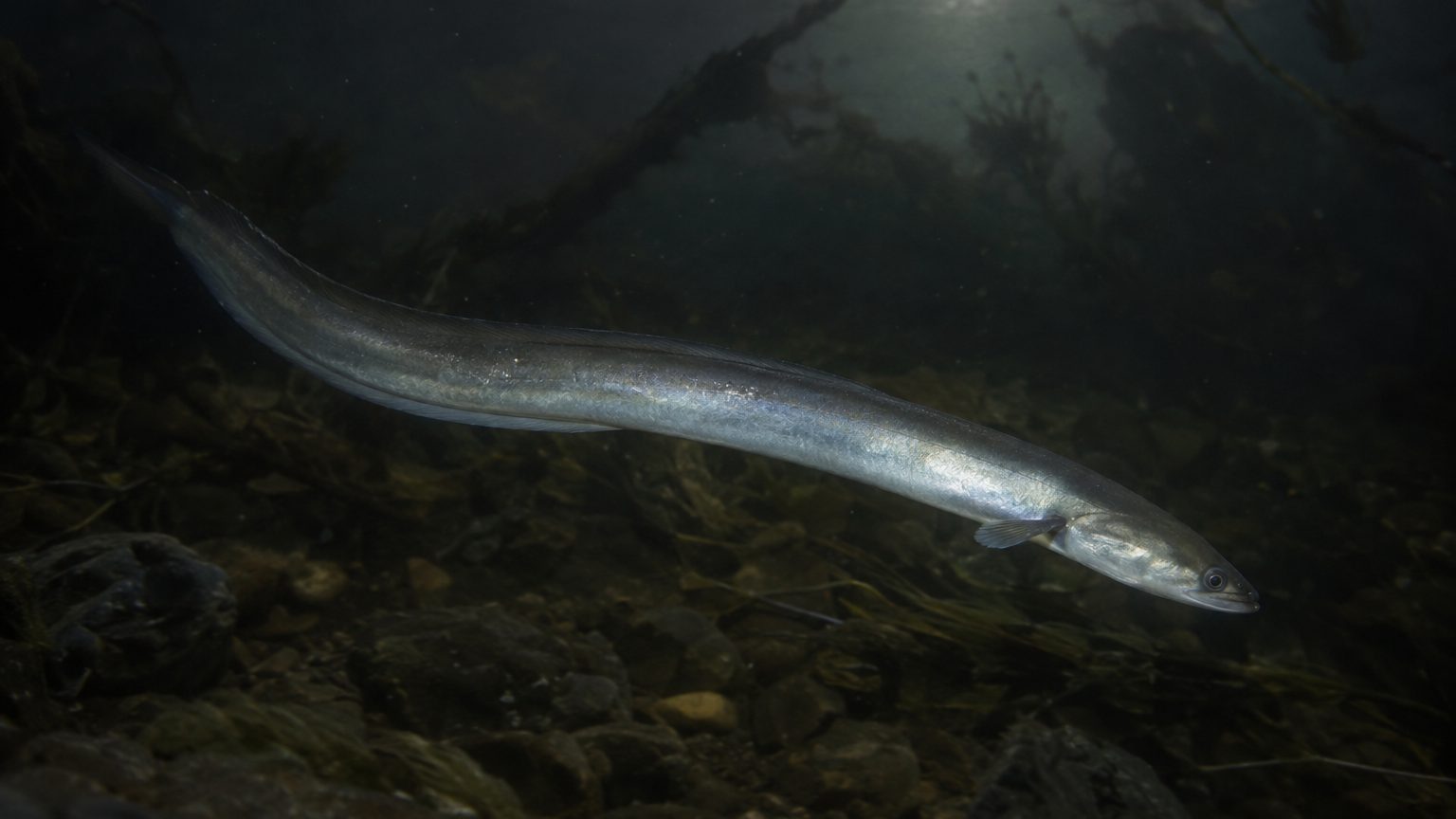
Yet every autumn the phenomenon repeats in our rivers with the precision of a biological clock. Adult eels undergo a transformation: their yellow belly becomes pale silvery white, their eyes grow to double and then quadruple in size, as if to see better in the depths that await them. The skin thickens, the back darkens, and the lateral line becomes clearly visible. Fishermen and naturalists call this stage “the silver eel,” a sign that departure is near.
- Adult eels transform each autumn into silver eels before migrating toward the Sargasso Sea
- No scientist has ever observed an adult eel spawning in the wild, despite more than a century of research
- The European eel is in danger of extinction and could disappear before its reproductive secret is revealed
A migration that tolerates neither light nor dryness
The starting signal is anything but random. The onset of downstream migration occurs at the eel’s physiological maturity and in response to environmental factors such as rising discharge (rain, floods, dam openings, atmospheric depression) and low light conditions. A moonless night, drenched by rain, with a river on the rise. The downstream migration takes place each year mainly in autumn and at night, riding a flood and carried by the current. It is the perfect window to slip toward the estuary without attracting the attention of predators.
Once set in motion, the eel never goes back. When it becomes silver and heads toward the Sargasso Sea, it completely ceases to feed. It lives only on the fat reserves accumulated during years spent in freshwater, sometimes far inland.
The mystery that has resisted for more than a century
Here is where the story takes a turn into the unknown.
The supposed destination of all these eels bears a name that evokes maritime adventure: the Sargasso Sea, this calm expanse of the North Atlantic where rafts of brown algae drift. It is said to be there that the larvae are born. The Sargasso Sea is considered the birthplace of eel reproduction. But this certainty rests on a single indirect clue, not on direct observation.
Canadian researchers studying the American eel, the closest cousin of our European eel, capture the scale of the problem. Larval eels were observed in the Sargasso Sea as early as 1904, suggesting that the species reproduced in this zone, yet no adult eel had ever been seen in that part of the Atlantic. More than a century of research later, not a single adult has been observed mating or spawning. No sexually mature adults in open water, no fertilized eggs, no reproduction observed to date for the European eel either.
Satellites, the Azores, and still nothing
Facing this stalemate, scientists pulled out the technological big guns. Teams attached satellite transmitters to silver eels before their departure, hoping to finally crack the secret of their final route. A European research team succeeded, for the very first time, in tracking silver eels by telemetry across thousands of kilometers, whereas previously we had not been able to follow their migration beyond the Azores. A real advance. But a wall remains.
Never has an adult eel been observed, not even eggs, in the Sargasso Sea. The sensors confirm the route, not the act. For the American eel as well, no mature adult has ever been captured in the zone and the reproductive behavior remains a mystery. The spawning event may be dated, determined by otolith biology and oceanographic models, yet no camera has yet captured the precise moment.
A species that could disappear before we crack its secret
The paradox is bitter. This familiar species, fished and cooked for generations along our coasts, keeps a portion of itself entirely inaccessible to science. The European eel currently sits in the “critically endangered” category on the IUCN Red List of freshwater fishes of metropolitan France, established in 2019. A status that makes the race against time all the more urgent: understanding reproduction could prove decisive for conservation, before it is too late to observe anything at all.
Every autumn, in the dark and under the rain, thousands of silver eels leave our rivers for a rendezvous that no one has yet seen conclude. The mystery, for its part, continues to drift downstream.
Sources: ici.radio-canada.ca | observatoire-poissons-migrateurs-bretagne.fr
