
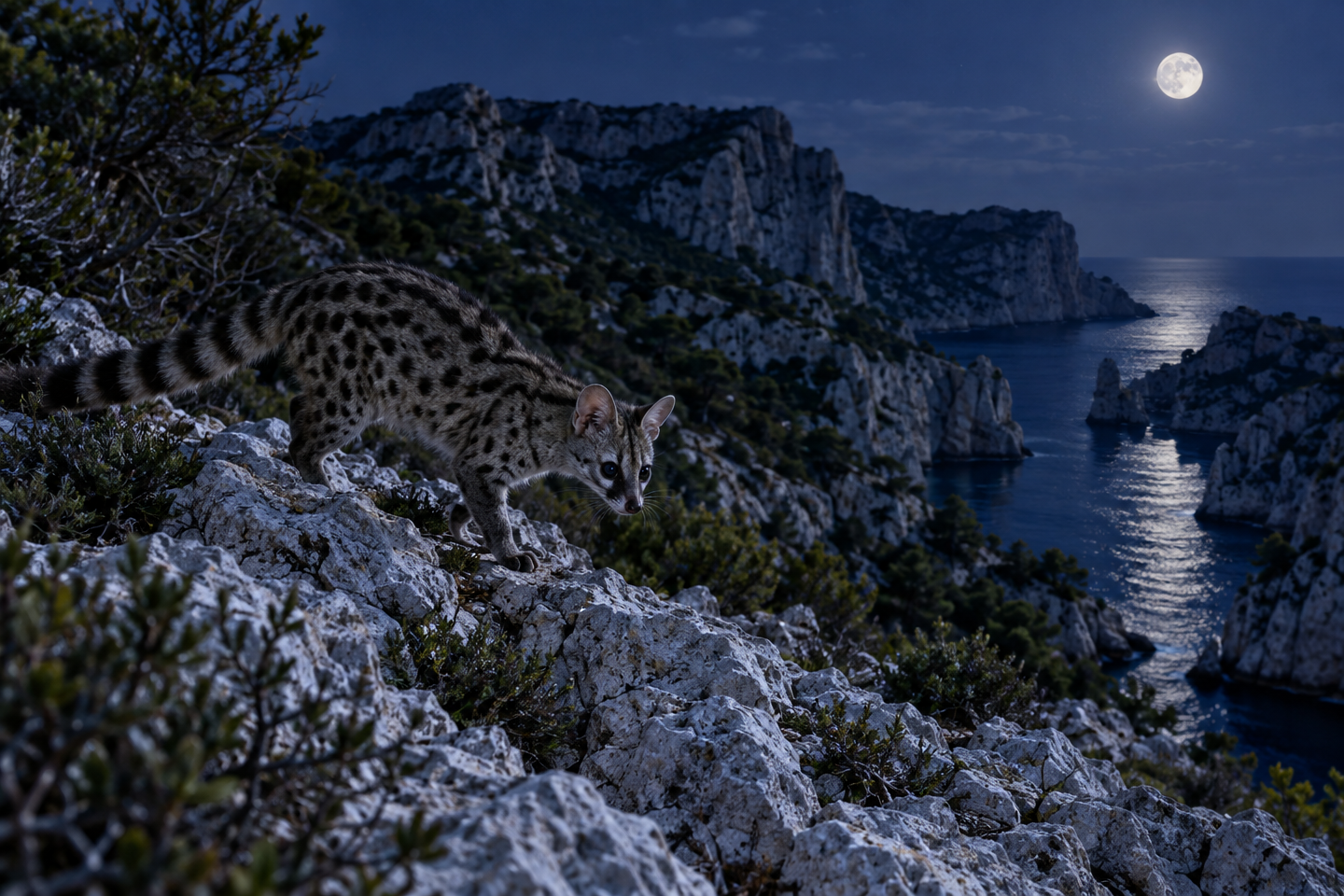
The genet is a small nocturnal carnivorous mammal with spotted fur, often mistaken for a cat because of its sleek silhouette. Yet this enigmatic creature has nothing to do with a feline. In the mineral escarpments and pine groves of the Calanques National Park, on the edge of Marseille, its presence has long hung in the realm of suspicion rather than certainty. An observation filmed in 2020 by park rangers finally confirmed that this discreet visitor indeed roams the area after dark. A fascinating discovery, since the animal seems to belong to a world far removed from well-trodden paths, white cliffs, and the neighboring urban districts.
- A genet was filmed for the first time in the Calanques National Park thanks to a tracking device installed after the discovery of traces distinct from those of a fox.
- Despite its feline appearance, the genet belongs to the viverrid family, native to Africa, and is thought to have settled in Europe around the 8th century.
- This small nocturnal carnivore, protected in France, must cope with habitat fragmentation and human activity tied to the proximity of Marseille.
- A furred ghost in the Calanques for more than a thousand years
- An animal that resembles a cat but is not one
- Why it almost never comes out during the day
- A discreet survivor amid Marseille’s urbanization
A Furred Ghost in the Calanques for More Than a Thousand Years
When the last hikers leave the calanques and the light slips away behind Marseille, a small predator may step out from the shadows. The genet moves with caution under the pines, along low walls and between the limestone rocks. Its gray-beige, black-spotted coat makes it surprisingly hard to discern in the Mediterranean half-light. It typically leaves behind only a few clues, notably a latrine site, those locations used to deposit droppings and mark its territory.
It is precisely this kind of trace, spotted during a botanical census, that put the park teams on its trail. The droppings did not match those of the fox, far more common in the massif. The installation of a tracking device then allowed the animal to be filmed after nightfall. For local naturalists, this confirmation carries particular weight: genet sightings remain exceptional in the Calanques.
Originating from Africa, the genet would have settled in Europe in the VIII century, aided by trade and population movements around the Mediterranean. It would then have been appreciated as a domestic creature capable of curbing rodents in homes, a role that the cat eventually came to fulfill more broadly. More than thirteen centuries later, this ancient companion of humankind leads a solitary, nearly invisible life in the wild landscapes along Provence’s coast.
An Animal That Resembles a Cat but Is Not One
At first glance, confusion is understandable. The genet bears a slender head, large eyes suited to darkness, and a flexible gait that evokes felines. Yet its body is slimmer, its snout more pointed, its paws relatively short, and its neck appears longer. An adult genet measures about 90 centimeters from head to the tip of the tail, with nearly 40 centimeters of tail length, and weighs between 1.5 and 2 kilograms.
Its most striking distinctive feature remains its long tail, darkly banded. It serves as a counterweight when it climbs and moves across rugged terrain. Despite its feline bearing, the genet belongs to the family of viverrids, the civets, not to felids. It is even Europe’s sole representative of that group. This African kinship partly explains its singular appearance in French fauna, as if a savanna silhouette had slipped among the garrigues and cliffs of Provence.
Why It Almost Never Comes Out in the Daylight
The genet is above all a creature of the night. It uses the cover of darkness to minimize encounters with humans and other predators, but also to avoid the extreme heat that can press down on the Calanques during summer. In early autumn, when evenings grow cooler and trails empty earlier, it can traverse its territory with even greater discretion.
By day, it retreats into rocky hollows, hollow trees, piles of stones, or old dry-stone walls. These shelters fit perfectly into the park’s mosaic of habitats. The genet is also an accomplished climber: its semi-retractile claws, agile paws, and its tail give it exceptional balance. It hunts mainly small rodents, but also birds, insects, and other accessible prey. This varied menu makes it a versatile predator, without making it easy to observe.
A Discreet Survivor Amid Marseille’s Urbanization
The presence of a genet so close to Marseille reminds us that biodiversity does not end at the city limits. The Calanques National Park marks a fragile border between the metropolis and natural spaces where discreet species persist. The genet must contend with habitat fragmentation, infrastructure, human activity, and road traffic risks. Its existence depends on the continuity of refuge zones and the preservation of the least-disturbed areas.
Protected in France for several decades after being hunted for its fur, the species now has substantial populations in the Iberian Peninsula and the southwest of France. Its range is gradually expanding into new territories, with sightings further north and east than in the past. This expansion does not mean the animal has become common everywhere: the genet remains difficult to detect and depends on favorable habitats.
In the Calanques, the furtive silhouette of this small carnivore tells an astonishing story: that of an animal that came from Africa more than a thousand years ago, today a discreet guest of the French Mediterranean. Its discovery reminds us that beyond cicadas, gulls, and famous trails, the massif shelters a nocturnal life that remains unsuspected. The next time silence settles among the pines and rocks, one question remains: how many other unseen inhabitants still share this territory with us?
