
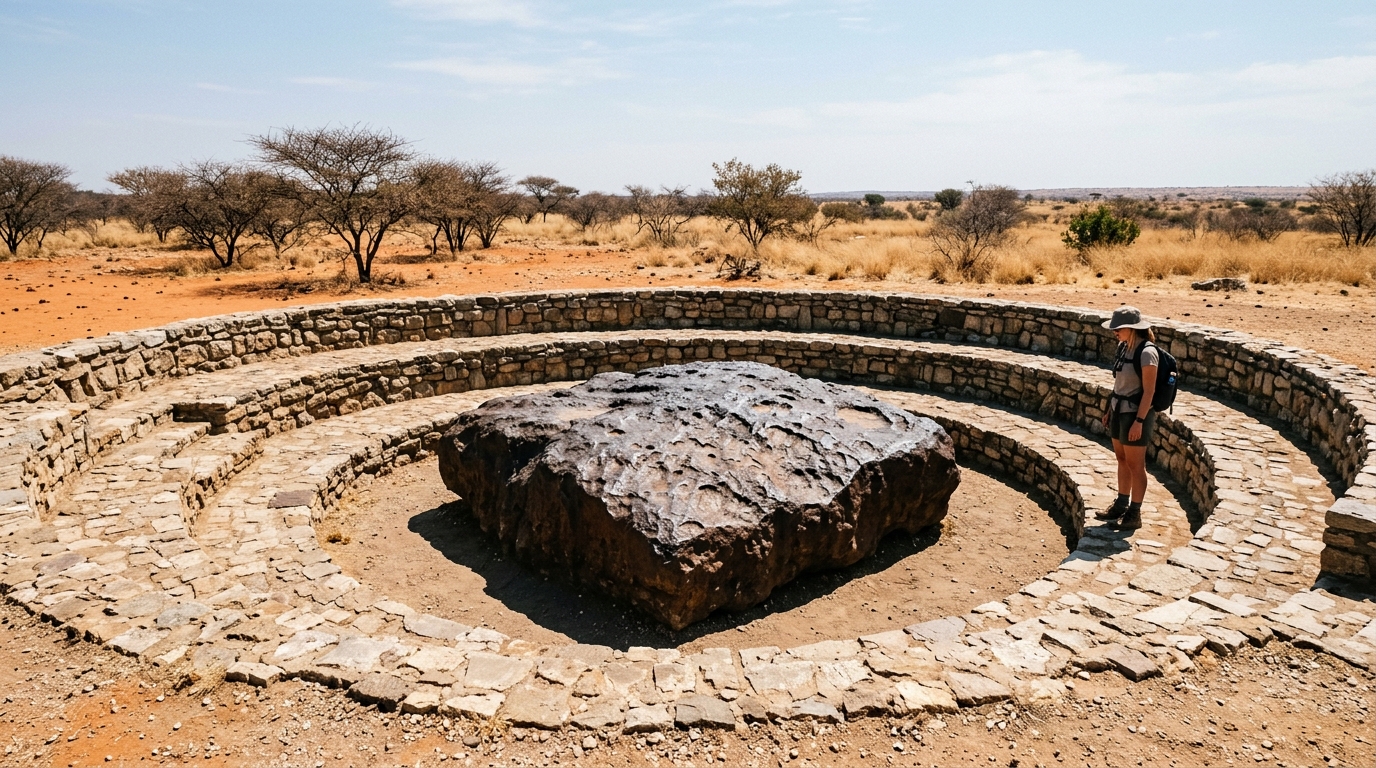
There are objects so massive that they seem to defy any logic of movement, and yet their history begins with a silent fall from the depths of the universe. Imagine for a moment: a block of metal as heavy as ten trucks, fallen from the sky about 80,000 years ago, and still resting today exactly where it crashed. No spectacular crater, no trace of violent impact, just a mass of iron and nickel planted in the Namibian earth, as if it had always been part of the landscape. This geological enigma bears a name, Hoba, and its story blends agricultural happenstance, scientific mystery, and a world record never equaled.
- Discovered in 1920 by a farmer near Grootfontein, the Hoba meteorite was confirmed extraterrestrial by the Smithsonian Institution in 1929.
- Weighing originally 66 tons and today about 60 tons, this block of iron and nickel has never been movable and remains the largest known iron meteorite on Earth.
- Its flat shape would have allowed it to ricochet in the atmosphere, explaining the absence of an impact crater, and the site has been designated a national monument since 1955.
- The day the sky crashed near Grootfontein
- Why no one has ever been able to move this iron behemoth
- An alloy from space that defies earthly logic
- What Hoba still reveals today about giant meteorites
The day the sky crashed near Grootfontein
It all begins on a farm in northern Namibia, not far from the small town of Grootfontein. In 1920, a farmer plows quietly through his field when his plow suddenly strikes an invisible metallic obstacle. A muffled scraping, a sudden stop, and he finds himself facing a black mass half-buried in the soil, far too large and heavy to be mere agricultural debris. No one at the time suspects that he has unearthed one of the most fascinating relics of our solar system.
It is only in 1929 that the Smithsonian Institution officially confirms what many had already suspected: this strange block is not terrestrial. It is indeed a meteorite that fell to Earth about 80,000 years ago, a span so staggering that it predates the emergence of writing or even agriculture. Since then, the Hoba meteorite has become a cornerstone reference for anyone interested in objects from space.
Why no one has ever been able to move this iron behemoth
With its impressive dimensions, 2.7 meters long by as wide and nearly a meter tall, Hoba is not just a rock fallen from the sky. It is a true metallic monolith, whose original mass was estimated at 66 tons at its discovery. Over the decades, natural erosion, a few scientific samples, and even vandalism have slightly chipped away at its mass, bringing it today to about 60 tons. Despite this loss, it remains by far the largest iron meteorite block ever found on the planet’s surface.
Such a weight represents a logistical challenge almost beyond reach. No machine, no known transport technique has ever managed to move something so dense over such a distance without risking fracture or irreparable damage. The result: since its discovery, the meteorite has never left its original site. It still rests exactly where it came to rest tens of thousands of years ago, as if frozen in time.
An alloy from space that defies earthly logic
What makes Hoba truly remarkable goes beyond its size. Its chemical composition also puzzles specialists: the meteorite is composed of roughly 82.4% iron and 16.4% nickel, with traces of cobalt. A natural alloy of formidable density, forged not in a furnace, but in the heart of a disintegrated asteroid somewhere between Mars and Jupiter, before wandering for millions of years until it crossed Earth’s path.
But perhaps the most astonishing aspect remains its arrival method. For an object of such mass, one would logically expect a devastating impact, carving a gaping crater into the ground. Yet, nothing of the sort at Hoba. Scientists propose an elegant and surprising hypothesis: the meteorite’s flat, broad shape, almost like a metal pancake, would have allowed it to ricochet at the surface of the atmosphere, in a manner similar to a stone skipping on water before slowly sinking. This phenomenon would have slowed its fall enough for it to touch down almost intact, without creating a single impact crater.
What Hoba still reveals today about giant meteorites
Aware of the exceptional value of this extraterrestrial witness, the administration of South West Africa designated the Hoba meteorite as a national monument in 1955. Since then, the site has become a genuine pilgrimage site for scientists and tourists alike. A stone amphitheater was even built all around the block, allowing visitors to observe it from every angle, almost as one would contemplate a sacred relic set in the heart of the Namibian savannah.
Apart from its status as a geological curiosity, Hoba continues to fuel research into how massive objects interact with our atmosphere. Its case remains a rare exception, almost a fortunate accident of celestial physics, enabling researchers to study a fragment of an asteroid of unparalleled purity and size elsewhere on the globe. Each visit, each renewed analysis sheds further light on the mechanisms still poorly understood that govern the descent of large celestial bodies.
More than eight decades after its fortuitous discovery at the end of a plow, the Hoba meteorite has still not moved an inch, and nothing indicates it ever will. This block of iron from the depths of space reminds us, with a simplicity that is almost disarming, that some relics of the universe sometimes choose to settle permanently among us, never asking for permission. So, the next time you walk across a field, who knows what cosmic secret might be sleeping beneath your feet?
