
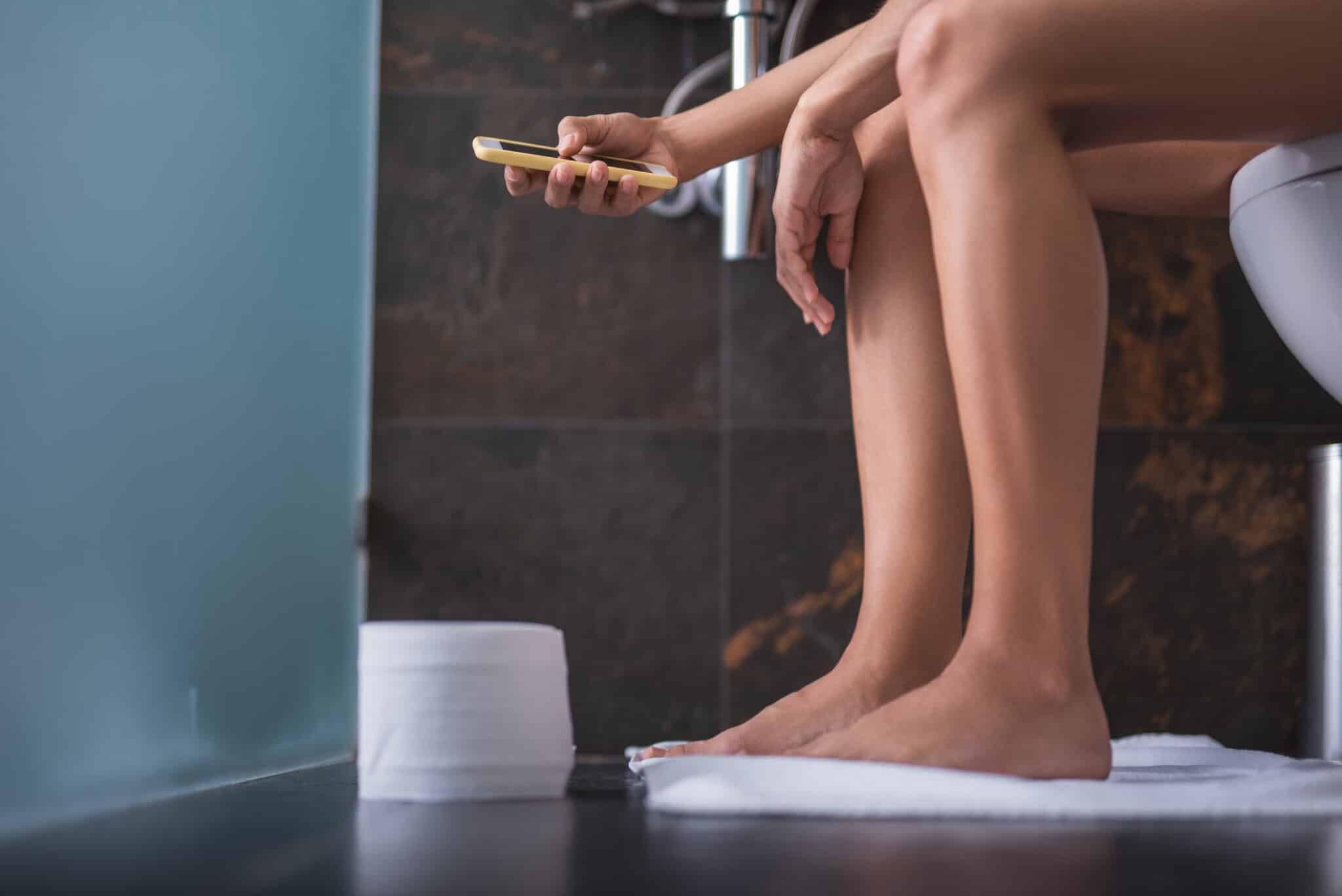
In the United States, researchers have focused on a practice that has become firmly anchored in the daily life of many people. For the authors, there are real physical risks associated with using a smartphone on the toilet seat. The authors highlight the lack of support and the suspended posture induced by prolonged sitting on the toilet seat.
Increased risks of developing hemorrhoids
For many internet users, bathroom time drags on. Indeed, these people scroll through social networks, watch videos, or check the news. While this practice is now widespread, more and more experts are warning about physical risks, more precisely about the link between smartphone use in the toilet and an increased risk of hemorrhoids.
A team from Beth Israel Deaconess Medical Center (United States) published a study on the subject at the end of 2025 in the journal Plos One. The researchers say they interviewed 125 patients who had undergone a colonoscopy. Of these, two-thirds reported using their smartphones in the bathroom at least once a week. According to the study authors, these individuals had a 46% higher risk of developing hemorrhoids compared to those who left their device outside.
“Although anecdotal observations suggest that the duration spent on the toilet constitutes a risk factor for hemorrhoids, no multivariate analysis regarding smartphone use in this context has been conducted.” “This study examines the correlation between the use of a smartphone on the toilet and the prevalence of hemorrhoids.”, as stated in the publication.
The root cause is prolonged sitting
In reality, the problem has nothing to do with the screen itself. For the authors, the real issue lies in the time spent seated on the toilet. In fact, the oval shape of the toilet seat keeps the rectum in a lower position. Thus, sitting like this for more than 5 to 10 minutes exerts excessive pressure on the veins of the anus. Blood pools there, causing the hemorrhoidal bundles to descend and swell, leading to painful episodes. And this news is all the more worrying when one considers that social media algorithms are designed to capture attention, making users lose track of time.
The American researchers also mentioned other problems related to prolonged sitting. Notably the unnatural angle that the position imposes on the legs, which crushes the blood vessels of the thighs and the sciatic nerve. This causes numbness and/or tingling – the “sleeping legs.” Moreover, forming the habit of sitting too long on the toilet weakens the muscles of the pelvic floor, eventually increasing the risk of urinary incontinence.
According to scientists, a toilet session should not exceed five minutes. Thus, if stools do not come quickly, the best course is to avoid straining, stand up, and try again later. This is the right reflex to avoid falling into the trap of prolonged sitting.
A prime habitat for bacteria
The study authors pointed to another deviation related to the habit of scrolling on the toilet. Indeed, toilets contain many invisible particles that are projected into the air, especially when the flush is pulled. Moreover, the smartphone is a warm object frequently handled, which turns out to be a prime breeding ground for bacteria such as the well-known Escherichia coli, strongly linked to feces.
In other words, washing hands before leaving the toilet is useless if a few seconds later we touch our contaminated smartphone again. It is therefore necessary to clean the device as well after leaving the toilet. Obviously, the ideal is to leave it outside before entering.
