
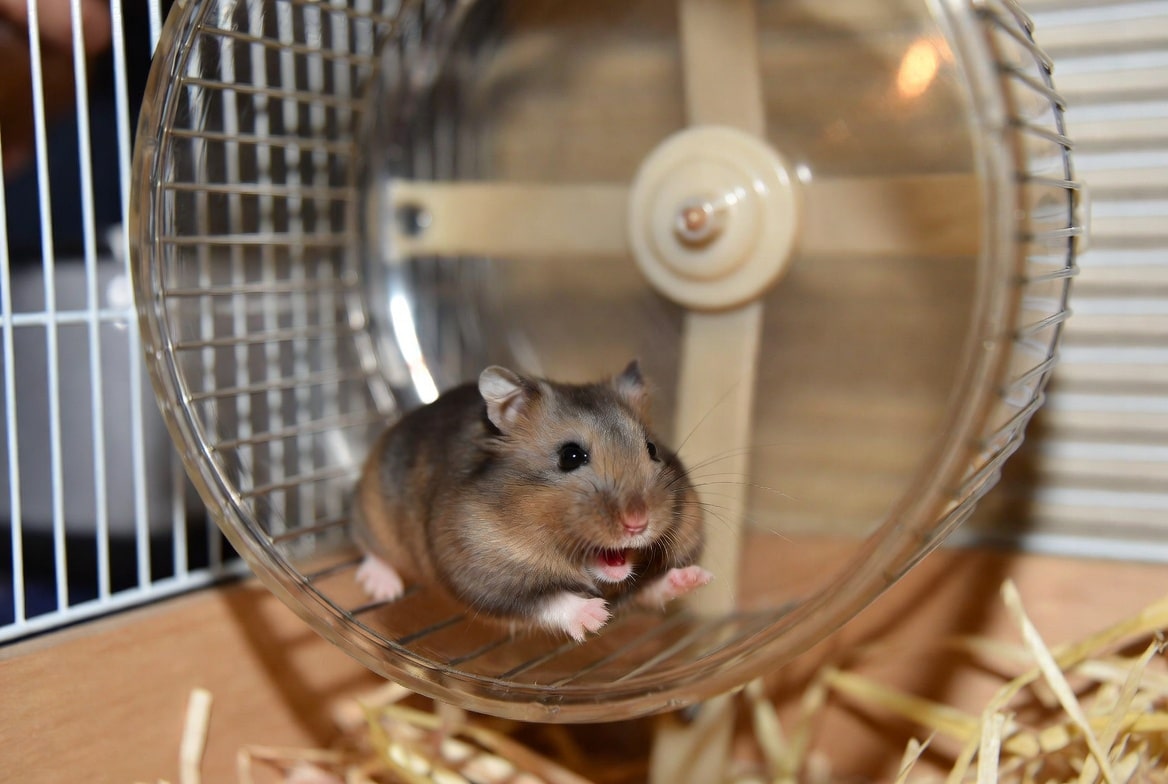
Your hamster doesn’t run in circles because it is neurotic or unhappy. Decades of research on rodents — including entirely free-living wild mice — show that this frenzied racing is voluntary, rewarding, and likely enjoyable. This seemingly absurd behavior actually sheds light on brain mechanisms that concern us directly.
What you will learn
- Why wild mice, with no constraints, spontaneously choose to run on a wheel
- What role dopamine plays in this compulsion — and what that reveals about the pleasure of physical effort
- How exercise engaged early in life durably reshapes the brain, in both rodents and humans
Wild mice running without being forced
For a long time, science considered wheel running a symptom of captivity. An addictive, artificial behavior born of boredom or stress. The hamster’s equivalent of obsessive pacing inside a cage.
In 2014, researcher Johanna Meijer seriously unsettled that theory. She installed exercise wheels in the wild — in an urban area and on isolated dunes — and filmed what happened over three years. The result: wild mice, free to move, climbed onto these wheels and ran. Sometimes for up to eighteen minutes in a row. Even after the bait food used to attract them had been removed.
They did not run for a reward. They ran because they wanted to.
Dopamine, the common denominator of effort-based pleasure
Dr. Theodore Garland Jr., a biologist at the University of California, Riverside, and a specialist in this behavior for more than thirty years, points to a well-known neural mechanism: dopamine.
This neurotransmitter, at the core of the brain’s reward circuit, is released during running. Just as a human emerges from a workout with that hard-to-explain sense of lightness, the rodents receive a chemical dose of satisfaction with every lap.
Garland has observed in his laboratory mice that, in the midst of a run, they pause to perform a full spin on themselves before resuming their activity. A behavior with no obvious functional purpose, it looks unmistakably like a pleasure pirouette. He hesitates to use the word “fun” to describe what a rodent feels, but concedes that it’s hard to ignore that possibility.
Why rodents are built for this — and not toads
The preference of mice and hamsters for running is not universal across the animal kingdom. Over the three years of Meijer’s study, shrews, frogs, and even a few slugs used the wheel — but mice accounted for 88% of users, reports Popular Science.
Garland explains it through biology: rodents have naturally large territories to cover, a fast metabolism, and aerobic endurance that lets them sustain a high tempo for long distances. A toad simply isn’t built for that. A chipmunk, by contrast, could travel ten kilometers in a day without breaking a sweat.
What the brain of a young rodent tells us about physical education
Perhaps the most unexpected aspect of Garland’s work concerns the age at which exercise is introduced. In his experiments, mice given access to a wheel from the time of weaning — at just three weeks old — ran significantly more as adults than those that never had early access.
His conclusion: early exposure to physical effort durably rewrites the brain’s reward system. Movement becomes pleasurable because the brain learns at a young age to associate it with gratification.
The implications extend far beyond the lab. Garland does not hesitate to draw a parallel with the removal of physical education from school curricula. A child who has never regularly engaged in sport simply develops a brain in which movement is not a natural source of pleasure. An habit that, whether present or absent, can shape decades of behavior.
