
A sea rocket. It was the first plant to take root on Surtsey, in 1965, two years after this Icelandic island erupted from the waves. Four years later, a botanist finds something entirely different: a 15-centimeter tomato plant, grown where no one should have stopped.
On November 14, 1963, early in the morning, a crew of fishermen spotted a plume of smoke 18 kilometers southwest of Heimaey, in the Vestmannaeyjar archipelago, south of Iceland. The eruption, born from a seabed about 130 meters deep, likely began a few days earlier. The next day, an island was born. Within weeks, it climbed to 174 meters in height by late January 1964. The eruption would last about three and a half years, until the early days of June 1967, leaving behind an island of 2.65 km² rising to around 170 meters. Two satellite islands, Syrtlingur and Jólnir, would also be born in 1965 before disappearing within months, gnawed away by the sea.
- Surtsey rose from the ocean during a volcanic eruption on November 14, 1963 and reached 174 meters in height within three months.
- The island has been off-limits to all but scientists since 1965 to study the natural colonization of a sterile land.
- A 15-centimeter tomato plant grew on the island in 1969 from human excrement, a discovery kept secret for 46 years.
- Gulls that arrived around 1985 accelerated plant colonization by delivering marine nutrients to the volcanic soil.
An open-air laboratory, closed to all but researchers
Surtsey has been protected since 1965, amid the eruption, with renewed protection in 1974 and then again in 2006. The objective: observe, without any human interference, how life colonizes a completely sterile land. In 2008, UNESCO inscribed the island as a World Heritage Site. Visits are strictly forbidden, except for a handful of scientists with authorizations who land briefly to conduct their measurements.
The results of this grand-scale natural experiment are impressive. According to a study by Magnússon and colleagues published in 2014 in the journal Biogeosciences, the first species to colonize Surtsey in 1965 was sea rocket, carried by ocean currents. By 2013, researchers had cataloged 69 species of vascular plants on the island, of which 59 were still present and 39 formed viable populations.
The true accelerator of this plant colonization is not botanical at all: it is the gulls. Arriving around 1985, they transport marine nutrients to the land, fertilizing the barren volcanic soil. Their colony expanded dramatically: 0.03 hectare in 1988, 6.6 hectares a decade later, and 12.1 hectares in 2012. Where they nest, a dense meadow has replaced bare rock.
The summer of 1969, a discovery kept quiet
Everything changes in the summer of 1969. Ágúst H. Bjarnason, a young employee of the Surtsey Research Society tasked with monitoring plant growth, stumbles upon something that does not belong there. Under a lava overhang, wedged between two rocks, a plant about 15 centimeters tall catches his eye. Moving the stones aside, he discovers beneath it a strangely soft mass.
The reality quickly becomes clear. Someone had used the site as a toilet, and that handsome tomato plant had grown from the excrement. Bjarnason acts immediately. He puts everything into a plastic bag and seals it carefully, making sure not to leave anything behind that could compromise the island’s natural settlement of plants.
The matter might have stopped there. But it becomes a troublesome secret.
Revealing that a human had left an organic trace on this island meant to welcome only nature would have tainted the credibility of the entire scientific endeavor. According to the account published by Bjarnason himself in 2012 on his website, the story was deliberately hushed at the time, deemed capable of harming the reputation of those who considered themselves scientists. It eventually circulated quietly, never making a splash. It was only in 2015, more than forty years after the events, that the Icelandic daily Morgunblaðið made the anecdote public.
An island that slips away from science’s grasp
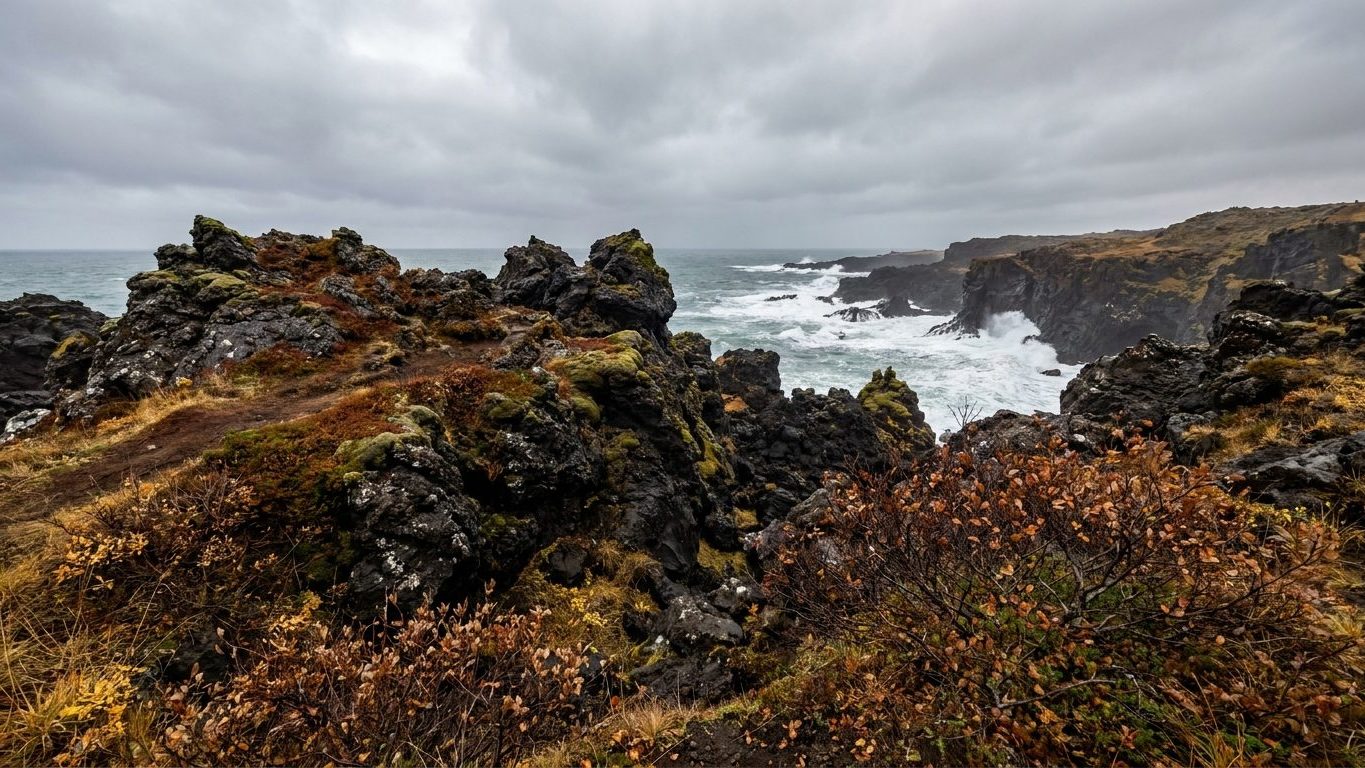
While botanists tallied the species, the sea patiently gnawed away at its work. Erosion has struck Surtsey from day one. According to measurements by Óskarsson and his team published in 2020, the island’s area had dwindled to just 1.2 km² in 2019, with a maximum coastline retreat of 720 meters in some places. More than half of the surface gained during the eruption has already disappeared.
Not all erosion proceeds at the same pace. The lava fields, being looser, yield quickly to waves coming from the southwest. The core of volcanic tuff, by contrast, resists far better: its hardness shields it from the Atlantic’s constant assault.
This difference in resilience sketches Surtsey’s future. Within about a century, according to a forecast put forward in 2000 and still deemed valid by researchers, only this hard core would remain, an area of roughly 0.39 km². This remnant, unlike the rest, could endure for centuries.
Surtsey will thus continue to exist, but reduced to the essentials. A island that took four years to be born will spend most of its existence slowly disappearing, stone by stone, under the watch of only the scientists allowed to set foot on it.
Sources: zenodo.org | pmc.ncbi.nlm.nih.gov
