
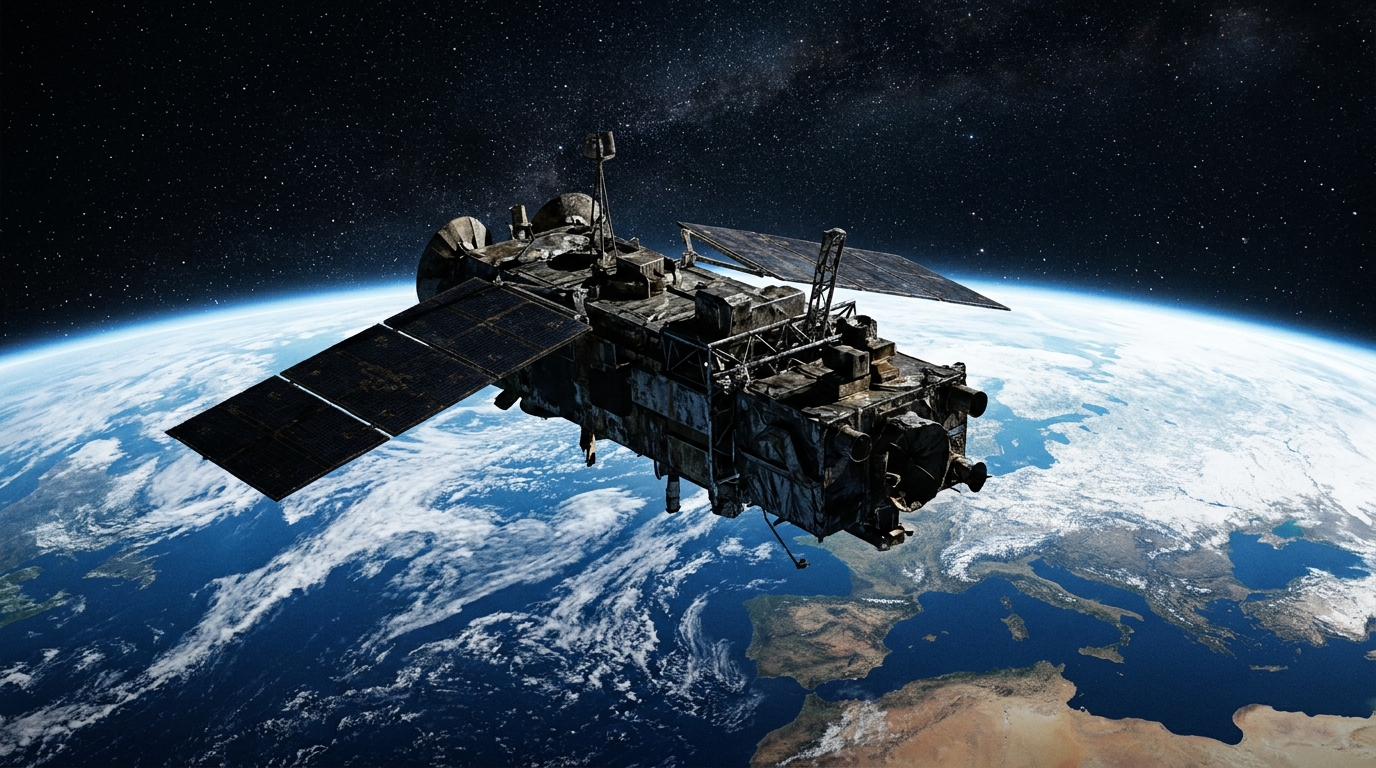
A school bus lost in the void, streaking at more than 25,000 kilometers per hour, with no one to take the wheel. The image might look drawn from a science-fiction novel, and yet it describes a very real situation that has hovered above us for more than a decade. At this very moment, a former flagship of European space technology is drifting silently at an altitude well above 700 kilometers, unable to respond to the faintest signal sent from Earth. This metal leviathan, once a symbol of the continent’s scientific know-how, has become, whether by chance or by design, one of the most closely watched and most feared objects in low Earth orbit.
- Envisat, the European 8.2-tonne satellite launched in 2002, ceased to respond on 8 April 2012 and its mission was officially ended on 9 May 2012.
- Stalled at an altitude of 768 km, this largest piece of space debris in low Earth orbit should naturally re-enter the atmosphere only around 2160–2170.
- Its crowded trajectory raises fears of a collision that could trigger a Kessler syndrome, while the e.Deorbit capture project was abandoned due to a lack of viable technical and financial solutions.
- The day Europe lost control of its space giant
- Why 8 tonnes of wandering metal worry experts so much
- Envisat, a ticking time bomb for orbital traffic
- What solutions to defuse this floating threat
The day Europe lost control of its space giant
It all started with a successful launch, one March morning in 2002, from the Guiana Space Centre in French Guiana. On board an Ariane 5 rocket, the European Space Agency sent into space Envisat, an Earth-observation satellite then the largest ever built by Europe. For ten years, the craft carried out its mission brilliantly, scanning oceans, polar ice, and the atmosphere with a level of precision that was remarkable for the era.
But in the spring of 2012, everything changed. On 8 April, contact was abruptly broken. A power failure, the exact causes of which will probably never be clarified, definitively cut off communications with the satellite. ESA engineers then attempted the impossible: they sent repeated remote-control signals, explored all technically feasible hypotheses, hoping for a spark of life from the machine. In vain. A month later, on 9 May 2012, the agency was forced to officially announce the end of the mission. Envisat had become, overnight, space junk.
Why 8 tonnes of wandering metal worry experts so much
What makes Envisat so exceptional is not only its failure but its enormous size. Weighing 8.2 tonnes and stretching about 25 meters in length thanks to its solar panel and radar antenna, the satellite has dimensions comparable to a school bus. It is simply the largest piece of space debris ever recorded in low Earth orbit.
The problem is that at the time of its failure the craft was at an altitude of 768 kilometers, well higher than the roughly 600-kilometer threshold needed for a natural atmospheric re-entry within about twenty years. As a result, stranded on this too-high orbit, Envisat should keep circling the Earth for around 150 years before it burns up on its own. That long horizon drew severe criticism from the International Institute of Space Law, which at a conference in Naples argued that the agency could have anticipated this catastrophe sooner.
Envisat, a ticking time bomb for orbital traffic
An out-of-control satellite weighing nearly eight tonnes is not merely a symbol of technical failure—it is a very real danger to the entire space traffic. Envisat travels in a polar orbit that passes through a busy region, frequently crossing paths with other active satellites. Each year it would pass within less than 200 meters of two already catalogued objects, a margin that becomes perilous when traveling at tens of thousands of kilometers per hour.
The feared scenario is known as the Kessler syndrome. It describes a chain reaction in which the collision of a large debris piece like Envisat—even with a fragment as small as ten kilograms—would instantly generate thousands of new fragments hurled at high speed. These shards would, in turn, become projectiles capable of striking other satellites, eventually making certain regions of Earth’s orbit completely unusable for decades. A straightforward trajectory assessment even suggested that, left to drift, Envisat would not descend until roughly 2160–2170, four or five generations hence.
What solutions to defuse this floating threat
In response to this assessment, the ESA has not remained entirely inactive. A project named e.Deorbit had been envisioned to physically capture Envisat with a purpose-built spacecraft, before guiding it toward a controlled deorbit. Unfortunately, the technical complexity and prohibitive cost of the operation proved decisive, and the initiative was abandoned before it could be realized.
Since then, other avenues have appeared, championed by both public agencies and startups specializing in space cleanup. Robotic arms fitted with grippers, capture nets, or even ground-based lasers to nudge the debris’ trajectory slightly are all among the ideas on the table. None has yet been tested at a scale appropriate for an object as massive as Envisat. Until a reliable and affordable technology emerges, the satellite continues its quiet orbit, reminding every passing moment of the urgency of better end-of-life management for space missions.
This story illustrates how space exploration, long seen as a pursuit aimed at the stars, must now contend with a far more terrestrial reality: the management of our own debris. Envisat is not the first nor the last object left to drift around the planet, but its exceptional size makes it a near-symbol of the issue. As more satellites are launched each year, the question posed by this runaway giant resonates with particular intensity: will we learn in time to clean up after ourselves before Earth’s orbit becomes, too, saturated with our own refuse?
