
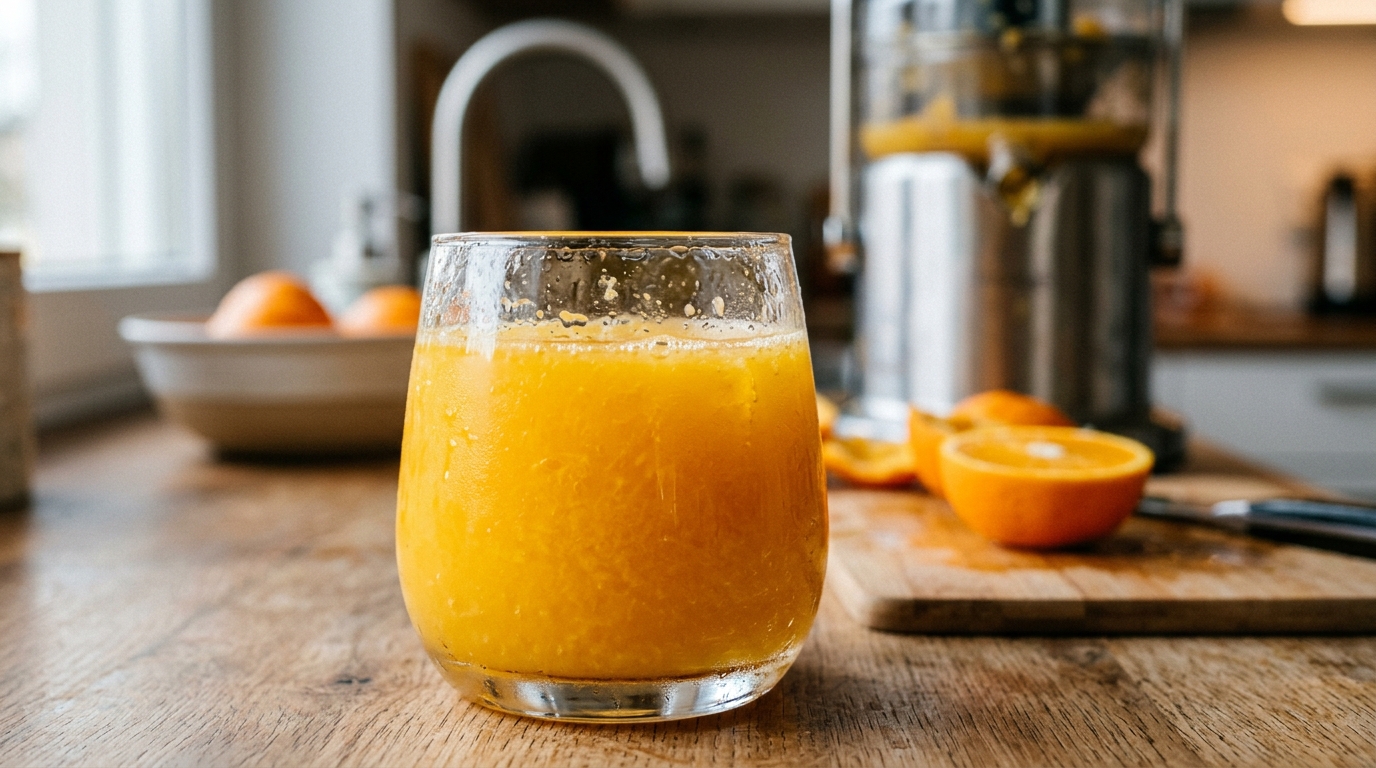
A glass of freshly squeezed orange juice at breakfast is a bit of a wellness ritual for the back-to-school season. We squeeze, we drink, we feel ready to face the day with a full dose of vitamins. Yet, behind this bright, tangy image, a detail far quieter than the vitamin C content catches the attention of nutritionists. It isn’t a matter of the fruit’s quality or its origin, but of what disappears between the whole orange and the glass we swallow in a few sips. An almost invisible mechanism, but one that completely changes the nutritional equation.
- A 200 ml glass of orange juice contains about 18 grams of sugar, roughly the same level as a soda of equivalent volume, due to the lack of fiber to slow absorption.
- Regular and excessive consumption of orange juice can promote insulin resistance and raise the risk of type 2 diabetes, even though its glycemic index is lower than that of soda.
- It is preferable to favor the whole orange, rich in fiber and satiating, and reserve pressed juice for occasional consumption accompanied by other foods.
- The sugar hidden behind the natural label
- Why three pressed oranges are almost equivalent to a soda
- How to rethink your consumption without guilt
The sugar hidden behind the natural label
A 200 ml glass of orange juice provides about 18 grams of sugar, roughly four sugar cubes dissolved in the liquid. The keyword here is indeed natural: unlike sodas, there is no added sugar in homemade freshly squeezed orange juice, only the sugar from the fruit. But the body doesn’t really distinguish between natural sugar and added sugar when it is no longer accompanied by its fibrous matrix. It is precisely this point that nutritionists watch closely: the label “natural” is reassuring, but it says nothing about how quickly that sugar will reach the blood.
Why three pressed oranges are almost equivalent to a soda
That is where the comparison becomes sharp. A 355 ml can of Coca-Cola contains about 39 grams of sugar, a level ultimately quite close to that of orange juice of the same volume. The major difference isn’t the amount of sugar, but the almost total absence of fiber in pressed juice. And it is precisely these fibers, present in the whole orange, that slow sugar absorption and prevent glycemic spikes. Once pressed, the fruit loses this natural barrier, and the sugar released acts almost like that of a classic sugary drink. The glycemic index of orange juice remains lower than that of soda, but regular and excessive consumption can still promote, over time, insulin resistance and increase the risk of type 2 diabetes. Calorically, the juice fares a bit better, with about 80 kcal for 200 ml versus 140 kcal for the same amount of soda, but the gap is not enough to make it a daily slimming ally.
On the vitamin C front, the juice remains generous: 150 ml covers about 65% of an adult’s daily needs. But in France, true vitamin C deficiencies are rare, and a child who does not drink orange juice every morning is not at particular risk. The vitamin argument, often cited to justify the habit, weighs far less in the health balance than one might think.
How to rethink your consumption without guilt
No question of banning orange juice from the breakfast table, nor of feeling guilty every time you press the juicer. The idea is rather to put things back in their proper place. Experts mainly recommend limiting the frequency and, as much as possible, favoring the whole fruit rather than the juice. Eating an orange rather than squeezing it preserves the fiber, slows sugar absorption, and provides a real sense of fullness. A few simple guidelines can help adjust one’s habits:
- Prefer the whole fruit over juice on a daily basis
- Reserve pressed juice for occasional consumption
- Avoid drinking juice on its own, without any other food, to limit the glycemic peak
- Be particularly wary of nectars, which sometimes contain added sugar
The morning ritual retains its charm, that little sunny ritual that makes you feel you’ve started the day on the right foot. But behind the vitamin label lies a more nuanced reality, that natural sugar which, without its fiber, behaves almost like any free sugar. So, whole orange or pressed juice: the real question may not be about choosing, but about knowing how to dose.
