
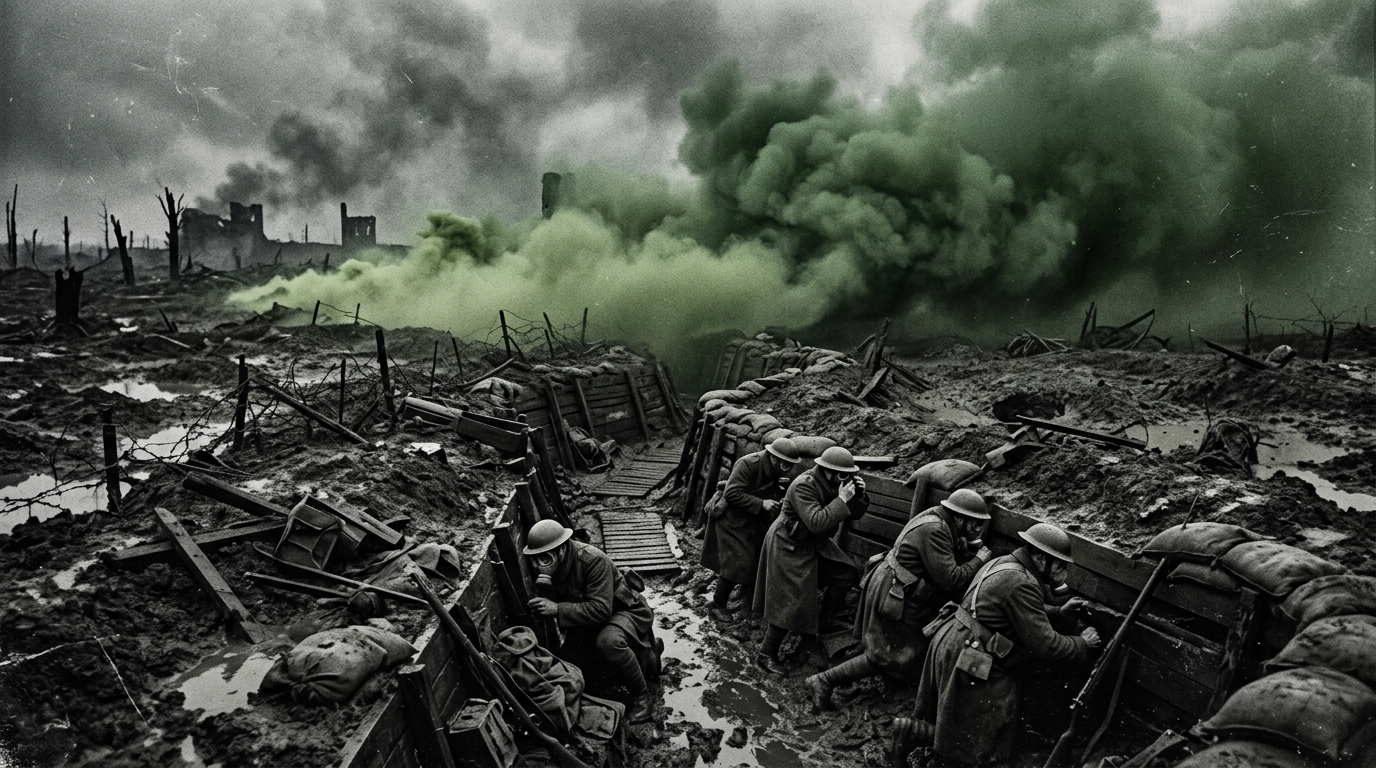
Men running and screaming, lungs burning, with not a single shot having been fired at them: that is what French and Algerian soldiers experienced on a day in April 1915, near Ypres in Belgium. On that day, a weapon never before deployed on such a scale on a battlefield changed the very nature of war. It wasn’t a shell, nor a machine gun, but a simple cloud carried by the wind that sowed panic and opened a new era of the conflict, an era where the air itself became a deadly threat. This story, documented at the time by the specialized press, reveals how humanity crossed a threshold that international conventions had failed to prevent.
- In April 1915 near Ypres, the German army deployed chlorine gas on a large scale for the first time as a weapon of war, sowing panic among French and Algerian troops.
- Without proper gas masks, soldiers had to improvise, breathing through urine-soaked rags in an attempt to neutralize the chlorine.
- Despite the prohibition of poisoned weapons by the Fourth Hague Convention, the Allies quickly retaliated with their own chemical weapons, triggering a technological escalation.
- Chlorine, a weapon chosen for its psychological effect as much as its lethality
- Facing the toxic cloud, the macabre improvisation of the trenches
- An immediate chemical counterstrike despite international conventions
- From panic to gas masks, the race against a weapon with no return
Chlorine, a weapon chosen for its psychological effect as much as its lethality
The German army did not improvise that day. The choice of chlorine as a war weapon responded to a precise logic, blending chemical effectiveness with psychological impact. This gas had the particularity of infiltrating directly into the trenches, these refuges meant to protect soldiers. Impossible to escape by lying down or seeking shelter as one would against conventional gunfire. The greenish cloud provoked immediate terror even before its toxic effects could be felt.
The Germans had indeed already tested this type of weapon during their assault on Hill 60, not far from Ypres. This terror strategy was aimed above all at deterring the enemy, to break its will to fight before the assault. But military strategists quickly understood a fundamental limit: a weapon so spectacular would always be copied by the adversary, and that is exactly what would happen in the following months.
Facing the toxic cloud, the macabre improvisation of the trenches
No soldier present that day had a proper gas mask. Faced with absolute urgency, men had to improvise on the spot with whatever was at hand. Thus arose one of the most disturbing scenes of World War I: soldiers breathing through urine-soaked rags, ammonia intended to partially neutralize the chlorine. A desperate method, born of survival instinct rather than real scientific knowledge, but which shows how utterly unprepared the army was for this kind of attack.
Chlorine acts by chemical asphyxiation, attacking the airways of exposed soldiers. Those who survived described uncontrollable panic, a frantic flight forward away from the lines, leaving gaping breaches in the Allied lines.
An immediate chemical counterstrike despite international conventions
Yet the use of gas as a weapon of war was not a gray area of international law. The Fourth Hague Convention explicitly prohibited the use of poison or poisoned weapons, as well as any weapon causing unnecessary suffering. A clear text, immediately trampled by the reality on the ground. For as soon as chlorine demonstrated its tactical effectiveness, the Allies did not delay in replying with their own chemical weapons.
In the Argonne Forest, in France, both sides began using gas at every opportunity. According to press reports at the time, the gas used by the French did not kill systematically, but rendered unconscious for one to two hours, an immobilizing rather than exterminating weapon. There was also talk of a French bomb containing turpinite, presented as instantly lethal, and some attributed Allied successes in Flanders to its use. Even London worried about a possible gas attack launched from Zeppelins, a sign that fear of this new weapon extended well beyond the front lines.
From panic to gas masks, the race against a weapon with no return
In response to this escalation, the armies had to adapt in a hurry. Soldiers were gradually equipped with rudimentary respirators, visually likened to mining rescue teams, with bulky masks and filter cartridges. An image that would become iconic of the conflict, far from the ornate uniforms at the war’s outset.
The race for chemical armament did not stop there. There were even reports, on the American side, of a shell whose fragments, coated with poison, would render any wound deadly within four hours if not treated immediately, despite cauterization or amputation. A technological escalation that shows how the logic of destruction had taken precedence over humanitarian considerations, despite the international instruments intended to regulate it.
What unfolded at Ypres in April 1915 goes far beyond the scope of a single battle. It was the opening of a Pandora’s box of chemical warfare whose effects would shape the way war was waged for a long time. A timeless question remains: when a weapon crossing a moral boundary, is it even possible to go back?
