
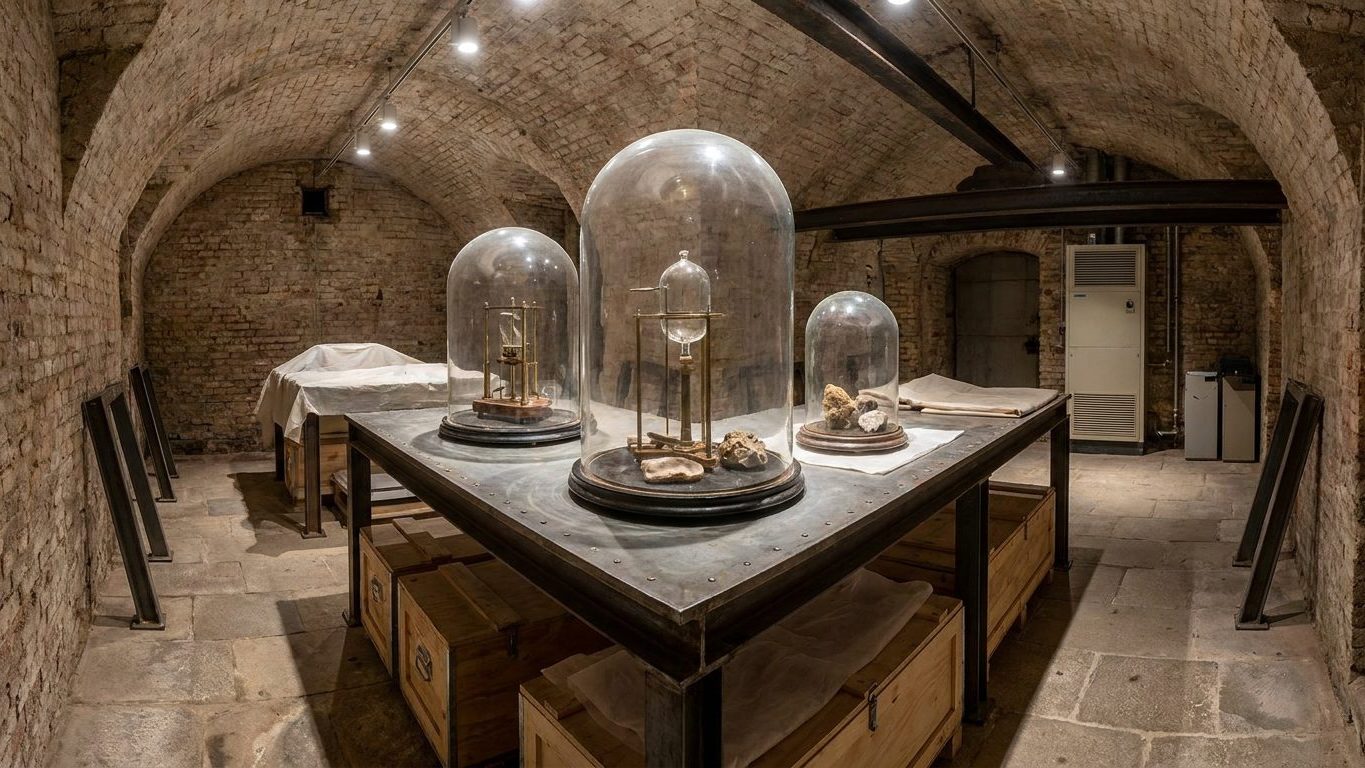
Three sealed glass domes hid a small metal cylinder, locked away in a vault deep inside a tomb near Paris, and for a long time it held in its tiny form the exact definition of the weight of everything on Earth. The historical kilogram standard, a 125-year-old metal cylinder, began showing signs of weakness. No one was allowed to touch it without a procedure worthy of a missile launch.
Three different keys, held by three distinct people, were required merely to open the vault. The cylinder itself, a perfectly polished alloy, should hardly ever be handled in the open air. Every contact, every grain of dust, every fluctuation in humidity posed a risk to the object that alone defined what a kilogram was across the planet.
- A metal cylinder kept under three glass domes near Paris had been the official standard defining the world’s kilogram since 1889.
- Periodic comparisons revealed that the mass of the original cylinder differed from its copies dispersed worldwide, weakening the entire measurement system.
- In 2019, the kilogram was redefined based on a physical constant of the universe rather than a single material object that could degrade.
An Infallible Standard
Here lies the crux of the problem: this object could not err. By its very construction, its mass equaled exactly one kilogram—period. If the cylinder shed a speck of dust, if it oxidized ever so slightly, if it gathered a few particles invisible to the naked eye, it wasn’t the cylinder that changed in the eyes of the international system: it was the definition of the kilogram that moved with it, pulling along every scale, every food label, every engineering calculation on Earth.
A dizzying logic. A unit meant to be universal and immutable depended, in reality, on a piece of metal that, like any physical object, aged and was subject to the whims of chemistry. A dependence on a single physical object posed a real risk: if the prototype degraded, the entire global metrology chain would be affected.
The Weighings That Betrayed the Secret
Official copies of this cylinder had, from the outset, been produced from the same mold and under the same conditions. These prototypes included official copies made from the same mold and kept under the same conditions, as well as national prototypes assigned to most countries to serve as mass standards. Each nation thus possessed its own copy, believed to be rigorously identical to the original kept near Paris.
The problem appeared during periodic comparisons. When the reference cylinder was taken out of its vault to be weighed against its copies scattered worldwide, metrologists noted discrepancies. Over long periods, the mass of the original proved inconsistent with that of the other prototypes, even though their shape and composition were almost identical. Nothing dramatic to the naked eye. Yet enough to shake the foundations of a system that was supposed to rest on absolute certainty.
It was impossible to know which of the specimens had truly drifted. Had the original thinned? Had the copies grown by collecting particles from their surroundings? This physical artefact existed in only one place and, more importantly, it was not stable over time, because it did not rest on immutable natural constants. The question itself had no rational answer, since the reference object was by definition the one that was always right.
Replacing an Object with a Law of Nature
The chosen solution was to shift the logic entirely. Rather than anchoring the unit to a single artefact somewhere on Earth, scientists decided to anchor it to a physical constant, a fixed quantity of the universe, identical here and at the far end of the galaxy. The new kilogram had to be a method, not a prototype: anyone could manufacture a perfect standard at home.
Concretely, this means that a properly equipped laboratory can now reconstruct the exact mass of a kilogram without needing to consult any artefact kept somewhere. No more travel, no more borrowing an official copy, no longer trusting a cylinder sealed under three domes. The definition lives in an equation, not in a vault.
This shift was formalized in 2019. The official copies of the international prototype of the kilogram carried this unit from 1889 until the redefinition based on physical constants in 2019. The historic cylinder has not disappeared, however.
A Retired Object, a Method Takes Over
The cylinder sits where it always did, under its three glass domes, near Paris. But it no longer defines anything. It has become a simple polished piece of metal, historic perhaps, yet as anonymous now as a bar of bullion in a reserve. Its mass may vary by a microgram or so, and that no longer has any consequence for the rest of the world.
The shift goes far beyond the kilogram alone. With this reform, none of the International System’s fundamental units rests on a physical object kept somewhere on the planet. The meter had already shed that logic long ago, redefined from a universal speed. The kilogram was the last holdout, the final bastion of a time when measuring the world meant first forging a reference object and hoping it would never move.
What stands out in retrospect is the modesty of the solution in the face of the problem’s scale. A piece of metal under a cloche was enough for more than a century to guarantee the coherence of all weighings on the planet, before yielding to a law that no one can manufacture, damage, or lock away in a vault.
Sources: metrologie-francaise.lne.fr | ici.fr
