
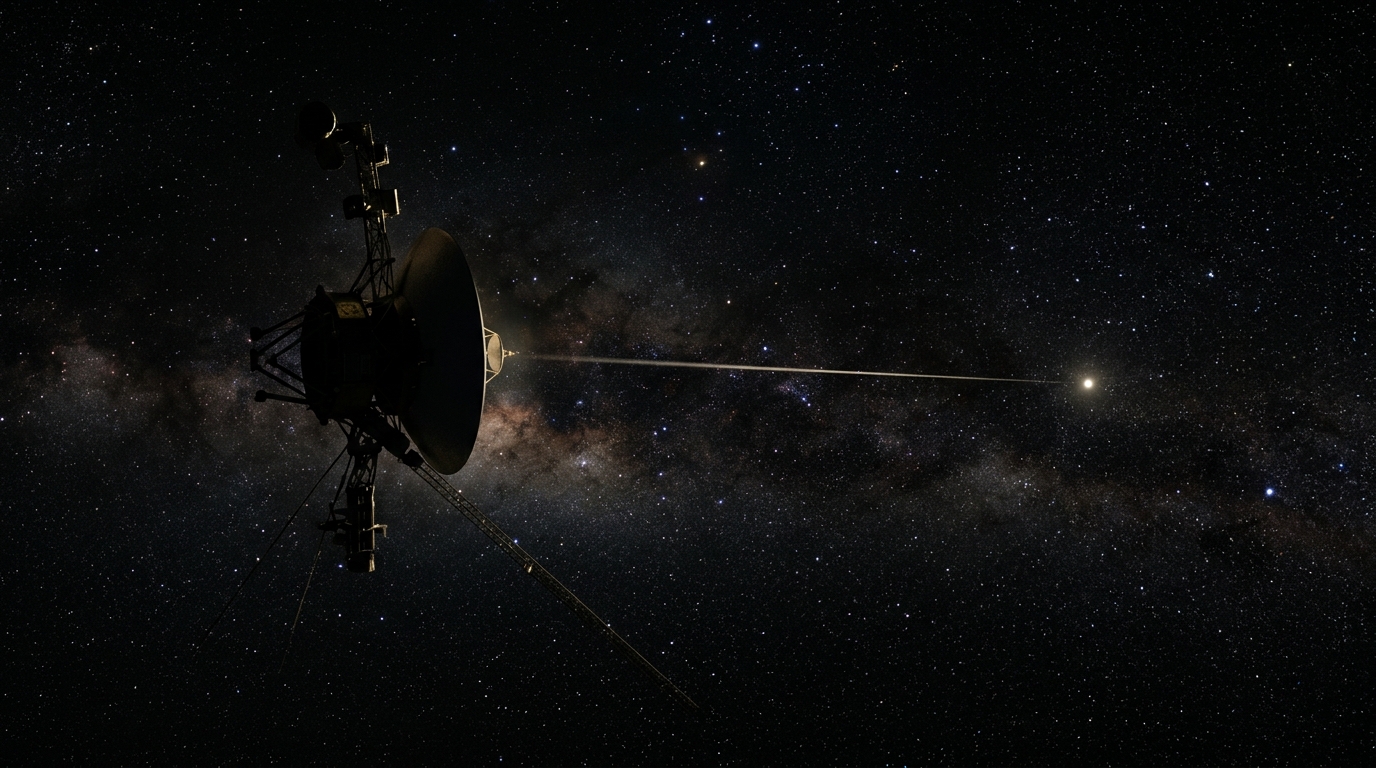
Imagine for a moment that your computer stops responding, yet it lies billions of kilometers away from you, out of reach of any technician, with a delay of several hours just to receive a signal. That is precisely the situation NASA faced when Voyager 1, the farthest probe ever launched by humanity, suddenly ceased sending intelligible data. For five long months, radio silence, or almost: the probe answered, but in an indecipherable gibberish. The outcome of this story resembles a small engineering miracle, carried by a team that refused to let a whole chapter of our space history go unpreserved.
- Voyager 1, more than 24 billion kilometers from Earth, transmitted for five months data that was incomprehensible due to a corrupted memory chip in the command and data subsystem.
- The team led by engineer Suzanne Dodd bypassed the problem by redistributing the affected code to another functioning chip on the probe, without any physical intervention.
- Because each command took about 22 hours to reach the probe and as long to receive a response, a clear signal was eventually restored in the spring after several carefully tuned attempts.
- Five months of radio silence at 24 billion kilometers
- A faulty memory chip and a team that refused to give up
- The risky bet of a fix sent across the solar system
- What this rescue reveals about Voyager 1’s future
Five months of radio silence at 24 billion kilometers
Launched in 1977, the Voyager 1 spacecraft has been on a near fifty-year nonreturning journey toward the edge of the solar system. It has now crossed into interstellar space, that region where the solar wind yields to the frigid emptiness between the stars. Its current distance from Earth exceeds 24 billion kilometers, a figure so staggering that a radio signal, even traveling at the speed of light, takes about 22 hours to reach it, and the same amount of time to receive a reply.
It is within this already extreme context that, toward the end of autumn, the probe began transmitting data that were entirely unintelligible. Engineers at the Jet Propulsion Laboratory could receive a signal—proof that the craft was still alive—but it contained no usable scientific or telemetry information. In short, Voyager 1 spoke, but no one understood its language.
A faulty memory chip and a team that refuses to give up
After weeks of meticulous analysis, conducted without any possibility of direct intervention, the team led by engineer Suzanne Dodd pinpointed the origin of the problem: a memory chip in the command and data subsystem, responsible for formatting information before it is sent to Earth, had become partially corrupted. A portion of the code essential to the transmission had simply become unreadable.
The challenge was not only technical; it was almost archaeological. Voyager 1 carries onboard computing built in the 1970s, with computing power diminutive compared to that of a modern smartphone. Few engineers still master this decades-old programming language, and the original manuals, when they still exist, do not always suffice to solve the riddle. The team had to literally rediscover the spacecraft’s architecture, much as historians deciphering an ancient manuscript.
The risky bet of a fix sent across the solar system
Replacing the defective chip physically was, of course, impossible. The solution devised by Suzanne Dodd and her team was to bypass the problem rather than repair it directly: the affected code was redistributed and stored on another portion of the probe’s memory, a chip that remained functional. It was a bit like moving essential files from a damaged hard drive to a healthy one, without ever touching the machine itself.
Each instruction sent represented a bet, because a single error in the fix could make the situation irreversible, or even condemn Voyager 1 to silence. And patience was required: each command took nearly a full day to reach the probe, and as long to receive the reply. In the following spring, after several attempts tuned with surgical precision, the signal finally became clear again. Voyager 1 had regained its voice.
What this rescue reveals about Voyager 1’s future
This episode demonstrates how these two twin probes, Voyager 1 and Voyager 2, remain feats of engineering that continue to defy time. Their power sources, driven by the radioactive decay of plutonium, inexorably lose power, and NASA teams must regularly shut down certain instruments to conserve the precious energy that remains. It is estimated that the probes can continue functioning, at least partially, until around the end of this decade, before the silence becomes definitive.
This rescue also underscores a broader reality: our ability to repair, remotely and without physical contact, aging machines depends above all on human expertise and the technical memory passed down through generations of engineers. Voyager 1 continues its solitary journey, carrying the famous Golden Record intended for possible extraterrestrial civilizations, and every bit of data it returns is now seen as a precious reprieve snatched from the inexorable wear of time and distance.
This 24-billion-kilometer rescue is not merely a technical feat among others; it is a symbol: that of a humanity that refuses to let one of its farthest explorers die prematurely. How much longer can Voyager 1 keep defying the laws of wear and oblivion before its signal truly goes quiet for good?
