
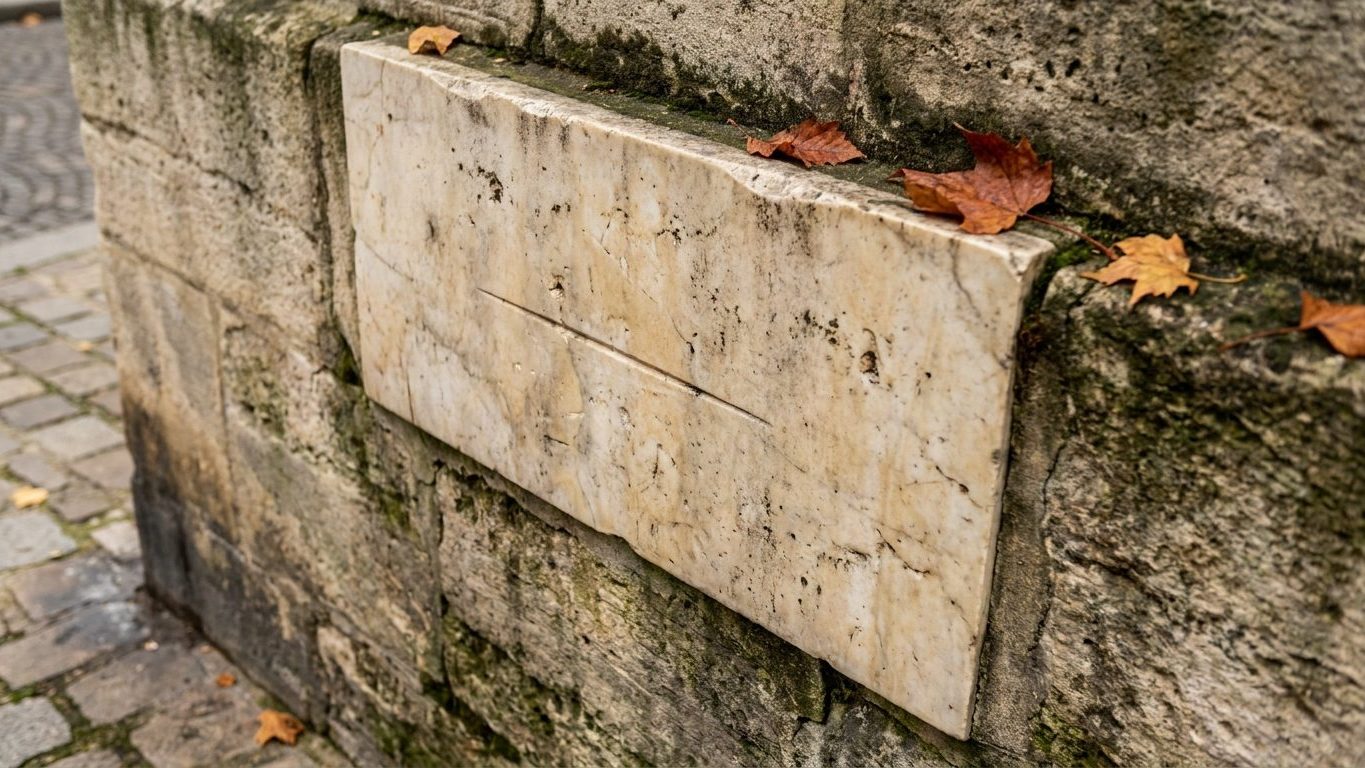
Under the arches of a building on Rue de Vaugirard, just steps from the Jardin du Luxembourg, a slender marble plaque blends into the wall’s stone. The metre-standard of Rue Vaugirard fades quietly into the urban landscape, and a plain marble plaque marks its presence, offering curious passersby a chance to discover this historical relic. A carved line, a barely visible notch: that is all that remains of an object that, in its time, was supposed to change everyone’s life.
No one stops to look at it.
And yet, this stone notch has a vast history. It dates from the French Revolution, when authorities sought a way to bring a brand-new unit, the meter, into the daily life of Parisians. Despite its discreteness, this engraved meter embodies the spirit of precision that guided the creation of the metric system. Other similar plaques were sealed elsewhere in the capital, on heavily trafficked façades, so that everyone could come verify their own measurement against the official one engraved in marble.
- Marble plaques engraved with the first definition of the meter have been embedded in Parisian walls since the French Revolution
- The metric system was created to free measurements from royal arbitrariness by basing them on a portion of the Earth’s meridian
- The length of the meter has never changed since the Revolution; only the technical supports of its definition have evolved
Why entrust measurement to the Earth rather than to a king
Before the Revolution, measuring a distance often depended on who governed. It was the era of a bazaar of rods, inches, and the annoying king’s foot, which changed according to the monarch’s anatomy. A single length could thus vary from province to province, depending on local customs or the sovereign in power. This disorder is not merely a practical nuisance: in the eyes of the revolutionaries, it symbolized the arbitrariness of a power that imposed its own measure on the rest of the country.
The idea that emerges is radical.
To base a unit of measurement on a king, a region, or even a part of the human body always ends up making it dependent on someone. The Earth, by contrast, belongs to no one. By choosing to define the meter from a portion of the Earth’s meridian, the scientists of the time sought precisely this: a reference that no one could appropriate or alter to their advantage. It is a measurement designed to belong to everyone, because it rests on no particular authority.
The gamble of an expedition amid upheaval
There remains a major problem: this portion of the meridian still had to be measured on the ground. A scientific expedition would thus have to traverse the country to determine, with the instruments of the time, the exact length of an arc from one point to another across the territory.
The undertaking unfolds in the midst of the revolutionary period, which does not make things easier. The Reign of Terror is hardly conducive to travel with an unusual measuring device, and travelers armed with strange instruments arouse suspicion among local authorities. Delays lengthen, permissions become more complicated, and the project expected to last a short time stretches over several years of difficult fieldwork. Measuring the Earth during the Revolution is already a symbol in itself: scientific precision trying to survive amid political chaos.
A length that remains, a support that changes
Once the measurement is obtained, it must be made concrete, tangible, verifiable by all. That is the role of those marble plaques sealed into Parisian walls: to give a physical body to an abstract calculation, allowing any merchant or craftsman to compare their own ruler to the official reference.
This stone support, however, was not meant to endure forever. As measuring instruments grow finer, the definition of the meter changes its physical support several times, at times relying on objects kept with extreme care, and at other times on measurable physical phenomena with ever-increasing precision. The length itself does not move: only the technical means chosen to guarantee it with exactness changes.
Today’s meter thus measures exactly the same as the one engraved beneath the arches on Rue de Vaugirard.
That is the paradox hidden in this discreet plaque. The most banal object in our daily life, the one we use without thinking about to buy fabric, measure a room, or select a shelf, was first a political gambit launched in the midst of revolutionary turmoil. Another one of these marble meters still stands today on the façade of the Ministry of Justice, on Place Vendôme, a silent witness to a wager that almost no one, passing by daily, ever notices.
Sources: parismamanetmoi.com | lelivrescolaire.fr
