
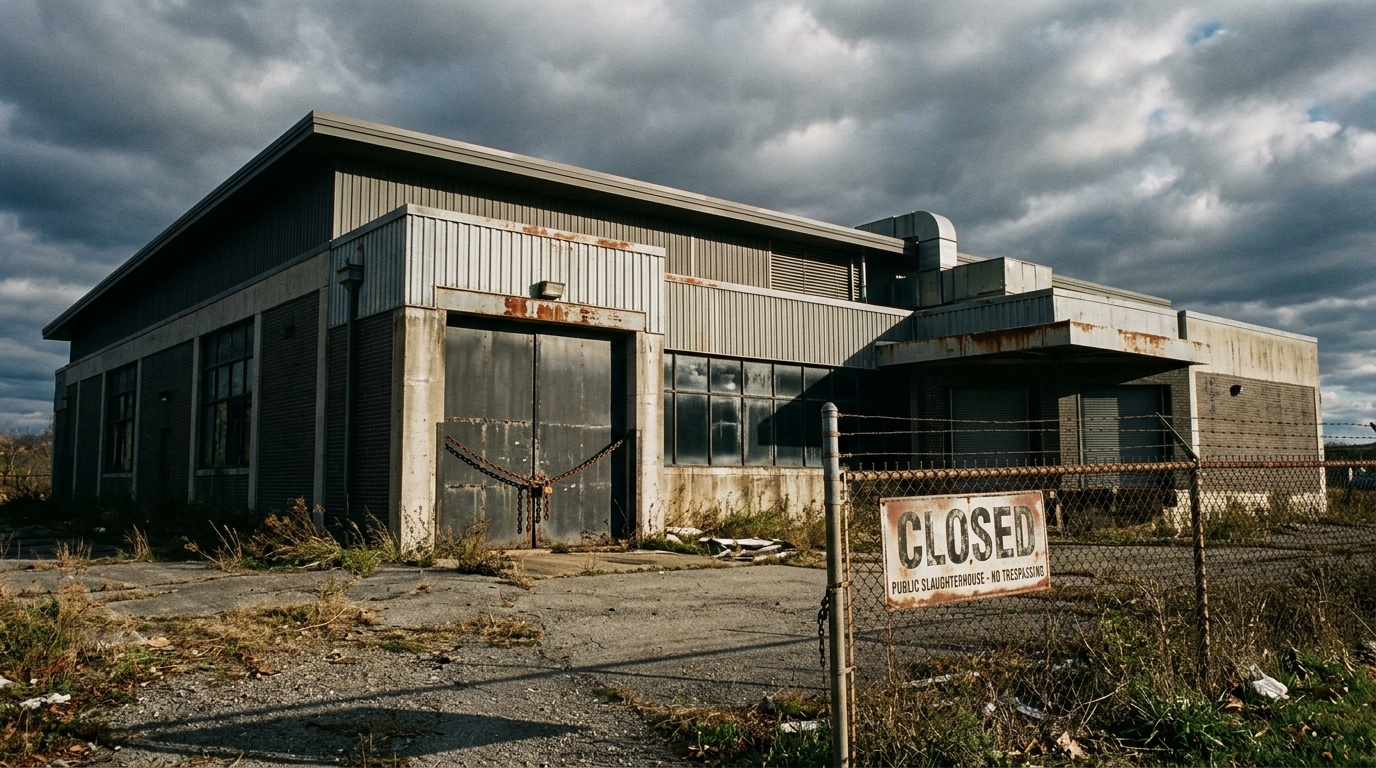
Imagine pouring tens of millions of euros into renovating a building only to watch it shut its doors just as the work was completed. Yet that is what happened at several French slaughterhouses, financed heavily with public money without guaranteeing their long-term viability. As the Court of Audithas just published a blunt report on the management of these facilities, the question must be addressed directly: where did that money go, and why did so many subsidized sites end up closing?
- Approximately one third of the subsidized slaughterhouses under the France Relance plan (130 million euros) closed shortly after their renovation work.
- Among the 80 public slaughterhouses still in operation, more than 55 run chronic deficits and 90% process fewer than 5,000 tonnes per year.
- The Court of Audit recommends rethinking the governance of these sites and developing mobile slaughtering rather than direct management by local authorities.
- When Public Money Funds Buildings That Close Their Doors
- The Slaughterhouse Modernization Plan, a 130-Million-Euro Promise
- One in Three Slaughterhouses Closed: The Court of Audit’s Damning Finding
- Local Supply Chains Sacrificed and Public Oversight Too Absent
- What This Fiasco Reveals About Public Funds Management in the Agri-Food Sector
Quand l’argent public finance des murs qui ferment leurs portes
The finding is bitter for taxpayers. Slaughterhouses modernized with the help of public subsidies, intended to revive a local activity essential to the meat sector, ended up shut down only a few months or a few years after the work was completed. This phenomenon is not anecdotal: according to the Court of Audit, about a third of slaughterhouses that received public subsidies ceased activity in the years following the works. A figure that, in itself, sums up the scale of financial waste and raises questions about the relevance of the choices made by public authorities in this sensitive sector.
This paradox is not new, but it takes on particular resonance this autumn as local authorities seek to balance increasingly tight budgets. How can such investments be justified when the return on them is virtually nil? The question preoccupies both local elected officials and players in the agricultural sector, who see their nearby tools disappearing one after another.
Le plan de modernisation des abattoirs, une promesse à 130 millions d’euros
To understand the scale of the problem, one must revisit the original intentions. As part of the France Relance plan, the state set aside a substantial envelope aimed at modernizing slaughterhouses, whether public or private, to meet ever stricter sanitary and environmental requirements. The stated objective was laudable: to maintain a nationwide network of slaughtering facilities able to serve local farmers, while preventing French meat from traveling hundreds of kilometers before processing.
But the gap between theory and practice proved abyssal. The case of the AIM slaughterhouse in Val-Couesnon, in Ille-et-Vilaine, perfectly illustrates this administrative and financial fiasco. In 2021, the site benefited from a €1.6 million subsidy to carry out modernization work. An advance of €832,000 had even been paid. Result: the works were never completed, and the facility eventually closed after the suspension of its slaughtering authorization. A colossal sum swallowed for nothing, revealed by a parliamentary question addressed to the Minister of Agriculture.
Un abattoir sur trois fermé : le constat accablant de la Cour des comptes
The report by the financial magistrates goes beyond a few isolated cases. It provides a global snapshot of the situation of 80 public slaughterhouses still operating in France, a figure that already signals an industry collapse since there were 114 in 1989. Despite this ongoing decline, these facilities now account for only 7% of French meat production, a negligible economic weight in light of the resources spent to keep them running.
Even more troubling, nearly 90% of these public slaughterhouses process less than 5,000 tonnes per year, a volume far from sufficient to ensure economic viability. The Court also notes that more than 55 of the 80 facilities examined run chronic operating deficits and have negative self-financing capacity, in other words, a structural inability to fund themselves from their own resources. The example of the Ambert slaughterhouse, in the Puy-de-Dôme, is particularly telling: its activity volume, which had exceeded 1,000 tonnes up to 2018, collapsed to 637 tonnes in 2021, then to less than 100 tonnes in 2022. A dizzying drop that shows just how hard these local tools are struggling to find their audience nowadays.
Des filières locales sacrifiées et un contrôle public resté trop absent
Behind these figures lies a more complex human and territorial reality. Local slaughterhouses play a role often underestimated by local farmers, who see them as a way to avoid long-distance transport and to value short supply chains. Their gradual disappearance thus weakens an entire agricultural ecosystem already stretched elsewhere.
Paradoxically, this mismanagement costs the State far beyond the subsidies lost. No fewer than 230 officials from the Ministry of Agriculture are permanently tasked with sanitary oversight of these public slaughterhouses, for an annual payroll estimated at €13.37 million. A substantial human and budgetary effort that nonetheless fails to stem the cascading closures. The Court of Audit goes further, estimating that local authorities’ direct management of these establishments is no longer justified, given the unsatisfactory economic and sanitary results.
Ce que révèle ce fiasco sur la gestion des fonds publics dans l’agroalimentaire
The most troubling aspect of this affair is that none of this is truly new. The financial magistrates remind us that these dysfunctions were already pointed out in reports dating from 1990 and 1996. In other words, three decades have passed without the necessary reforms being undertaken, despite repeated and documented warnings. A paralysis that raises questions about the administration’s ability to learn from its own findings.
Facing this dead end, the Court of Audit does not merely present a critical assessment. It offers concrete recommendations, notably to involve more actors from the meat sector in the governance of these establishments rather than letting local authorities manage tools that they do not always master economically. The institution also advocates for the development of mobile slaughtering, a solution already tested under the Egalim law and which would help reduce infrastructure costs while preserving proximity to farmers.
This dossier on public slaughterhouses ultimately acts as a reveal of a deeper malaise in the management of public funds allocated to the agri-food sector: investments decided without a true viability assessment, in regions where the volumes of animals to be slaughtered continue to decline. At a time when every euro of public money is scrutinized with growing vigilance, this slaughterhouse fiasco poses a simple yet essential question: how much longer will the state continue to finance structures whose failure seems, year after year, prewritten?
