
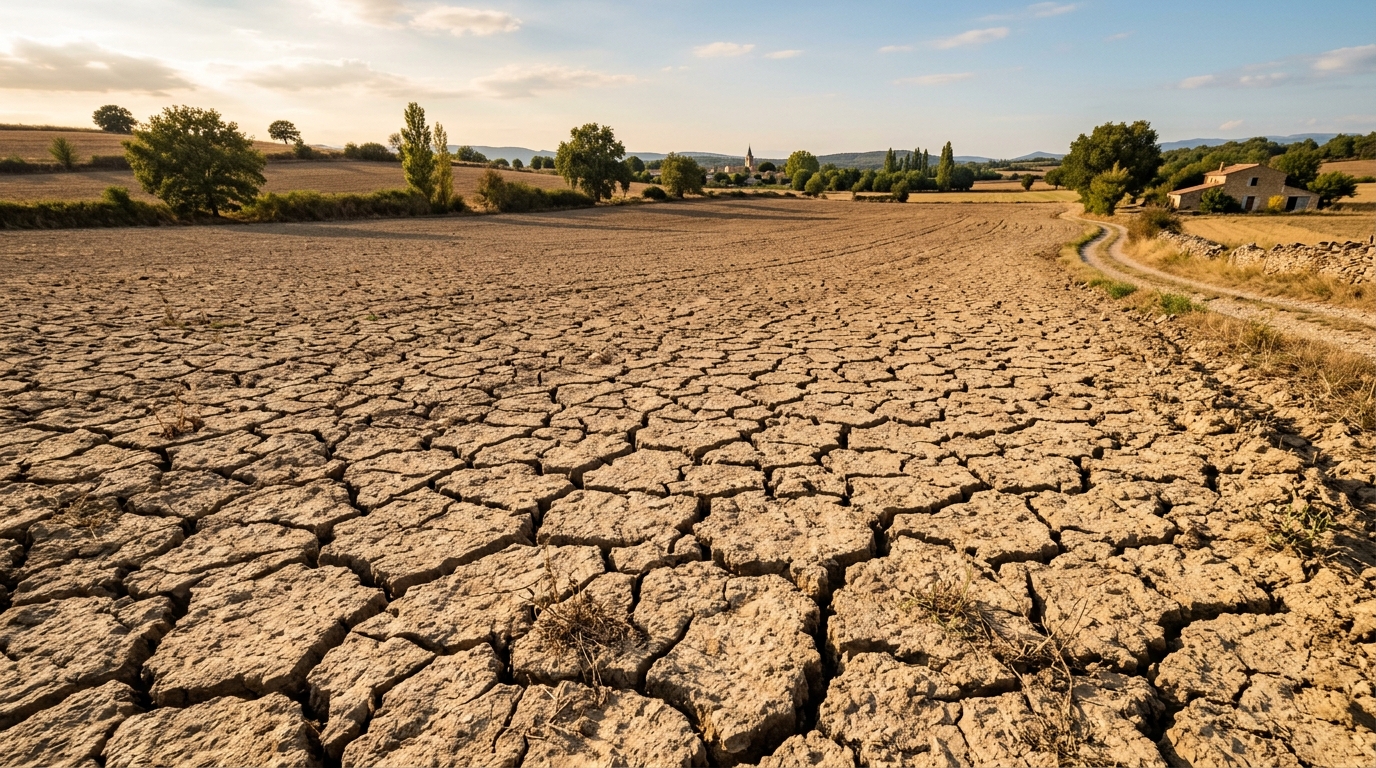
And what if the map of the world as we know it is being redrawn before our very eyes, not because of a lack of rain, but because of a gas we breathe every day? This is the question raised by a study conducted by the Chinese Academy of Forestry and published in Environmental Research Letters. Currently, 38.58 % of the planet’s land area is already classified as arid. By the end of the century, this figure could rise to 40.28 %. But contrary to what one might imagine, it is not the decline in rainfall that will drive this shift: it is CO2 itself, through a plant mechanism that is as subtle as it is decisive.
- 38.58% of the land area is already classified as arid, a share that could reach 40.28% by 2071-2100 according to CMIP6 models.
- Contrary to intuition, a higher CO2 concentration causes plants to partially close their stomata, reducing their transpiration and thereby slowing the expansion of drylands.
- The drylands are distributed into four categories based on their degree of dryness: semi-arid (14.72%), arid (11.24%), dry sub-humid (6.35%), and hyper-arid (6.27%).
- The invisible threshold that turns land into desert
- Four faces of aridity, from semi-arid to hyper-arid
- CO2, this unexpected brake on desertification
- Why current drylands maps all contradict each other
The Invisible Threshold That Turns Land into Desert
To understand how a region shifts into the drylands category, researchers rely on a measurement tool called the aridity index, abbreviated AI. Its calculation is actually fairly straightforward: it is the ratio of precipitation received in a zone to its potential evapotranspiration, that is, the amount of water soil and vegetation could theoretically lose under heat and wind. When this ratio falls below the 0.65 threshold, the area officially enters the realm of drylands, those dry lands that already cover a substantial part of our planet.
To establish their projections, scientists combined meteorological data spanning 1960-2023 with the most recent climate models from the sixth phase of the Coupled Model Intercomparison Project, better known by the acronym CMIP6. This combination allows for the simulation of long-term global climate evolution, and it is what led to the projection of expanding drylands by 2071-2100.
Four Faces of Aridity, from Semi-Arid to Hyper-Arid
Talking about drylands often conjures the image of a uniform, sandy desert, but the reality is much more nuanced. Researchers actually distinguish four subcategories of drylands, each corresponding to a different degree of dryness.
- The semi-arid zones, the most extensive, account for 14.72 % of the land area
- The arid zones, concentrated mainly in Australia and China, cover 11.24 % of the Earth’s surface
- The dry sub-humid zones, very present in China and Russia, occupy 6.35 % of the lands
- The hyper-arid zones, such as those found in Algeria, Libya or Saudi Arabia, extend over 6.27 % of the planet
This classification matters because each sub-type exhibits its own dynamics and ecological vulnerability. An area that is semi-arid does not respond in the same way as a hyper-arid region to climate variations, which complicates the projection exercise undertaken by the researchers.
CO2, This Unexpected Brake on Desertification
Here is the most surprising part of the study, the one that upends a fairly widespread intuition. One might think that increasing atmospheric carbon dioxide, by warming the planet, would mechanically accelerate soil drying. However, the researchers point to the opposite effect, a largely underestimated phenomenon: a higher CO2 concentration can prompt plants to partially close their stomata, the tiny openings on leaves through which water vapor normally escapes.
In plain terms, vegetation transpire a little less when the ambient air is richer in carbon, which mechanically limits water loss to the atmosphere. This phenomenon, often neglected in previous models, would thus act as a partial brake on the expansion of drylands. It is precisely to integrate this subtlety that the team built a methodological framework that modifies the calculation of potential evapotranspiration as a function of CO2 rate, an approach that greatly refines the accuracy of long-term projections.
Why Current Drylands Maps All Contradict Each Other
If you have ever tried to determine precisely what share of the planet is arid, you have probably noticed that figures vary significantly from one source to another. It is no accident: researchers themselves acknowledge that global estimates fluctuate strongly depending on measurement techniques and the climate data sets used. An aridity index calculated with a simplified model will never yield exactly the same result as a calculation that incorporates, like this one, the effect of CO2 on plant transpiration.
This methodological divergence is not merely a technical detail for specialists. It has concrete consequences for how climate adaptation policies are conceived and prioritized around the world. That is why the study’s authors call for harmonization of approaches and for regularly updated assessments of the actual extent of drylands, the only way to accurately gauge the scale of risks related to water scarcity, ecosystem degradation, and desertification.
It is almost counterintuitive to think that global climate is decided as much in the leaves of plants as in the clouds. What this study ultimately reveals is that the fight against desertification is not simply a matter of a straightforward equation between heat and dryness. It also hinges on a better understanding of the most subtle biological mechanisms, those that, at the scale of a leaf, can influence the fate of entire continents. The question remains whether this new lens will manage to gain traction amid the diversity of existing models, or whether the global mapping of drylands will continue for a long time to tell several stories at once.
