
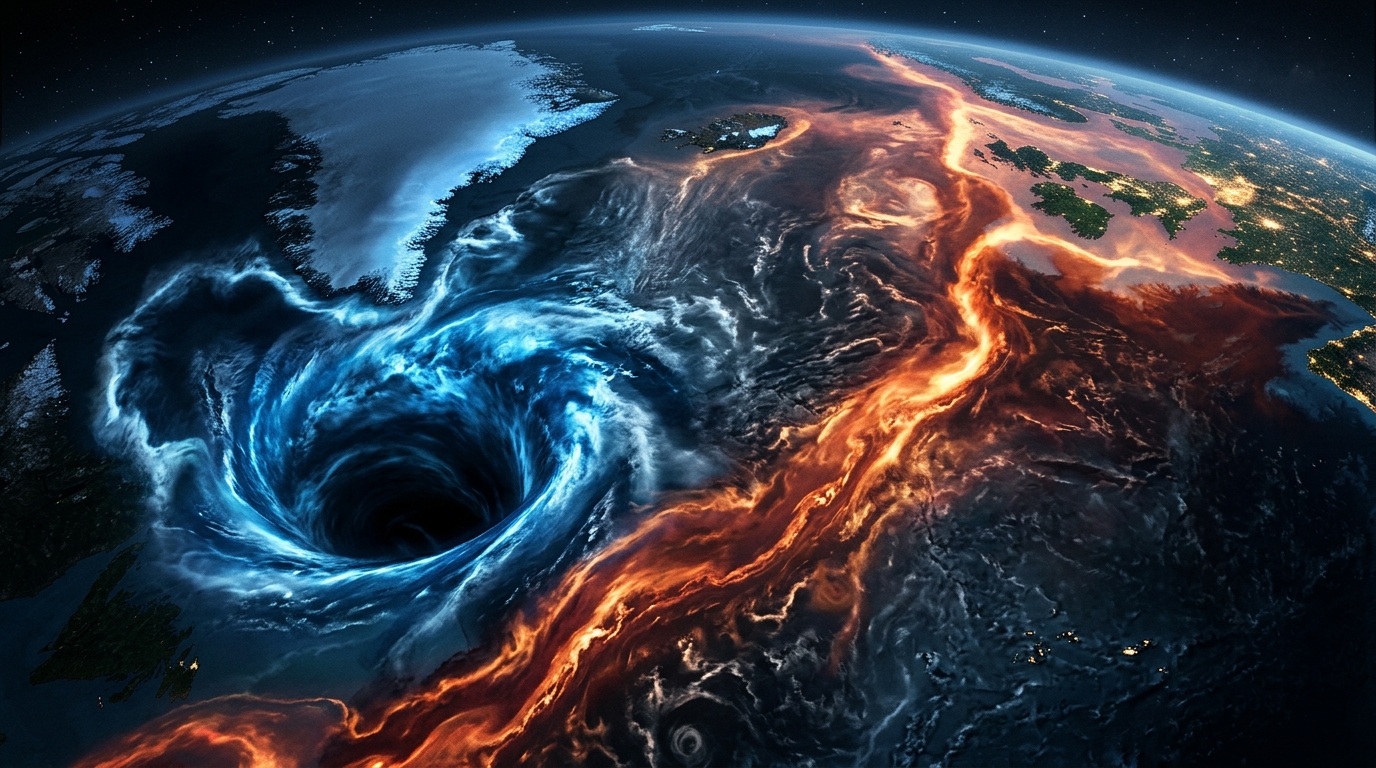
A surface ocean current and an overturning circulation are not exactly the same thing. The former mainly moves a mass of water through the upper layers, somewhat like a horizontal conveyor belt. The latter descends into the depths, rises again, sinks, and essentially shapes the climate of entire continents. It is precisely this second mechanism, known as the AMOC, that today worries climate scientists. A study published in Nature Geoscience reminds us that this system, invisible from the surface, could be approaching a tipping point. And if its slowdown were not merely a local cooling effect, but the sign of a much broader energy imbalance for the entire planet?
- The AMOC would act as a true oceanic thermal valve, not merely a conveyor belt redistributing heat between hemispheres
- When this circulation weakens, deep convection slows, and heat becomes trapped in the ocean rather than escaping to space
- This mechanism would explain why Greenland and Antarctic ice cores record climate variations at different tempos
- An invisible oceanic valve has long regulated Earth’s heat, and it is starting to stall
- When the ocean breathes: the mechanism behind glaciations forgotten
- The thermal conveyor-belt model has begun to look outdated
- Greenland vs Antarctica: two climate clocks that do not beat at the same pace
- What ice cores reveal about the approaching tipping point
An invisible oceanic valve has long regulated Earth’s heat, and it is starting to stall
Under the cold waters of the North Atlantic flows a gigantic system of currents named AMOC, for Atlantic Meridional Overturning Circulation. Its role is twofold: it redistributes the heat accumulated in tropical regions toward the planet’s colder regions, and it also transports nutrients essential to marine life. Without it, ocean ecosystems and global precipitation patterns would be substantially different.
The problem is that this mechanism already shows signs of fatigue, weakened by human-caused climate change. A recent study set out to identify the precise threshold beyond which this weakening would no longer be temporary but would become self-sustaining and thus irreversible. A question that extends far beyond science, as it directly concerns future temperatures and precipitation almost everywhere on Earth.
When the ocean breathes: the mechanism behind glaciations forgotten
To understand what could unfold in the coming decades, researchers looked to a much more distant past: the Pleistocene. During this glacial period, the Earth experienced climate changes of astonishing speed, known as Dansgaard-Oeschger events. Their imprint remains etched in ice cores from Greenland, true climatic archives capable of revealing rapid temperature shifts.
These episodes have long intrigued scientists, because they show that Earth’s climate does not always warm or cool in a gradual way. It can abruptly flip from one state to another, a bit like a switch changing position. It is precisely this behavior that has driven scientists to revisit the role of AMOC in these past upheavals.
The thermal conveyor-belt model has begun to look outdated
Until now, the dominant explanation rested on the concept of a bipolar seesaw, a sort of thermal swing between the two hemispheres: when one warms, the other cools, as on a swing. This model treated the AMOC as a simple conveyor belt, responsible for moving heat from one point to another without changing the overall amount of heat in the system.
The new approach offers a very different reading: that of a true oceanic thermal valve. Building on three distinct climate models able to spontaneously reproduce oscillations similar to Dansgaard-Oeschger events, researchers observed a precise mechanism. When the AMOC operates at full strength, deep convection in the North Atlantic acts like a valve: it releases heat toward the atmosphere, then toward space. But when this circulation weakens, convection slows down, or even stops. The heat, deprived of an outlet, remains trapped in the ocean, and the planet as a whole begins to accumulate energy rather than dissipate it.
Greenland vs Antarctica: two climate clocks that do not beat at the same pace
One of the major merits of this thermal valve model is that it explains a long-standing mystery: why Greenland ice cores show rapid, pronounced temperature variations, while Antarctic cores evolve much more slowly and in a more attenuated fashion.
The answer lies in the fact that these two glacial archives do not measure exactly the same thing. Greenland temperatures would mainly reflect the rate of heat loss in the North Atlantic, in other words the speed at which the thermal valve opens or closes. Antarctic records, by contrast, would reflect the global ocean heat content, a quantity that necessarily evolves more gradually on a planetary scale. Two climate clocks, therefore, set to different tempos but linked by the same underlying mechanism.
What ice cores reveal about the approaching tipping point
This new theoretical framework also sheds light on another puzzle: the particularly marked climate instability observed during certain intermediate glacial states. According to this reading, these chaotic phases would not result from a simple hemispheric imbalance, but from a structural inability of the climate system to reconcile the ocean’s global heat uptake with the rate of heat loss in the North Atlantic, regardless of how the AMOC is functioning at that moment.
The most troubling implication concerns, of course, our era. If the AMOC were to weaken durably under ongoing warming, the planet could, according to this mechanism, absorb more heat instead of dissipating it to space. The exact threshold beyond which this tipping would become irreversible is not yet quantified, but the avenue opened by this study provides a more nuanced conceptual tool than the old bipolar seesaw model to try to determine it.
One last question, however, will not be answered by a glacier core thousands of years old: how much longer before this quiet but essential thermal valve finally closes before our eyes? By digging into Earth’s glacial past, researchers may have sketched the outlines of a future climate that remains uncertain.
