
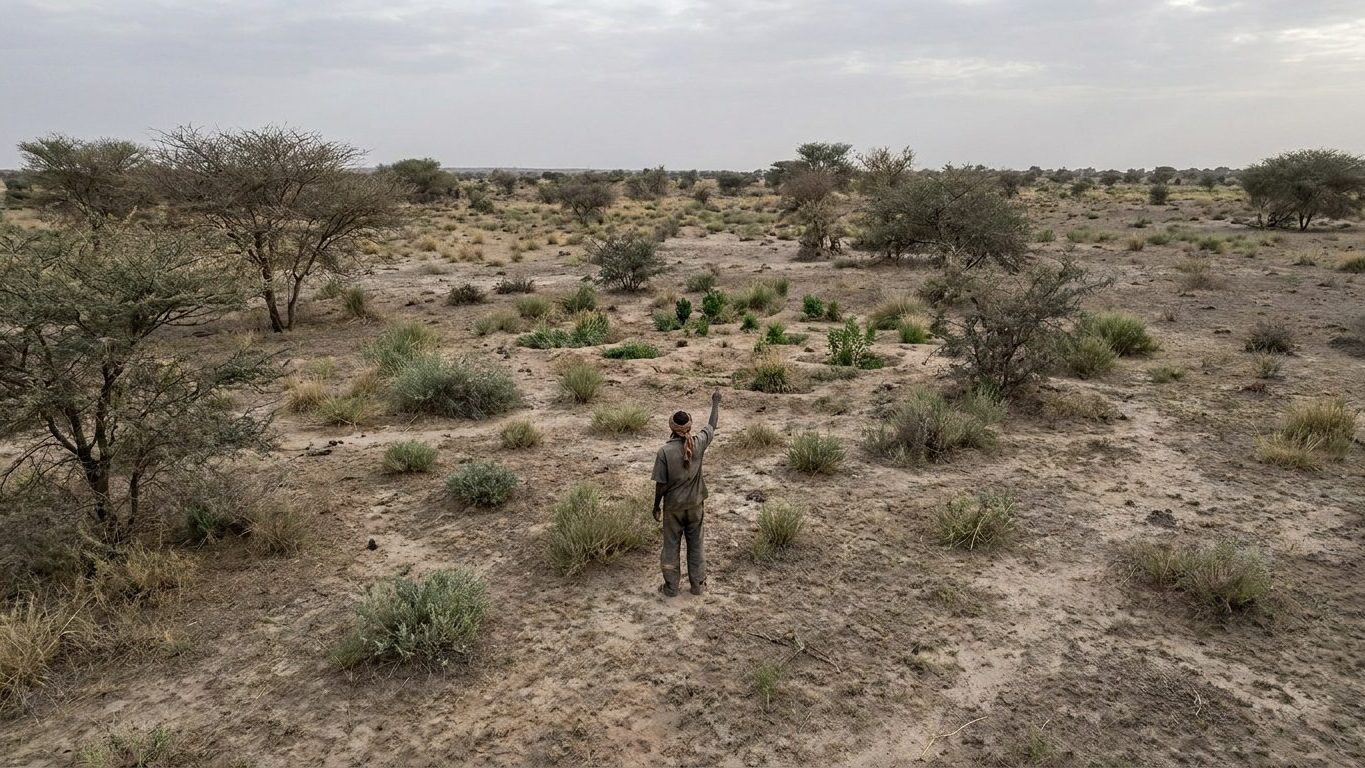
Eleven countries, eight thousand kilometers, a green line intended to block the desert. On paper, the project resembles a climate-adjusted Great Wall. But what has truly slowed this monumental undertaking isn’t drought or dune progression: it’s erratic funding, armed conflicts, and a concept that was poorly conceived from the start.
- Only 18 million hectares have been restored out of the 100 million targeted by 2030.
- Erratic funding, armed conflicts, and a lack of cross-border coordination have slowed the project.
- The approach has shifted from a continuous line of trees to a mosaic of productive landscapes, more realistic in practice.
A project launched in 2007, with a bilan far below the promises
Launched by the African Union in 2007, the Great Green Wall began as an ambitious tree-planting campaign intended to span from Senegal to Djibouti across the Sahel. The initiative, backed by eleven countries, aims to restore 100 million hectares of land and improve living conditions in the Sahel by 2030. The ambition also included creating ten million green jobs, a figure that appears in the project’s official documents.
The target has not been met.
On the occasion of the program’s fifteenth anniversary, a report commissioned by the United Nations Convention to Combat Desertification and published in September 2020 found that only four million hectares out of the hundred targeted had been planted. In 2019, an official assessment reported only 72,450 hectares planted that year. A year later, the French Development Agency estimated in September 2021 that 20 million hectares had been restored and 350,000 jobs created. More recently, a World Economic Forum report published in 2024 put the figure at 18 million hectares restored and 350,000 jobs generated, far from the 100 million hectares and 10 million jobs hoped for by 2030.
What really blocked progress: money, conflicts, and coordination
Sand was never the main obstacle. The real bottlenecks bear more prosaic names: funding, security, governance.
The 2020 report pointed to funding inconsistency as well as ongoing conflicts and insecurity in the Sahel as the primary reasons for the delay. Only Senegal and Ethiopia had truly prioritized the project, leaving the other participating countries far behind. Two independent evaluations ordered in 2023—one by the United Nations Convention to Combat Desertification on the GMV accelerator, the other by Transparency International on the governance of the initiative—documented these institutional shortcomings. A Reporterre article about Senegal, hailed as the project’s showcase, described poorly maintained nurseries and reforestation efforts that fail to survive due to lack of follow-up.
It is more the management of funds, political instability in several zones, and the lack of coordination among countries that explain the mixed results, according to an analysis published by Vert. Money has indeed been mobilized: the French Development Agency allocated nearly €501 million between 2021 and 2024 to support accelerating the initiative across the eleven countries, i.e., more than 80% of the €600 million pledged at the One Planet Summit in 2021. The sums exist. They struggle to translate into hectares planted on the ground.
From the wall of trees to the agricultural mosaic
The image of a continuous line of trees eventually gave way to a more agronomically realistic approach. The goal of a wall of trees gave way to transforming millions of lives through a mosaic of green and productive landscapes spread across the eleven countries. The FAO now describes the project as an integrated ecosystem management approach, aiming for a mosaic of different land uses and vegetation systems, including sustainable management of arid lands, natural vegetation regeneration, and water conservation measures.
This shift changes almost everything, or nearly so.
Some sites are pulling ahead. A cost-benefit analysis published in Nature Sustainability and conducted by the FAO shows an average return of $1.20 for every dollar invested in land restoration, with results ranging from $1.10 to $4.40 per dollar depending on the site. In several areas, shea nuts, a highly sought-after agroforestry product, are now cultivated within this mosaic of practices, offering tangible income to local communities rather than a mere decorative line of trees on a map.
The project’s monitoring continues, with more structured methodology than in its early years. The Great Green Wall Observatory and other actors now track more than 300 projects across the entire affected zone, a framework that did not exist in the program’s early years. The tree wall envisioned in 2007 never fully came to fruition as such, but the restoration dynamics it set in motion continue to expand, patch by patch.
Sources: vert.eco | fr.mongabay.com
