
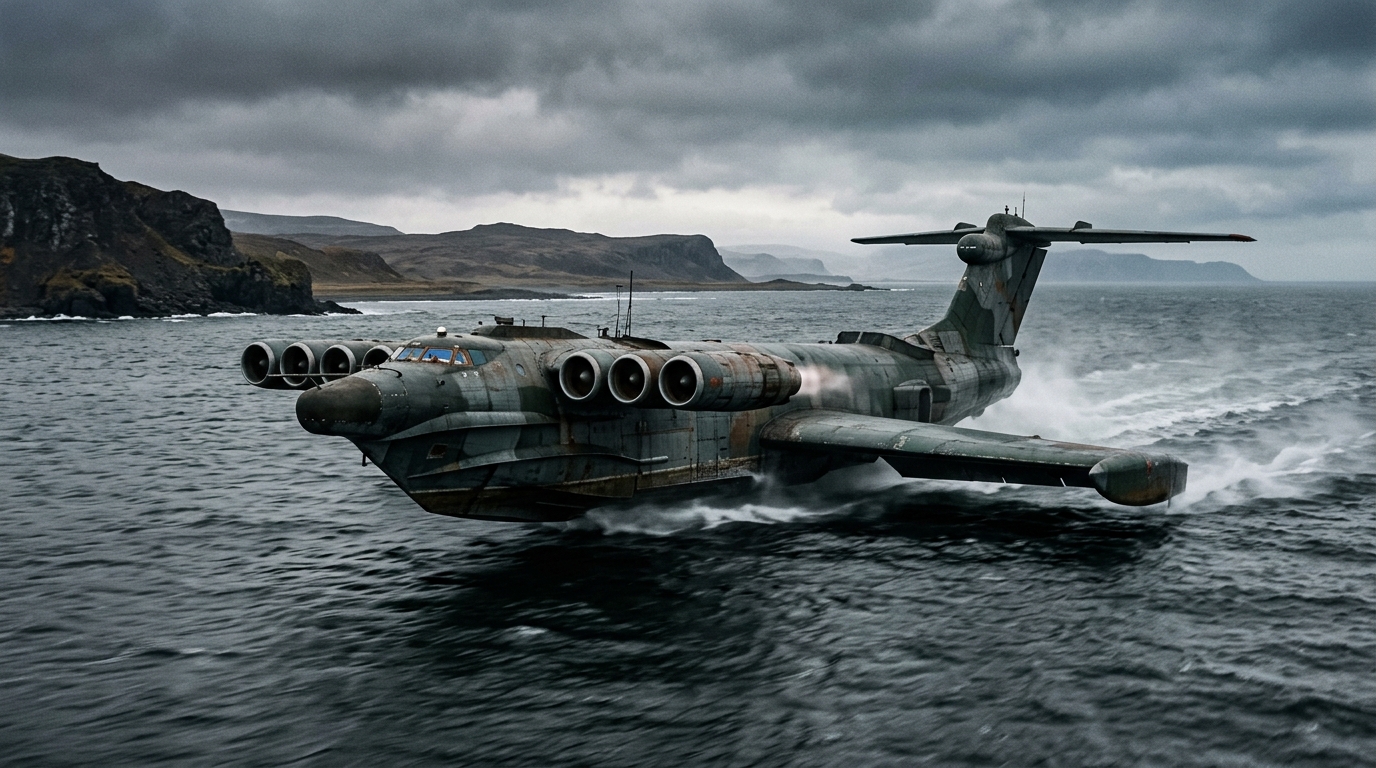
Imagine a large commercial airliner, two times heavier, that never truly takes off and skims the waves at the speed of a high-speed train. This isn’t science fiction, but a reality that existed on the Caspian Sea for several years, kept in the utmost secrecy. For years, American satellites watched a mysterious point evolve across this closed stretch of water, before they managed to pierce its mysteries. This steel giant, capable of transporting the equivalent of an entire building while brushing the surface of the sea, embodies the audacious technological daring and the military gigantism of a late-era USSR. But what ended its saga had little to do with a faulty engine or a breakdown at sea: the true explanation is far more political than technical, and it speaks volumes about the end of an empire.
- The Lun MD-160, a Soviet ekranoplan weighing 380 tonnes, flew about three metres above the Caspian Sea thanks to the ground effect, reaching around 500 km/h.
- Designed as a war weapon, it carried anti-ship missiles P-270 Moskit intended to strike NATO fleets, but it never saw combat.
- The collapse of the USSR in 1991—not a technical failure—brought the program to an end, and the aircraft is today exhibited as wreck near Derbent.
- A Giant That Defies the Laws of Conventional Aviation
- A Weapon Designed to Terrorize Western Fleets
- When the Soviet Economy Collapses, the Lun Runs Aground
- From Military Myth to a Rusted Wreck: What Remains of the Lun Program
A Giant That Defies the Laws of Conventional Aviation
The Lun MD-160 is neither quite a plane nor quite a ship. It belongs to that fascinating category of ekranoplans, hybrid vehicles that exploit a aerodynamic phenomenon known as the ground effect. In practical terms, when a massive wing operates at very low altitude above a flat surface like the sea, the compressed air beneath the wings creates a cushion of lift that dramatically increases flight efficiency while drastically reducing energy consumption. It was this principle that allowed this impressive 380-ton mass to stay aloft at just three metres above the waves, never truly taking off in the conventional sense.
With 73.8 metres in length and a wingspan of 44 metres, the aircraft’s proportions were that of a flying liner. Eight Kuznetsov NK-87 turbojets, each capable of delivering 10 tonnes of thrust, propelled this behemoth to a cruising speed close to 500 km/h. It goes without saying that piloting such a craft so close to the surface demanded nerves of steel, for the slightest miscalculation could end in catastrophic consequences.
A Weapon Designed to Terrorize Western Fleets
Behind this technical feat lay a far more bellicose intention. The Lun was not meant to carry passengers or cargo but to strike quickly and decisively. On its back rested six missile tubes arranged in pairs, housing P-270 Moskit anti-ship missiles, feared for their ability to pierce the defenses of Western carrier groups. The strategic objective was clear: to approach a NATO fleet at breakneck speed, while remaining almost invisible to surface radars thanks to its sea-skimming flight at altitudes between one and five metres.
This stealth combined with speed made it a formidable adversary on paper. Indeed, American intelligence services, intrigued by satellite observations they could not clearly identify, nicknamed the craft the Caspian Sea Monster. This moniker, famous among military aviation enthusiasts, embodies the mix of fascination and concern that surrounded this Soviet creation from beyond the Iron Curtain.
When the Soviet Economy Collapses, the Lun Runs Aground
Contrary to what one might imagine, the Lun MD-160 never took part in any naval battle, nor did it suffer a grim fate in combat. It was simply never engaged in armed conflict. The threat it posed remained purely deterrent, a card that the USSR never needed to play. What really brought its saga to a close was a far larger and more destabilizing event: the dissolution of the Soviet Union in 1991.
The fall of the Soviet bloc plunged the young Russian Federation into a severe economic crisis. Military budgets—almost unlimited for such pharaonic projects—dried up almost overnight. Maintaining a machine as complex and costly as the ekranoplan was no longer a priority, especially as the end of the Cold War radically altered strategic calculations. The need for ultra-fast coastal strike weapons, designed to counter specific enemy fleets, lost relevance in the face of new geopolitical challenges. Thus the program was abandoned, not because the technology failed, but because the country that birthed it no longer existed in its original form.
From Military Myth to Rusted Wreck: What Remains of the Lun Program
A second prototype, named Spasatel (Rescuer), had been developed from 1989 with a very different mission: a flying hospital capable of accommodating up to 500 people, intended to assist distressed submarine crews. But this project never reached completion. Its unfinished hull still sits in a hangar, a frozen testament to an ambition halted mid-flight.
As for the only fully built model, the MD-160, it was withdrawn from active service in the late 1990s after spending some time stored at Kaspiysk Naval Base. In 2020, it was moved near Derbent, Russia, to become the centerpiece of a military park dedicated to the history of Soviet aviation. Today, this stranded giant attracts curious onlookers and science enthusiasts who come to marvel at what remains of an outsized technological dream. It is now little more than a rusting hull, stationary on the sand, far from the waves it once streaked above at full tilt.
The story of the Lun MD-160 reminds us that major technical achievements are often hostage to political and economic contexts that exceed their creators’ control. Neither the sea, nor mechanical wear, nor an enemy brought down this flying monster: it was the collapse of an entire system that sealed its fate. In this sense, the wreck near Derbent tells not only the tale of an extraordinary machine but also that of an empire that collapsed, taking with it some of its most audacious projects. It invites contemplation of how many other technological feats, now forgotten, endured a similar fate across the history of great powers.
