
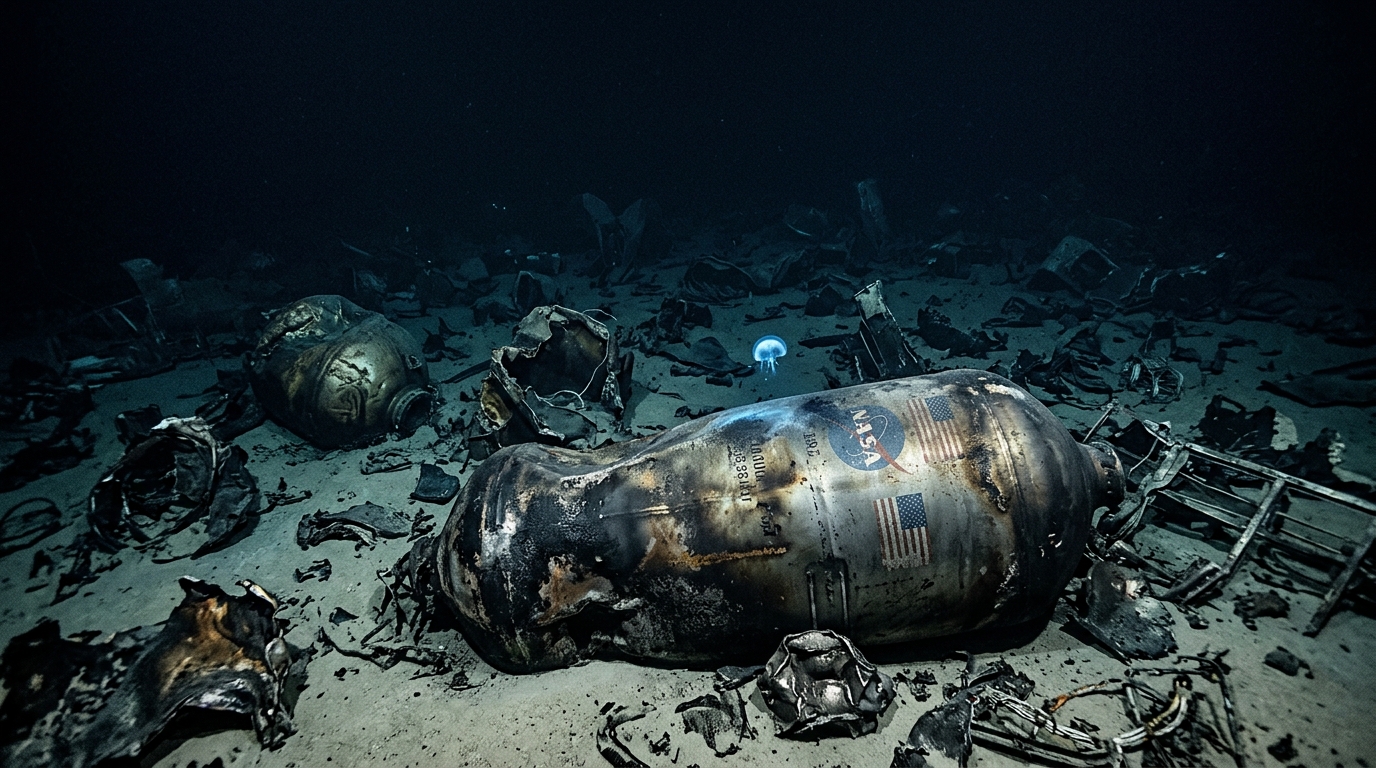
People often imagine that an deorbited satellite crashes in a precise spot, as if a space agency could target a point with the accuracy of a dartboard. Yet that idea is a misconception: nobody knows exactly where debris will fall before it breaks apart in the atmosphere. And it is precisely this uncertainty that, decades ago, pushed engineers to find the emptiest place on Earth to send their wrecks. This place does exist, it bears a name that sounds like it’s straight out of a Jules Verne novel, and today it houses more than two hundred space hulks that no one will ever recover.
- The Point Nemo, located 2,700 km from any land in the Southern Pacific, is the planet’s most isolated place and has served as a space cemetery since 1971.
- More than 263 spacecraft, predominantly Russian, have been dumped there between 1971 and 2016, with the Mir station as the most emblematic wreck.
- The ISS, weighing about 400 tonnes, is set to join this cemetery around 2031, a landmark operation in its sheer scale.
- The planet’s most isolated point exists for a precise reason
- Why space agencies send their wrecks here rather than elsewhere
- What the seabed at Point Nemo really hides
- A cemetery that will soon host a resident weighing over 400 tonnes
The Most Isolated Point on the Planet Exists for a Specific Reason
In the vast expanse of the South Pacific, at precise coordinates of 48° 25,6′ south latitude and 123° 23,6′ west longitude, lies what geographers call the oceanic pole of inaccessibility. Better known as Point Nemo, this spot sits roughly 2,700 kilometers from the nearest land, making it mathematically the most isolated place on Earth. No island, no continent is within reasonable reach; the closest humans are sometimes, quite literally, the astronauts flying overhead in the International Space Station.
This is no coincidence that the name evokes Captain Nemo, the solitary hero of Jules Verne who fled civilization aboard his Nautilus. This stretch of water stands in stark contrast to human activity: no commercial sea route traverses it, no fishing vessel dares venture there, and the only signs of life nearby relate more to plankton than to humans. It is precisely this total absence of activity that attracted engineers, starting in the 1970s, to a place where they could discreetly vanish bulky objects.
Why Space Agencies Send Their Wrecks Here Rather Than Elsewhere
Since 1971, Point Nemo has served as an unofficial graveyard for end-of-life space equipment. Dead satellites, rocket stages, cargo ships, and even entire space stations have been deliberately dumped there, in a maneuver specialists call controlled reentry. The logic is simple: rather than allowing a multi-ton object to fall at random on inhabited areas, it is preferable to steer it toward the spot where the risk of injuring someone or damaging anything is virtually nil.
The record is impressive. Between 1971 and 2016, more than 263 spacecraft have thus descended into the depths of the South Pacific, not counting the countless smaller debris pieces that elude precise accounting. A distribution chart published by Popular Science offers a sense of where this space scrap comes from: Russia sent more than 190 satellites, the United States 52, Europe eight, and Japan six. It would not be an exaggeration to say that the majority of this graveyard bears a Russian accent, a direct legacy of decades of Soviet and then Russian space exploration.
What the Seabed of Point Nemo Really Conceals
Among all the wrecks now resting thousands of meters beneath the surface, only one stands as a genuine monument: the Mir station. Launched by the Russians in 1986, it was for fifteen years the symbol of ongoing human presence in orbit, before being deliberately destroyed and sent to join Point Nemo. Since then, it has lain alongside dozens of other hulks, forming a unique underwater landscape that blends spacefaring scrap with the abyssal biodiversity of the ocean.
But one must temper the image of a single pristine point where everything falls neatly. In reality, the actual impact zone is far broader than a single point on a map. When an object enters the atmosphere at very high speed, it fragments, or even explodes under the force of friction and heat. Heavier pieces fall quickly, while lighter ones drift on the winds before sometimes crashing hundreds of kilometers away from the intended target. Result: even in a so-called controlled reentry, debris can spread over a stretch of 1,000 to 1,500 kilometers in length. That is why space agencies demarcate a surface area far larger than strictly necessary to ensure that all fragments land within the chosen perimeter.
Not everything goes according to plan, though. The Chinese station Tiangong-1 is the most striking example: after it ceased operating in March 2016, it remained in orbit for two years in an uncontrolled state before disintegrating mid-flight over the Pacific, with no one able to predict precisely where it would fall. A useful reminder that even the most advanced technology cannot guarantee absolute precision in the face of atmospheric physics.
A Cemetery That Will Soon Welcome a Tenant of More Than 400 Tonnes
The next major event anticipated at Point Nemo concerns a name familiar to the general public: the International Space Station. After more than thirty years of service, the ISS is destined to end its career in the same way as Mir did, plunging toward the globe’s most remote waters. Long discussed for 2024, the date of this deorbit has since been pushed back, with the latest estimates now favoring 2031. A schedule that could still shift, given how valuable the station’s scientific work remains to international research.
When that moment comes, it will be an unprecedented technical challenge in terms of scale: with around 400 tonnes of metal structures, solar panels, and habitable modules, the ISS will be by far the largest object ever sent to join the Pacific cemetery. The operation will require meticulous preparation, given the substantial safety implications surrounding an object of this size.
As autumn begins and attention shifts toward forthcoming space missions and launches, it is almost vertigo-inducing to consider that a place so far from the rest of the world already quietly holds a full chapter in the history of space exploration. Between Mir, the Russian debris, American, European, and Japanese remnants, and soon the ISS itself, Point Nemo continues to quietly write, kilometer by kilometer of depth, the little-known story of our celestial ambitions. One question, however, remains: for how long will this place stay so empty that it can keep playing this distinctive role?
