
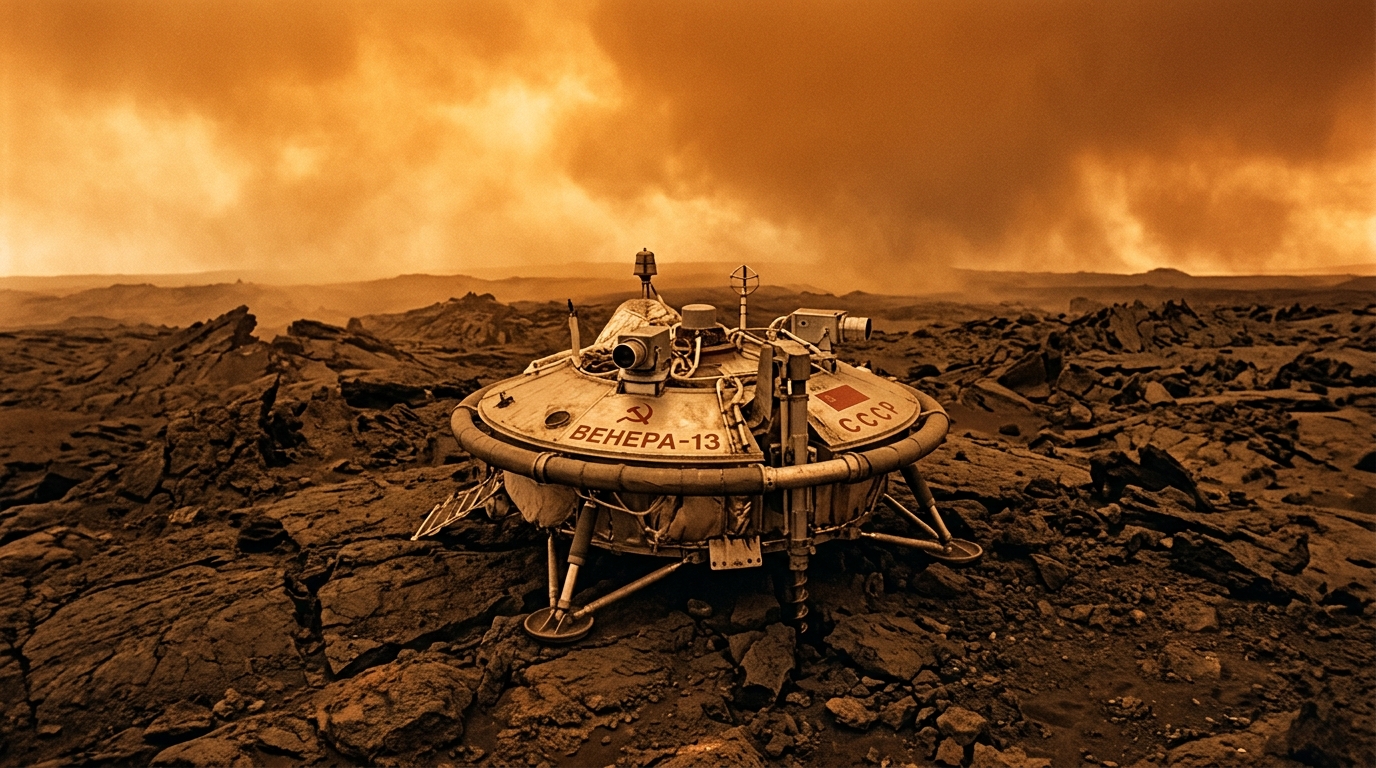
What if a Soviet machine had managed to last longer than a steak on a barbecue in the heat of mid-August, yet on a planet whose very air could melt lead? In 1982, the Soviet Union landed a device on Venus, the most hostile world in the Solar System, and what was supposed to last half an hour endured nearly two hours. A look back at a technical feat that remained incredibly discreet.
- In March 1982, the Soviet probe Venera 13 touched down on Venus, where surface temperatures reach around 457 degrees Celsius and atmospheric pressure is about 91 atmospheres.
- Designed to last 32 minutes, it operated for 127 minutes, enabling soil drilling, rock analysis, and the transmission of the first color photos of a planet’s surface.
- More than four decades later, no mission has equaled this longevity, nor has any lander returned to Venus since the Vega missions of 1985.
- Venus, the hell no one wanted to face
- Venera 13, the armored probe that defied the impossible
- 127 minutes that changed our view of Venus
- What Venera 13 left as a legacy for space exploration
Venus, the hell no one wanted to face
If Mars has long captured the public imagination with its ochre landscapes and promises of past life, Venus remains the great forgotten world of space exploration, and for good reason. Beneath its thick clouds of sulfuric acid lies an absolute hell, a planet where the surface temperature hovers around 457 degrees Celsius, hot enough to melt lead in moments. To this is added crushing atmospheric pressure, estimated at about 91 atmospheres, roughly equivalent to what a body would experience at nearly 900 meters beneath the ocean.
In this context, sending a probe to land on the surface is almost a suicide mission. Engineers knew that no conventional electronic hardware could withstand such extreme heat combined with such pressure. Yet this audacious bet was the one the Soviet Union decided to take, as part of its Venera program, a series of missions dedicated to exploring this neighboring planet, often eclipsed by its more media-friendly red cousin.
Venera 13, the armored probe that defied the impossible
It is within this climate of technical uncertainty that the probe Venera 13 begins its descent toward the surface of Venus in early March 1982, after a journey across interplanetary space lasting several months. The atmospheric crossing lasts about an hour, a period during which the craft must withstand violent winds, rising heat, and pressure that climbs inexorably as it nears the ground.
Designed as a true metal fortress, the probe carries an internal cooling system intended to slow the overheating of its electronics as much as possible. The Soviet engineers had anticipated only a theoretical 32-minute life on the surface before external heat would inevitably damage the onboard electronics. A window extremely tight, calculated to the last moment, since the conditions made any extension improbable.
127 minutes that changed our view of Venus
And yet, against all odds, Venera 13 continued to operate and transmit data for 127 minutes, almost four times the initial objective set by mission control. These two hours, small in human terms, represent a colossal achievement given the harsh environment in which the machine operated.
During that precious time, a mechanical arm drilled into the Venusian soil, collected a rock sample, and delivered it to a sealed chamber kept at a much cooler temperature to preserve the analysis instruments for as long as possible. An X-ray fluorescence spectrometer could then study the chemical composition of the soil before the exterior heat finally damaged the device. Venera 13 also transmitted the first color photographs ever taken from the surface of another planet, images revealing a landscape of flat, dark rocks bathed in a diffuse orange light.
Its twin lander, Venera 14, touched down four days later about 950 kilometers away, but managed to endure only 57 minutes before succumbing to the extreme conditions. As for the last image sent by Venera 13, it remained incomplete, the scan line abruptly breaking off in the middle of transmission, like a final breath captured just before the device finally shut down.
What Venera 13 left as a legacy for space exploration
More than forty years after this feat, no other mission has matched, let alone approached, the longevity of Venera 13 on Venus’s surface. Since Vega 1 and Vega 2 in 1985, no craft has rested on the planet’s soil, and the Russian space program has never flown a direct successor to the Venera program. A silence spanning decades that speaks to the difficulty of the technical challenge posed by that planet.
Yet this achievement remains a definitive reference for anyone interested in extreme space engineering. It demonstrated that, with the technology of the era, it was possible to design machines capable of functioning, even briefly, in conditions once deemed completely incompatible with any form of electronics. Several international projects today consider the idea of returning to explore Venus’s surface, using materials and technologies far more advanced than those of 1982.
Ultimately, those 127 minutes wrested from a planet that literally crushes anything sent its way tell a story far beyond a simple technical record. They illustrate humanity’s ability to push the boundaries of the possible, even in one of the most hostile environments in our cosmic neighborhood. The question remains which space agency will dare, one day, to undertake the venture again and perhaps beat this decades-old record.
