
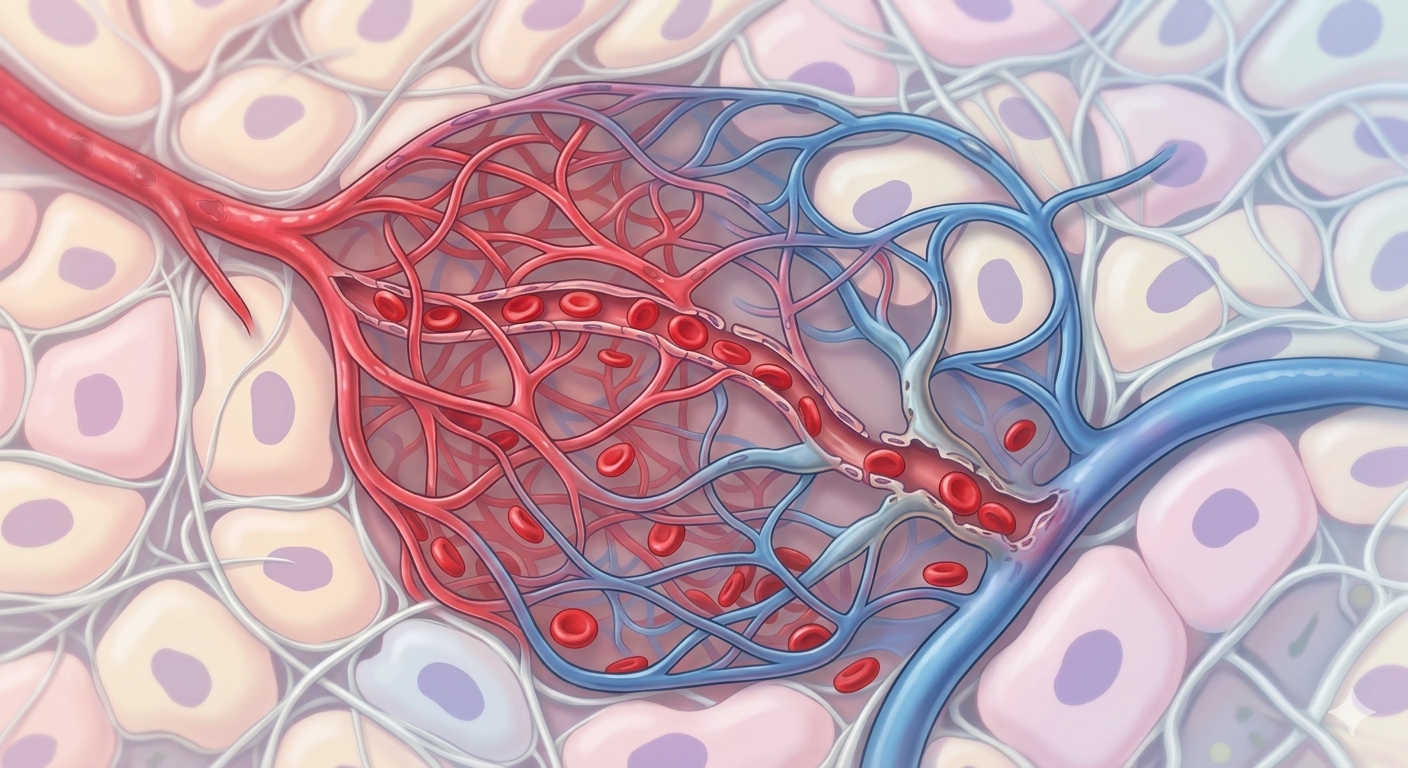
Representing the body’s finest and smallest vascular networks, capillary networks are essential for the exchange of gases, nutrients and waste. In the United States, researchers have developed a new 3D printing method to produce such networks. Beyond the technical feat, this approach aims to better meet the needs of organ transplantation in the long term.
3D printing capillary networks with diameters below 10 micrometers
As a reminder, the capillary networks form a microscopic interconnection zone between arterioles (from the arterial system) and the venules leading to the venous system. Their main function is to guarantee exchanges of oxygen and CO2, nutrients and waste between the blood and the cells of the body’s tissues. Moreover, these capillaries play a fundamental role in organ transplantation. Indeed, when an organ or tissue is transplanted, its survival depends entirely on the rapid restoration of blood circulation. It is therefore primarily a question of revascularization.
A team from the Department of Aerospace and Mechanical Engineering at the University of Notre Dame (USA) presented an intriguing innovation in the journal Nature Chemical Engineering in May 2026. The scientists introduced a new 3D printing technique allowing the fabrication of blood capillary networks with diameters under ten micrometers.
Until now, one of the major obstacles to creating artificial organs was vascularization. Without a functional capillary network, cells located at the core of a 3D-printed tissue die rapidly due to lack of oxygen and nutrients. However, the method developed by the American researchers could indeed address this persistent problem.
A technique integrating the use of AI
To overcome the limits of traditional techniques, the team combined biology, mechanical engineering, and artificial intelligence. Initially, the process uses extrusion printing to deposit a soft gelatinous matrix that mimics the architecture of natural tissues. Then, Aerosol Jet Printing (AJP) or aerosol jet printing continues the work, tracing microchannels with extreme finesse. In this approach, AI autonomously and in real time adjusts the flow rate of the biological ink and the shielding gas. It instantly discovers the perfect combination to achieve the required vessel diameter, and this without months of trials—and thus errors.
“Reproducing the hierarchical architectural complexity of natural vascular networks, particularly at capillary-scale resolution, remains a major challenge in organ fabrication.”, can be read in the study.
Towards relief for the global organ shortage?
This technique achieves micrometer-scale precision while maintaining cell viability above 90%. Thus, it brings medicine closer to the creation of fully functional whole organs intended for human transplantation. It holds very promising prospects for regenerative medicine as well as for tissue engineering and the discovery of new drugs.
Finally, the most intriguing aspect appears to be the potential to ease the world’s organ shortage. It should be noted that, at present, only about 10% of the world’s demand for transplants is met. In the United States alone, more than 100,000 people are on the waiting list, and each day, several patients die because they do not receive a graft in time.
