
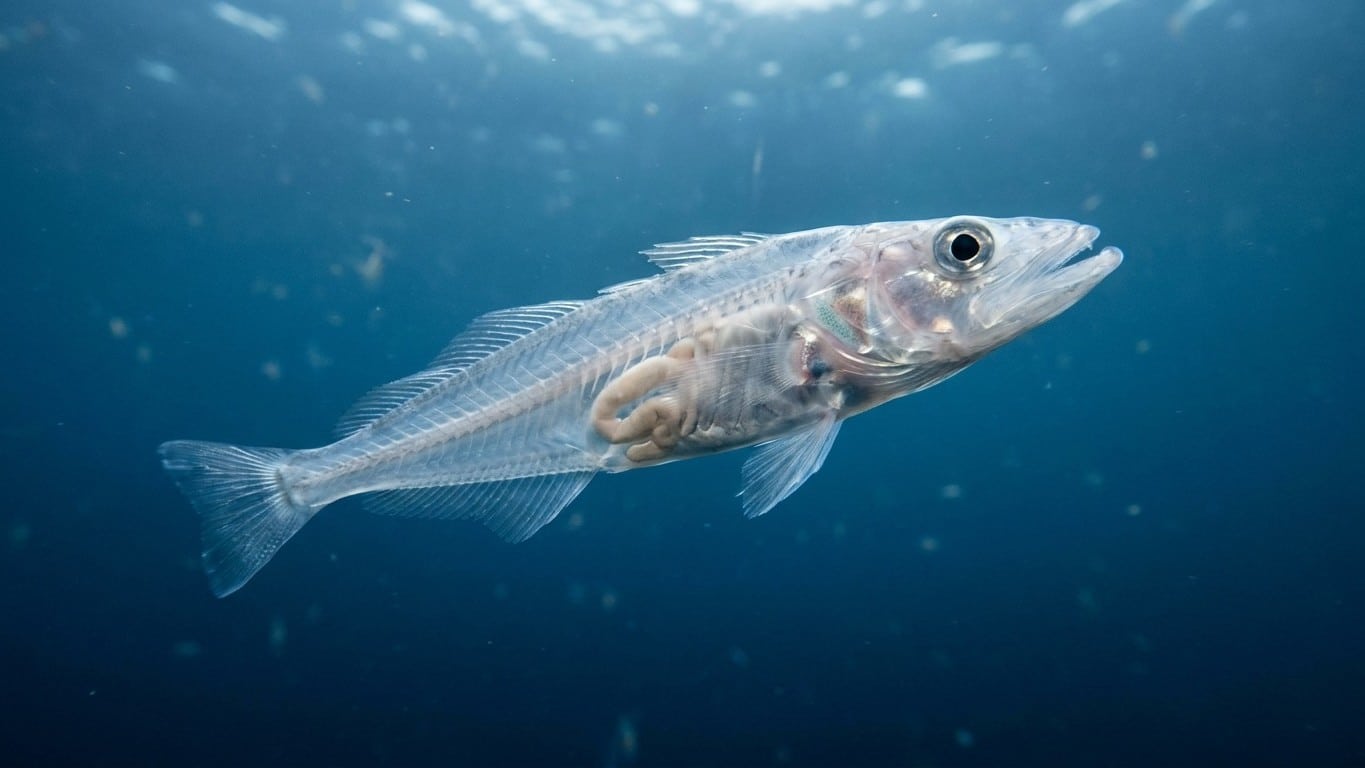
A fish can live without a single drop of red blood. This is the case for the Channichthyidae, a family of fishes from the Southern Ocean that, to date, constitutes the only vertebrates whose blood is colorless because it lacks hemoglobin, the protein responsible for transporting oxygen. Their plasma, almost transparent, resembles clear water more than the red, viscous liquid that circulates in our own veins. Long treated as an inexplicable curiosity, this complete absence of hemoglobin now has solid explanations thanks to genome sequencing conducted in recent years.
The blood of these fishes is not merely pale: it is colorless, with an opalescent appearance, due to the presence of proteins that help keep the blood functional in the icy waters of Antarctica. And the phenomenon does not stop at the blood. The muscles of these fishes do not contain myoglobin, the protein that would normally provide them with oxygen. The entire classic oxygen transport chain, the one found in any vertebrate—from sparrow to shark, including humans—has simply disappeared in these animals.
Key takeaways
- Antarctic fishes possess transparent blood with not a single molecule of hemoglobin — an adaptation that would seem impossible
- The extreme cold of the Southern Ocean creates the unique conditions that make this “fatal mutation” viable
- It may not be a deliberate evolutionary adaptation, but a fortunate accident preserved by a friendly environment
An anomaly spotted in the 1920s, understood only later
The story begins almost by accident. When the Norwegian biologist Ditlef Rustad collected his first specimens in 1928, he initially thought he had found an anomaly. Hard to blame him: opening a fish and discovering creamy gills rather than bright red challenges a few biological certainties. Scientists would later confirm, decade after decade, that this absence of hemoglobin was not an artifact of preparation or a disease, but a permanent feature of the entire family Channichthyidae, which groups perciform fishes found in the cold waters around Antarctica and the southern coast of South America, spread across eleven genera and fifteen species.
The question that occupied researchers for decades was straightforward to pose, far more complex to solve: how can a vertebrate survive, reproduce, and grow without the main oxygen transporter in the blood? A complete genome sequencing, carried out on the species Chionodraco myersi and compared with red-blooded Antarctic fishes, allowed reconstructing part of the scenario. Icefish display, in addition to the absence of hemoglobin, several striking peculiarities: large-diameter blood vessels, high vascular density, muscle cells rich in mitochondria, and an unusual mitochondrial architecture.
Why does oxygen still circulate in their veins
Without hemoglobin, there is no active transport of oxygen. These fishes thus rely entirely on physics. Oxygen is delivered to tissues simply by being dissolved in the blood plasma, somewhat like gas dissolved in a carbonated drink left in the fridge. And that is precisely where Antarctic cold becomes an ally rather than an obstacle: the frigid water holds much more dissolved oxygen than temperate water. At these extremely low temperatures, more oxygen dissolves in the water than at higher temperatures, partially offsetting the absence of a biological transporter.
However, this mechanism is not sufficient on its own. Icefish had to adjust their entire physiology around this constraint. Their blood flow and total blood volume are increased, ensuring the animal can respire. A relatively larger heart, wider arteries, blood that remains less viscous and circulates more quickly: everything is calibrated to compensate for the absence of the primary oxygen transporter in vertebrates. On top of this, these fishes have an abnormally low metabolism, which lowers their oxygen requirements. Fewer needs, greater flow: the equation eventually adds up.
A genetic accident that the cold made viable
The most surprising aspect may not be how these fishes compensate for the absence of hemoglobin, but how this absence came about. Comparative genomic analyses point to an almost counterintuitive explanation: the loss of hemoglobin genes resembles a lucky roll of the dice rather than a deliberately programmed adaptation. When biologists first encountered the pale blood of icefish in the 1950s, they initially assumed it was an adaptation to the cold. Later work suggested instead that the loss of the hemoglobin genes was the result of a fortunate accident: in most environments, this mutation would have been lethal. But because the Antarctic cold waters contain more dissolved oxygen than warmer waters, and because the icefish ancestors likely already possessed some cold-adapted traits, the fish survived.
This hypothesis echoes the idea proposed as early as the 1950s by the Norwegian biologist who first characterized the blood of these fishes. What would be deleterious in fish living at high temperatures can become neutral, or even non-lethal, at low temperatures. In short, the mutation that disabled the hemoglobin genes was not selected for its advantages: it simply happened to escape being punished by an environment unusually forgiving in oxygen. Once a surviving population was established, evolution then refined everything else—the enlarged heart, dilated vessels, reconfigured mitochondria—to transform a birth defect into a viable lifestyle for millions of years.
One unknown remains that worries biologists more than the fishes themselves: this adaptation rests entirely on cold water rich in dissolved oxygen. If warming of the Austral waters continues, the survival margin for these fishes—without a backup breathing plan—could melt away far faster than the ice.
Sources: media24.fr | aquabase.org
