
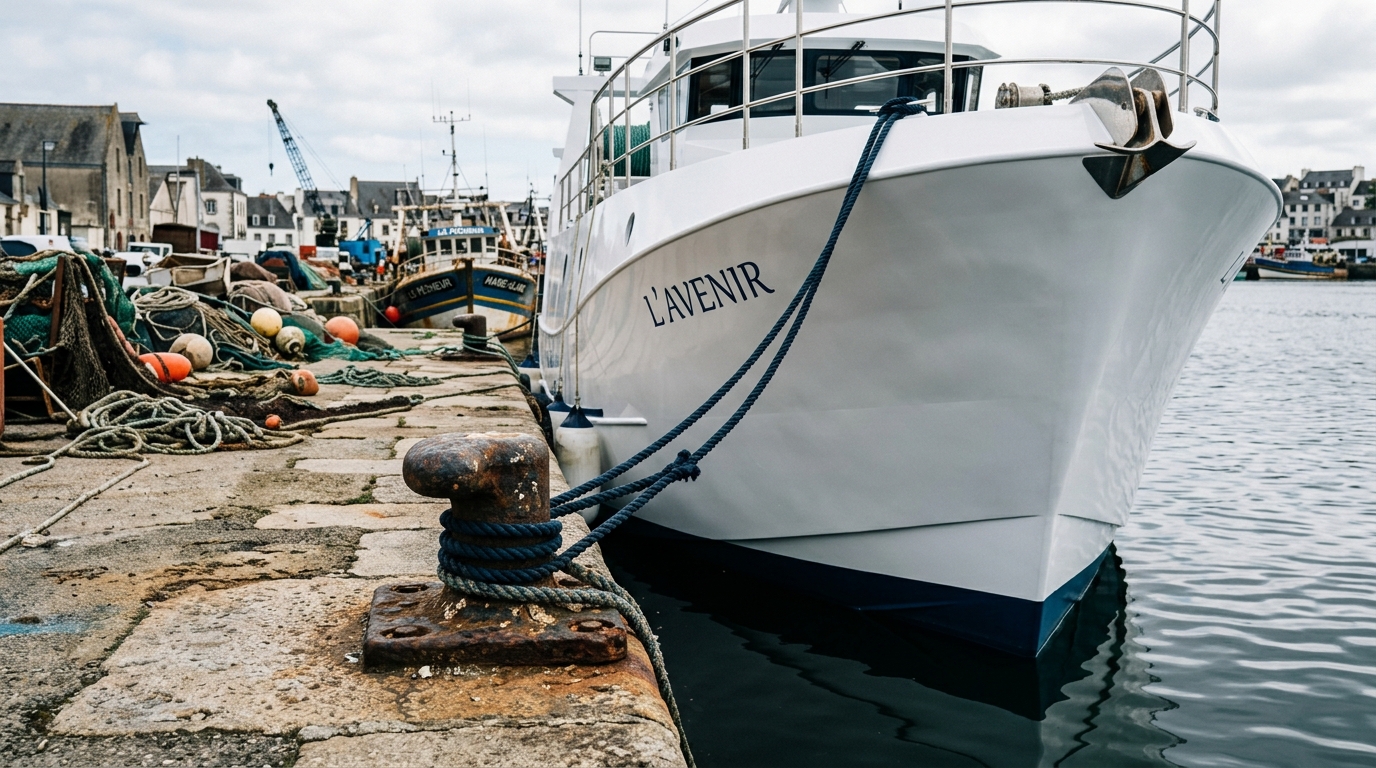
Breton, Norman, or Vendée quays where hulls still wear fresh paint and engines have never seen the sea: this is the unusual image the Court of Auditors sketches, between the lines, in its report on the European funding of French fishing. The amount at stake is dizzying, 588 million euros, a sum intended to modernize an entire sector, but which, according to the financial magistrates, has mainly exposed the yawning gaps of a system that spiraled out of control. How could a fund so generous yield such a paradoxical result, with gleamingly new boats kept in port? The answer rests in a few words, discreetly slipped into the report’s conclusions, but heavy with consequences for an entire profession.
- The European Maritime and Fisheries Fund (FEAMP) awarded investment aids without tying them to the issuing of fishing licenses and quotas, allowing shipowners to build before being authorized to operate their vessels.
- The Court of Auditors denounces monitoring procedures that were ill-suited to the budget’s growth (from 216 to 588 million euros), the main beneficiaries becoming public administrations and professional organizations rather than fishermen.
- The successor to FEAMP, FEAMPA, now states that no market failure justifies subsidizing the construction of new ships, the European fleet being judged globally profitable.
- When the subsidy precedes the authorization
- Brand-new trawlers, but forbidden to sail
- A control system remained blind
- What the Court of Auditors recommends for the future of French fishing
When the subsidy precedes the authorization
On paper, the mechanism seemed straightforward. The European Fund for Maritime Affairs and Fisheries, better known by its acronym FEAMP, was meant to assist professionals in modernizing their working tools by financing the construction or renovation of vessels. Yet the Court of Auditors highlights a major inconsistency: the allocation of investment aid has often been disconnected from the actual granting of fishing licenses and quotas, those precious credentials without which no vessel may legally go to sea.
Practically, shipowners received subsidies to build or upgrade their boats before even knowing whether they would obtain the necessary authorization to operate them. A backwards logic, where public money flowed faster than the administrative steps could keep pace, creating a gap with tangible consequences for fishermen themselves.
Des chalutiers flambant neufs, mais interdits de sortie
This is where the heart of the problem flagged by the financial magistrates becomes clear: a significant portion of the vessels subsidized by FEAMP simply never managed to operate, due to the absence of proper fishing authorization. According to estimates cited in the report, about 40% of boats built or renovated with these funds ended up immobilized, moored at the quay, even as their financing mobilized substantial sums drawn from European taxpayers’ money.
The paradox is particularly cruel for the professionals involved: possessing a modern, sometimes brand-new tool of the trade, yet unable to use it. For these shipowners, the investment becomes a financial burden rather than a source of revenue, since loan repayments continue regardless of the vessel’s activity. An even more absurd situation given that the report implies a risk of windfall effects: the urge to spend the budget envelope at all costs would have trumped the selectivity of the files.
Un système de contrôle resté aveugle
How could such a mismatch have slipped through the administrative cracks? The Court of Auditors points to a disproportionate complexity relative to the modest size of the fund, with validation circuits so cumbersome that they ultimately created substantial delays between grant awards and the ships’ actual operational readiness. The FEAMP budget nonetheless surged dramatically, rising from 216 to 588 million euros between the two most recent programmes, without monitoring procedures being adapted to this ramp-up.
As a result, the fund’s real impact was never satisfactorily measured. Worse still, the main beneficiaries turned out to be public administrations, local authorities, and professional organizations, rather than the fishing companies themselves. The fund thus finances fewer direct investments for fishermen, in favor of operating expenditures paid as annual quasi-subsidies, far from the original aim of modernizing the fleet.
This debate about subsidies for building ships remains particularly sensitive at the European level. A Breton Member of the European Parliament recently proposed reintroducing such subsidies, which had been banned since 2005 precisely because of their perceived distortive character. The proposal underscores that beyond the numbers, an entire economic doctrine is at stake: whether public money should fund the creation of new fishing capacity.
Ce que la Cour des comptes recommande pour l’avenir de la pêche française
In substance, the doctrine championed by major international institutions—whether the OECD, the World Bank, or European auditors—converges on the same finding: subsidizing the creation of new fishing capacity directly threatens the preservation of marine resources. An earlier confidential report, revealed by the press a few years ago, had already highlighted abusive use of subsidies and financial compensations, the result of years of short-sighted management in the sector.
Back in 2013, some experts had anticipated this kind of administrative bottleneck; a non-governmental organization estimated around 20,000 European boats, including about a thousand in France, could meet replacement criteria, at a maximum subsidy cost estimated at 1.6 billion euros. The replacement of FEAMP by its successor, FEAMPA, now officially restates a simple but fundamental principle: there is no market failure justifying public aid for the construction of new ships, the European fleet being broadly profitable overall. In short, there should be no reason to fund, with taxpayers’ money, vessels aimed at private profit.
What remains to be seen is whether this new doctrine will be enough to avoid past pitfalls. Between the need to modernize a aging fleet and the imperative to preserve already fragile marine resources, French fishing seems condemned to sail between two waters. One thing is certain: future vessels funded with public money will have to obtain their fishing authorization before leaving the shipyard, and not afterward.
