
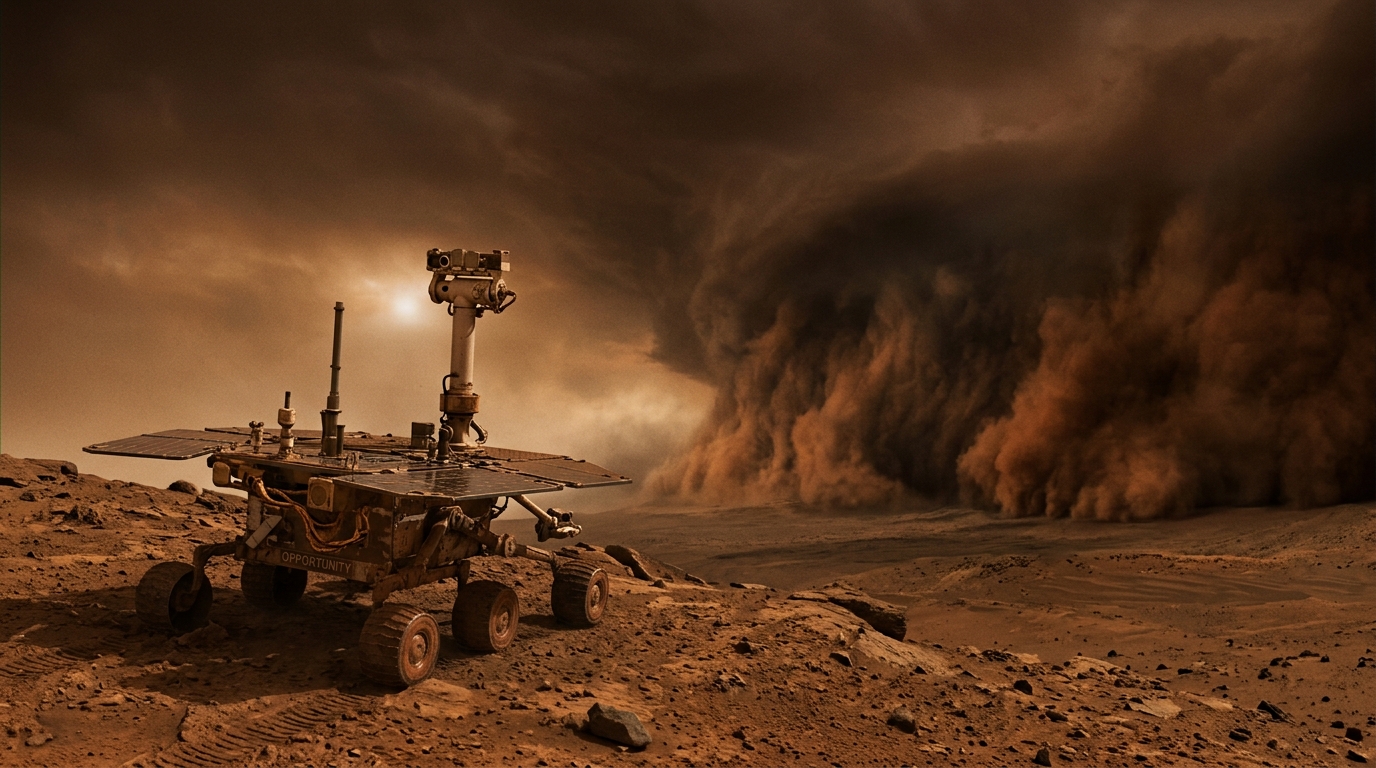
Somewhere on a dusty plain named Perseverance Valley, a 185-kilogram machine still awaits a signal that will never come. Motionless for years, this robot had, however, covered a distance equivalent to a full marathon on terrain not our own, before sinking into a silence that even its creator, NASA, never managed to break. How could a mere dust storm erase more than a decade of exploration? The story of this Martian shipwreck deserves attention, for it blends technological prowess with vulnerability in the face of a hostile planet’s whims.
- The Opportunity rover, designed for a 90-day mission, operated for more than 14 years on Mars and logged over 45 kilometers before a global dust storm, which appeared in late May 2018, plunged its site into darkness and blanked its solar panels.
- Despite over a thousand commands sent between the summer of 2018 and early 2019, NASA received no response and officially declared the mission over on February 13, 2019.
- Unlike Curiosity, which is powered by a plutonium-based radioisotope generator that is weather-independent, Opportunity relied entirely on its solar panels, making it vulnerable to light shortages and extreme cold.
- A 185-kilogram robot fell silent on Mars without ever waking up
- A dust storm swallowed half a planet
- Months of radio silence and a hope that refuses to die
- Why the Sun never managed to revive its solar panels
- Fifteen years of exploration closed by a chilling final message
A 185-kilogram robot fell silent on Mars without ever waking up
Its name was Opportunity, and it stood among those machines that, when least expected, end up inspiring admiration well beyond their initial mission. Designed to roam the Martian surface for only 90 days, this six-wheeled little rover remained active for more than 14 years, an achievement that no one, not even its creators, had dared to imagine. During all those years, it dug, photographed, analyzed rocks, and above all, it rolled: more than 45 kilometers on the odometer, a record for distance traveled off Earth at the time.
But every epic has an end, and Opportunity’s came in a matter of weeks, in the heart of 2018. A final message, transmitted on the June 10, marked the start of a silence that would become definitive. What makes this story so striking is not merely the mission’s duration, but the way it ended: abruptly, without warning, as if the red planet had decided to reclaim what it had lent.
A dust storm swallowed half a planet
To understand what sealed the rover’s fate, one must look at a Mars-specific phenomenon large enough to be called a global storm. Appearing in late May 2018, this atmospheric disturbance grew to cover almost the entire Martian surface. We often imagine sandstorms as localized and temporary events, but this one had nothing in common with what we know on Earth.
The layer of dust suspended in the Martian atmosphere plunged Opportunity’s site into near-total darkness, for several consecutive weeks. The sky, normally tinged with a bright beige, darkened to resemble permanent night in broad daylight. For a robot whose very existence depended on sunlight, this situation represented more than a setback: it was an existential threat.
Months of radio silence and a hope that refuses to die
Once the last signal was received, the NASA teams did not throw in the towel. Between the summer of 2018 and the start of the following year, they multiplied attempts to reconnect, sending more than a thousand commands to the silent rover, hoping each time for at least a sign of life. This perseverance, almost touching, testified to the particular attachment engineers had developed for this machine that had exceeded all expectations.
But month after month, the silence persisted, stubborn and definitive. The scientific community kept hoping for a jolt, a belated response that would reward this obstinacy. Nothing of the sort happened. It was finally on February 13, 2019 that NASA officially declared the mission over, after exhausting all avenues of contact. A long and painful farewell, commensurate with the attachment sparked by this indestructible little robot.
Why the Sun never managed to revive its solar panels
To fully grasp Opportunity’s fragility in the face of this storm, one must recall a fundamental difference with its sturdier cousin, Curiosity. The latter runs on a plutonium-powered radioisotope generator, an autonomous energy source that is unaffected by weather. Opportunity, by contrast, relied entirely on its solar panels to recharge its batteries, a logical technical choice at the time of its design, but one that would prove to be its Achilles’ heel.
With a layer of dust so thick that it nearly blocked sunlight entirely, the rover simply could not recharge its batteries for an extended period. Without enough electricity, it could not keep the internal heating of its electronic components running, essential for surviving the cold Martian nights, when temperatures plunge well below zero. This deadly combination—prolonged darkness and extreme cold—likely took its toll on its electronics, condemning it in silence, far from any human gaze.
Fifteen years of exploration closed by a chilling final message
Looking back at what Opportunity accomplished, one better appreciates the scale of the loss that such a sudden end represents. A robot designed for three months of activity ended up exploring Mars for nearly fifteen years, traversing landscapes humanity had never seen so up close. Its last transmitted message, often poignantly summarized by NASA teams, still resonates as the record of a machine aware of its own fragility in the face of growing darkness.
The episode deeply marked the space community, reigniting debates about the energy sources for future long-duration Martian missions. Should one favor the simplicity and lower cost of solar panels, even if it exposes such a risk, or should one systematically opt for nuclear generators—more reliable but costlier and more complex to implement? Opportunity’s disappearance provided a concrete answer to this theoretical question, starkly illustrating the limits of complete dependence on the Sun.
From this Martian adventure, what remains above all is the image of a tenacious robot, capable of defying all initial forecasts before fading in the face of a natural phenomenon of unprecedented scale. Between technical triumph and vulnerability to the elements, Opportunity’s story beautifully illustrates the challenges humanity will still have to overcome to explore other worlds sustainably. And what if the next generation of rovers could, this time, resist Mars’s fiercest storms?
