
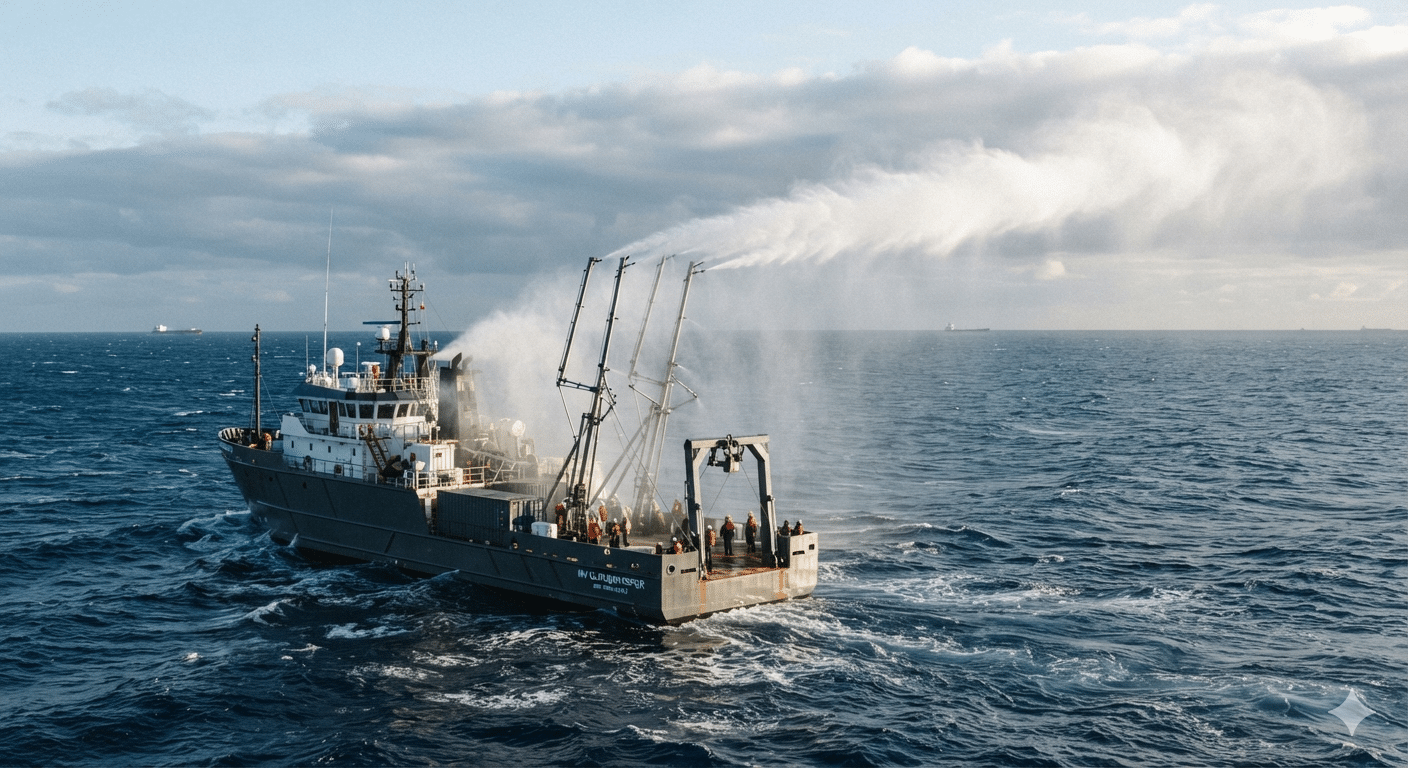
Amid the many concerns, a very intense El Niño episode is currently forming in the Pacific Ocean. Meanwhile, an American scientist believes she can mitigate the impacts of future episodes by spraying seawater into clouds. What exactly does this geoengineering technique involve?
An upcoming high‑intensity El Niño
In June 2026, the U.S. National Oceanic and Atmospheric Administration (NOAA) and the World Meteorological Organization (WMO) confirmed the arrival of a new El Niño cycle. Its development in the equatorial Pacific is underway, following a notable rise in sea surface temperatures. According to experts, there is a 63% chance that this episode will be “very strong”, potentially one of the most powerful on record.
It should be recalled that with each appearance, the El Niño phenomenon significantly disrupts global atmospheric circulation, triggering major climate anomalies worldwide. Primarily, it is associated with a temporary rise in global temperatures alongside an inversion of rainfall and drought patterns.
A geoengineering solution to curb the effects
As the current El Niño episode is poised to be exceptionally intense, climatologist Jessica Wan of the University of California (United States) has explored a strategy to lessen the impacts of such a phenomenon. As reported in a paper published in Science Advances on July 8, 2026, the approach is a targeted and temporary geoengineering method: marine cloud brightening—see the schematic below.
The marine cloud brightening process involves deploying ships equipped with nozzles to spray fine droplets of seawater into the lower atmosphere, just beneath the stratocumulus clouds over the maritime zone. After spraying, the water evaporates, leaving tiny seawater salt crystals around which humidity condenses. This causes the clouds to become denser and whiter, making them more reflective, like mirrors that redirect a larger portion of solar radiation back into space.
Jessica Wan and her team based their work on climate model simulations of two historic mega-El Niños (1997–1998 and 2015–2016). According to the researchers, applying marine cloud brightening to 7% of the surface of the southeastern Pacific Ocean should lead to a cooling of the water temperature. The cooling would thus be sufficient to disrupt the self-reinforcing feedback loop that fuels El Niño.
Crucial timing and the absence of zero risk
For the study’s authors, timing is critical. Marine cloud brightening could be highly effective if initiated in June—during the growth phase of El Niño—and continued through at least February of the following year. In this favorable scenario, the sea-surface temperature in the targeted Pacific region would fall by 1.88 °C. This drop would be substantial enough to offset most of the global weather anomalies associated with the phenomenon. Wan also noted that unlike grand-scale geoengineering projects that require decades of sustained application, marine cloud brightening can be turned on and off with each cycle.
Nevertheless, there is no such thing as zero risk. Some missteps are possible, notably a potential abrupt shift toward La Niña (the cooling phase) that could worsen drought and famine in vulnerable regions such as the Horn of Africa. There is also the possibility that altering major oceanic heat currents could disrupt global weather in unpredictable ways, potentially triggering heatwaves in Europe and Asia.
