
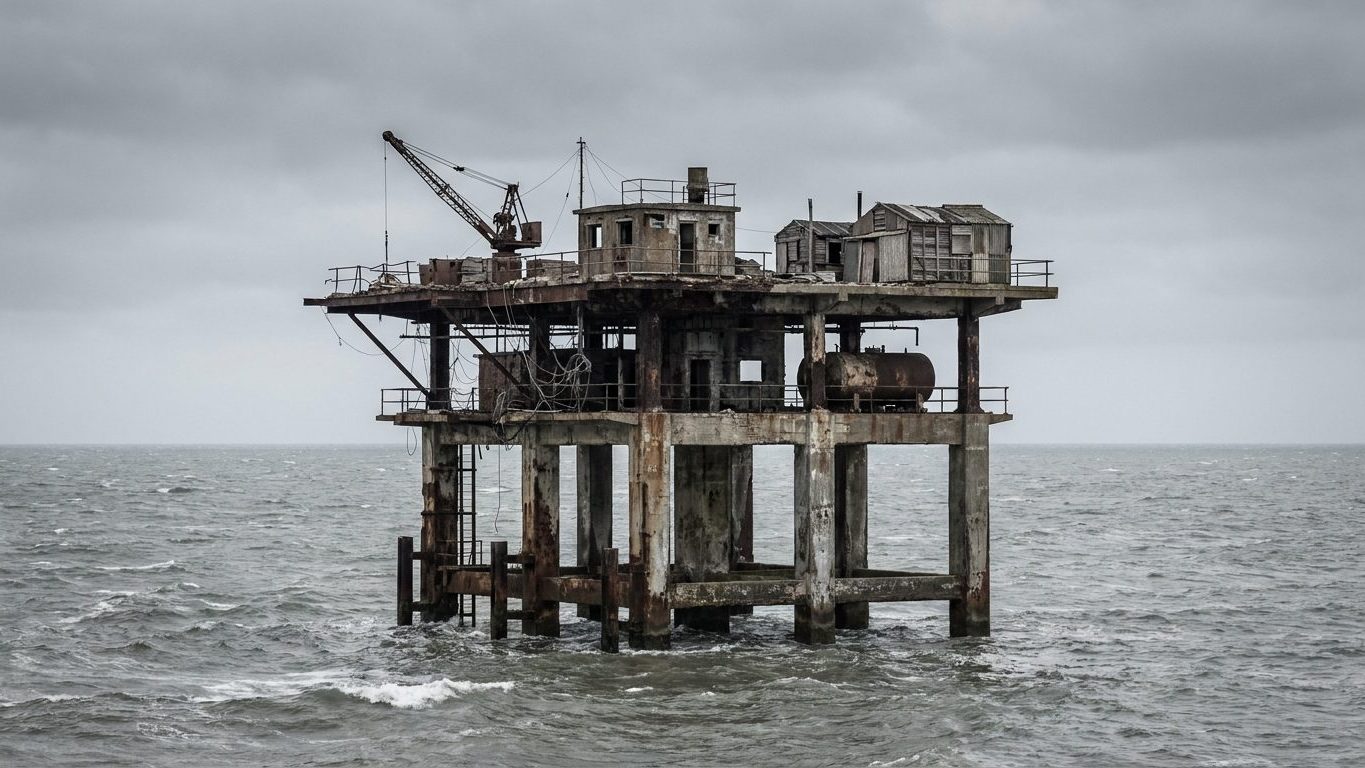
Taking possession of a rusty military platform planted in the middle of the North Sea, a former British Army major literally founded a state. The micronation equipped itself with a currency, a flag, a national anthem, stamps, a coat of arms, and a Constitution, up to a princess’s crown gifted to his wife for her birthday. Since then, no country in the world has ever officially recognized this micronation, which nevertheless continues to exist off the coast of England.
Its name: The Principality of Sealand.
- A World War II anti-aircraft platform became in 1967 the Principality of Sealand, founded by Roy Bates and his family.
- The 1968 judgment acknowledged the absence of British jurisdiction on the site, interpreted as de facto recognition of sovereignty.
- No state in the world has ever officially recognized Sealand despite its Constitution, flag, stamps and passports.
- A coup in 1978 led to the capture of prisoners, including a German lawyer released for a ransom of 75,000 marks.
From an anti-aircraft fort to an improvised kingdom
Built during World War II as one of the steel-and-concrete installations designed to house anti-aircraft guns, the Roughs Tower fort was later abandoned by the British Ministry of Defence once the conflict ended. On December 25, 1966, Roy Bates, a former British Army major and pirate radio operator, landed there with his fishing boat and a few friends to take possession. The structure then lay beyond the reach of the country’s laws, since British territorial waters at the time extended only about six kilometers from the coast. On September 2, 1967, the couple formally proclaimed the independence of the principality, under the name Sealand.
He settled with his wife, their sixteen-year-old daughter and fourteen-year-old son in the former military quarters perched on the concrete pillars. The principality adopted English as its official language and established a Constitution with libertarian rules.
The judgment that sealed the situation
The following year, Roy Bates’s son was pursued for shooting at British agents who came close to the platform. The Chelmsford Crown Court in Essex ruled on November 25, 1968: the incident had occurred outside British territorial waters, so the court held that it had no jurisdiction. Bates interpreted this lack of jurisdiction as a de facto recognition of Sealand’s sovereignty.
Yet no judge has ever recognized Sealand as a state.
What it takes to become a state
In international law, a recognized state must have a stable population, a defined territory, an effective government, and the capacity to engage in relations with other states. Even if these criteria are met on paper, one must still obtain recognition from other nations, which Sealand never did. Its status as a mere artificial island places it outside the UN Convention on the Law of the Sea’s definition of an island, which reserves such structures for sovereign states. Courts have also criticized the actual capacities of the Sealand government to provide for its residents.
The 1968 judgment did not settle the sovereignty question: it merely noted that a British court lacked jurisdiction over acts committed outside its territorial waters. In 1990, during an American administrative proceeding, the British government argued that no independent “Principality of Sealand” had ever existed.
Coup d’État, hostages and online auctions
In 1978, while Roy Bates was away, the self-styled “Prime Minister” of Sealand, Alexander Achenbach, organized an armed takeover of the platform with German and Dutch nationals, taking Bates’s son hostage before releasing him in the Netherlands a few days later. Bates responded by hiring armed men and retaking the fortress in a helicopter assault, thereafter detaining the attackers as “prisoners of war.” Gernot Pütz, a German lawyer with a Sealand passport, was accused of treason and held until a ransom of 75,000 marks, equal to more than £18,000 at the time.
Germany had to negotiate his release with London.
When the extension of Britain’s territorial waters to twelve nautical miles came into force in 1987, Roy Bates had claimed his own twelve-mile zone just a month earlier, so Sealand ended up inside its own waters rather than being absorbed by the United Kingdom. Twenty years later, when the platform was put up for sale, the file-sharing site The Pirate Bay raised nearly $2 million through crowdfunding in an attempt to acquire it. But Michael Bates ultimately refused to sell the territory to a buyer who would not respect international law.
Source: citizenpost.fr
