
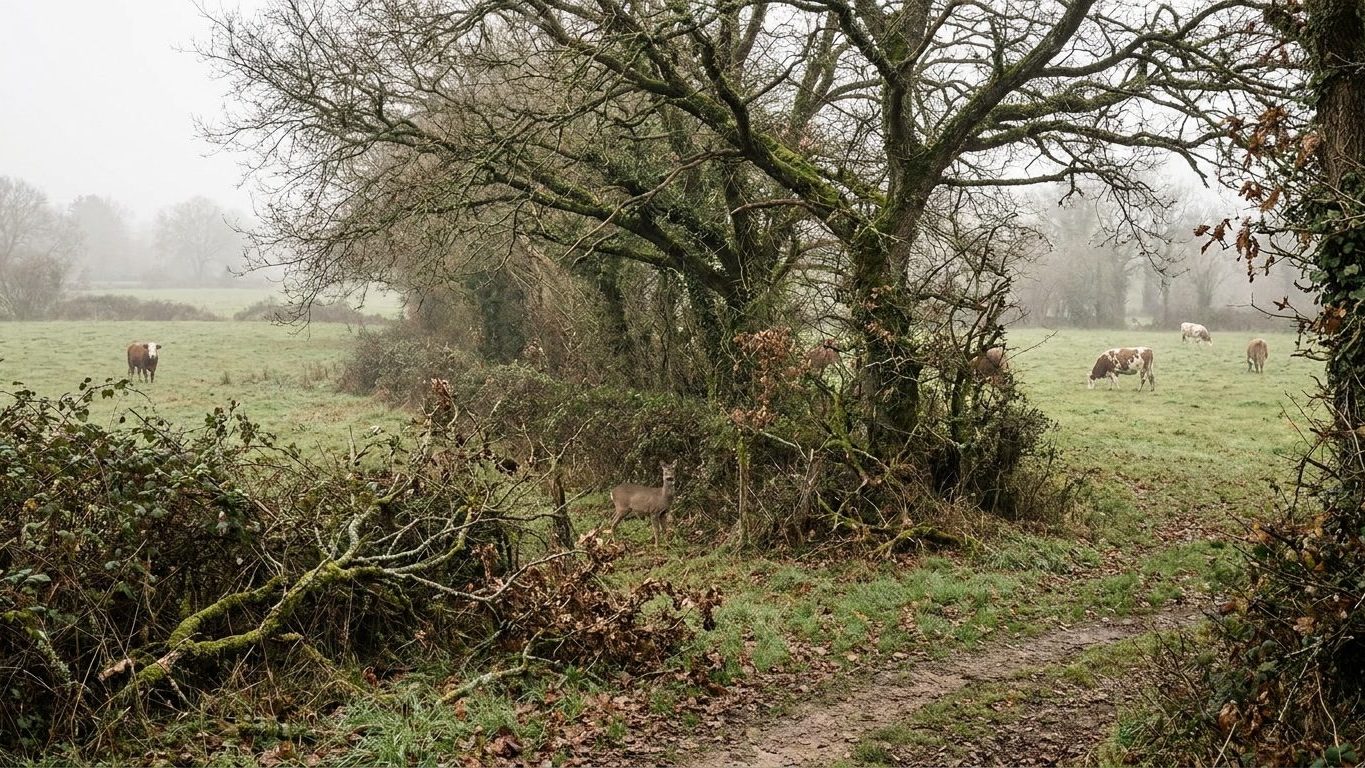
The bocage has lain there for more than half a century, about twenty kilometers north of Nantes. 1,650 hectares of fields, hedgerows, and damp meadows, frozen by a declaration of public utility signed in 2008 for an airport project drawn up as early as 1963. A portion of these lands, precisely 1,225 hectares, had already been placed under administrative supervision in 1974, via a deferred development zone. Surveyors had then planted their stakes in the fields of Notre-Dame-des-Landes. No runway was ever poured.
- The Notre-Dame-des-Landes bocage remained frozen for 55 years by an airport project that was never realized.
- Surveyors laid down the project’s markers beginning in 1974 on 1,225 hectares placed in a deferred development zone.
- The project’s abandonment in 2018 revealed a preserved ecosystem: 98% wetlands and 146 protected species.
A project conceived in 1963, never completed
The dossier traces back to the 1960s, a period when the state imagined equipping western France with infrastructure commensurate with its economic dynamism. The Grand Ouest airport project was born in administrative files as early as 1963. It would take forty-five years for it to reach the decisive step of a public utility declaration, signed in 2008.
In the meantime, as early as 1974, a deferred development zone of 1,225 hectares was created around the candidate site. This legal status gave the local authority a preemption right over the agricultural lands involved. This marked the first concrete act of a project that would remain, for decades, only in the realm of administrative promises.
The surveyors’ passage, an imprint left without follow-up
On the ground, things progressed. Surveyors walked the plots, planted their stakes in the fields, and drew on paper the route of an airport intended to replace Nantes-Atlantique. The bocage itself continued to live to the rhythm of the agricultural seasons, unaware that it already bore, beneath its hedges, the markers of a project of national scale.
The 2008 declaration of public utility consolidated this legal freeze over the entire 1,650 hectares. This administrative document forbids any construction or free sale within the designated perimeter. The bocage thus found itself pinned in an in-between: neither an airport nor full agricultural freedom.
The abandonment on January 17, 2018
The ax fell on January 17, 2018. The government announced the definitive abandonment of the project, fifty-five years after its initial conception in 1963. A decision that ended one of the longest planning conflicts in recent French history, yet did not alter the ground reality.
The lands remained agricultural throughout this period. No runway was ever laid on the 1,650 hectares. Eight years after the project’s official abandonment, Notre-Dame-des-Landes’s 1,650 hectares have returned to fields, with wetlands and bocage, where cows, beehives, and a few dozen farms—home to long-established farmers and former occupants of the zone—now coexist.
This prolonged administrative freeze produced an unexpected effect. 98% of the former ZAD area consists of wetlands and harbors 146 protected species. By blocking urbanization and agricultural intensification for decades, the abandoned project paradoxically helped preserve a bocage that has become rare elsewhere in France.
Land redistributed afterward
The question of land ownership occupied local authorities well after the project’s abandonment. The Loire-Atlantique department, which had gradually acquired these parcels from 1974 before transferring them to the State in 2012, later negotiated their retrocession. Elected officials of the Loire-Atlantique departmental council approved the transfer of 895 hectares from the State to the department, opening the way to new agricultural projects.
The Notre-Dame-des-Landes bocage remains today a case study for anyone interested in land-use planning. A project conceived during a period of economic expansion in the 1960s, surveyors’ stakes planted in the 1970s, an administrative endorsement in 2008, and then nothing more. The cows still graze there, the hedgerows still grow, and the silence of the never-built runways continues to weigh on this corner of the Nantes countryside.
Sources: francebleu.fr | europe1.fr
