
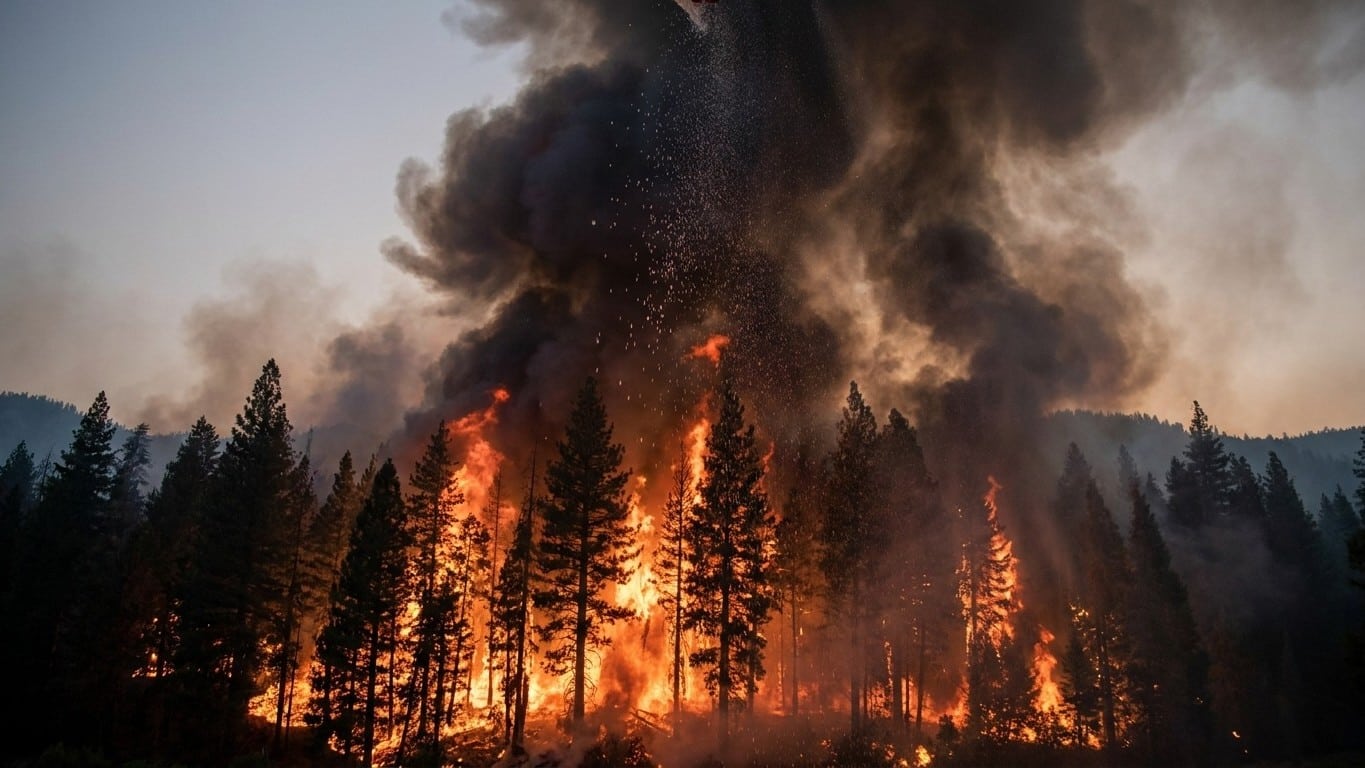
A wall of flames several meters high, smoke visible from Bordeaux, and residents fleeing in the middle of the night with their suitcases thrown into the back of their car. Between Saumos and Le Porge, in the Médoc of Gironde, a fire sparked on Wednesday, July 22 at noon devoured more than 2,400 hectares in a little over a day. A blaze of astonishing speed, which forced authorities to evacuate about 12,000 people, while the flames continued to advance in Gironde, a figure that later climbed to nearly 20,000 people according to the latest situational updates from the prefecture. Notably: no injuries were reported, but a lone house was destroyed, according to the regional prefect and the Gironde prefecture.
Key takeaways
- A forest planted to dry the land 150 years ago has become a tinderbox
- The monoculture composition of maritime pine acts as the perfect fuel
- Two firefighters died in a previous blaze: danger cannot be measured by hectares alone
A Fire That Finds in the Maritime Pine Its Best Ally
Why does this forest burn with such ferocity? The answer lies in its very composition. The maritime pines that cover the Médoc do not form a natural and diverse forest, but a nearly monoculture plantation, dense and aligned, inherited from an industrial choice dating back more than 150 years. On the ground, firefighters even witnessed a true fire tornado forming during the Saumos blaze, a sign of intensity rarely observed. The fuel is everywhere: the pine resin, highly inflammable, oozes from the bark and feeds the flames as soon as they touch a trunk; on the soil, the thick litter of dry needles, accumulated year after year, acts as a continuous wick that propagates the fire even when the wind slackens. Add to that trees that rise to more than fifteen meters, forming a continuous canopy where the fire can “run” from crown to crown, and you get nearly perfect fuel. It is exactly this configuration that firefighters themselves described during the Mérignac drama a few days earlier, an intervention on a very violent forest fire in a densely pine forest more than 15 meters tall.
This forest is not the fruit of chance. It was shaped in the 19th century to transform a territory deemed unhealthy. In 1857, an imperial law imposed by Napoleon III aimed to drain and cultivate the Landes de Gascogne, a vast area then marshy and dune-like and considered unhealthy. Under the leadership of engineers like Nicolas Brémontier and Jules Chambrelent, the communes had to drain the marshes through a network of ditches and canals before planting maritime pine en masse, a species chosen for its rapid growth and profitability, notably through gemmage, the resin harvest that long fueled the region’s economic wealth. The result, a century and a half later: the largest artificial forest in Europe, beautiful to traverse in normal times, but transformed into a tinderbox as soon as drought sets in. A forest designed to dry the land is, by cruel irony, among the most vulnerable to fire on the continent.
La Gironde, un territoire qui n’a pas fini de payer l’addition de 2022
This new episode rekindles a memory still painful. The department had already been ravaged by immense fires during the summer of 2022, with tens of thousands of hectares burned at La Teste-de-Buch and in the Landiras forest. Same massif, same dominant species, same meteorological ingredients: scorching heat, vegetation dried out by months without significant rainfall, and a wind that refuses to cooperate. Even today, conditions are unfavorable; the wind is poorly oriented, summarized the prefect. The difference this time is speed: four years after the trauma of 2022, Gironde re-learns that the natural regeneration of pine after a fire, often denser and thus more inflammable in the early decades, can turn certain plots into zones of heightened risk rather than sanitized spaces.
Deux pompiers morts, un avant-goût funeste
The Saumos blaze is not an isolated incident on the Gironde calendar of July 2026. Two days earlier, on Tuesday July 21, another fire broke out near the Bordeaux-Mérignac airport, presenting a direct threat to airport infrastructure. Two professional firefighters lost their lives there, trapped in their truck as flames surrounded their vehicle. Interior Minister Laurent Nuñez confirmed the tragedy to the National Assembly, and the President offered condolences to the families and loved ones of the two firefighters who died. An investigation has been opened to understand how a fire that ultimately covered only about twenty hectares could cost two lives in a matter of minutes, proof that the danger of these pine fires cannot be measured solely by the area burned.
Une saison qui bat déjà tous les records
These two incidents in the Gironde fit into a worrying national trajectory. Since January 2026, France has recorded at least 44,000 hectares burned by flames, with 12,500 fire starts, a toll announced by the Interior Minister while visiting the Gironde. Following these announcements, 128 people were arrested nationwide for starting fires, reminding that nine out of ten fires originate from human activity, whether through negligence or malice. The mix is familiar to emergency services: repeated heat waves, deeply dried soils, winds that turn the slightest spark into a blaze within a few hours.
A question deserves to be asked of forest managers: should we continue replanting maritime pine in dense monoculture on scorched plots, or finally diversify the species to break the continuity of the fuel? After 2022 and the new flare-up in 2026, some Landes forest owners are beginning to experiment with fuel breaks and mixes of broadleaf species, without, however, challenging the economic model of the massif, which remains one of France’s leading basins for resinous wood production.
Sources: gendarmerie.interieur.gouv.fr | ici.fr
