
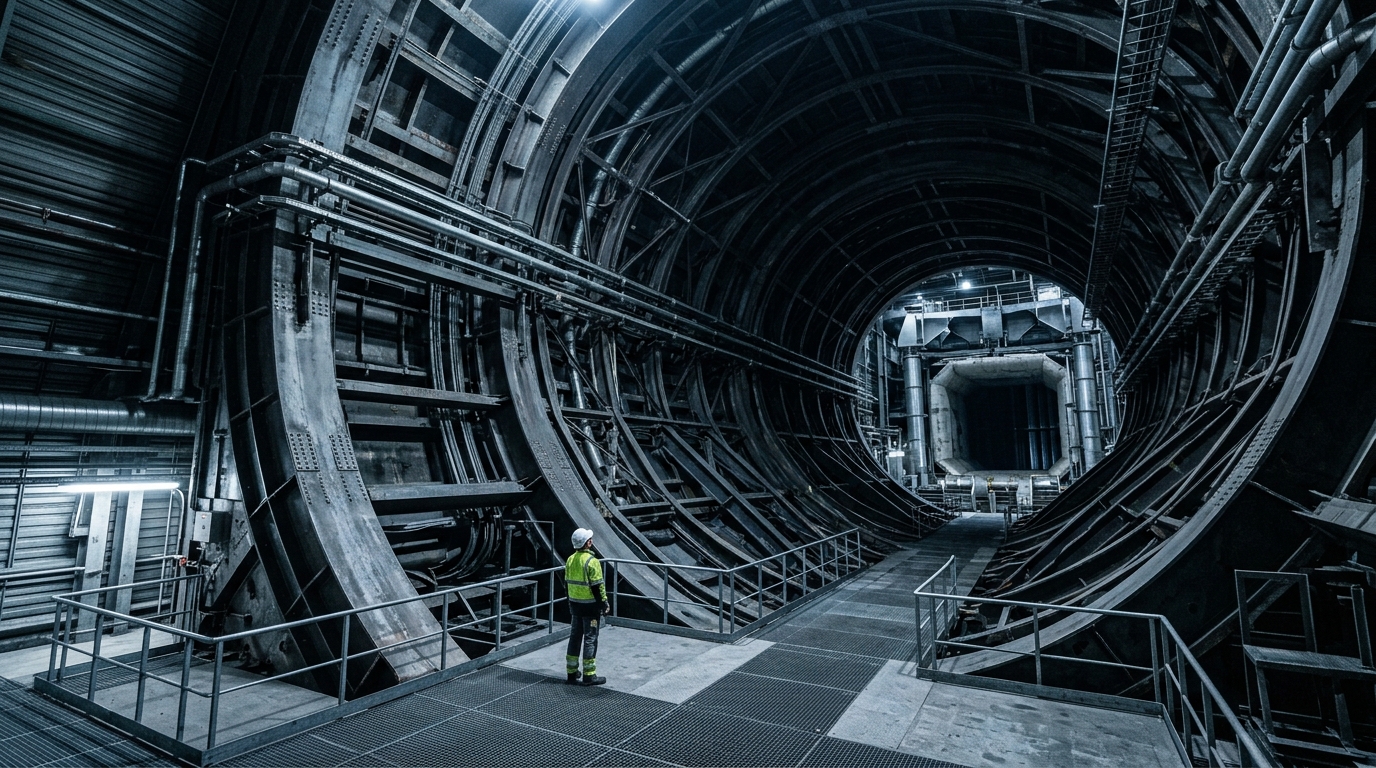
There is an essential difference between an industrial relic that one visits with nostalgia and a working tool, still capable of competing with the latest technologies. Most installations built in the immediate postwar era belong to the first category: they are admired, photographed, and filed away in industrial history books. The S1MA wind tunnel at Modane-Avrieux, in Savoie, belongs to the other camp. Born in a particularly turbulent context, this installation continues, more than seven decades after its commissioning, to turn engineers from the world’s leading aeronautical design offices. A paradox worth dwelling on.
- The S1MA wind tunnel, born from an unfinished German project recovered in 1945, features a test duct 8 meters in diameter, unmatched since its commissioning
- It is powered by two Pelton turbines via a forced water line dropping 800 meters in elevation, enabling Mach 0.8 in three minutes
- Concorde, the A380, the A400M, the Mirage and the Rafale have all been tested in this facility, whose ongoing operation required a 47-million-euro loan in 2024
- A mechanical monster buried under the mountain since the postwar era
- The raw power that no one has ever managed to surpass
- Why no one will ever build such a giant again
- From Concorde to modern rockets, the invisible footprint of an extraordinary machine
A mechanical monster buried under the mountain since the postwar era
The story of S1MA begins far from the French Alps, in the Austrian Tyrol, in the midst of war. It was there that Nazi Germany had begun constructing a transonic wind tunnel for its own aeronautical research. The project, left unfinished at Ötztal, fell into French hands in 1945, as the country reclaimed all available military and industrial equipment in the area. No fewer than 2,474 tonnes crossed the Alps: cement, mechanical parts, up to a diesel locomotive that would find a second life on the Savoy site.
Remarkably uncommon to note, the German designer of the project, Professor Heinrich Peters, accompanied the transfer and continued his work in France to complete the assembly. The urgency was such that the building went up before the construction authorization was obtained for this classified site, a hastiness that earned General Demanois a formal summons before the High Commission for Sites. An administrative anecdote that speaks volumes about the hurried nature of the era, but also about the strategic stakes this installation already represented.
The raw power that no one has ever managed to surpass
What first strikes about S1MA is its deliberately colossal scale. The test duct, the chamber where the models are subjected to the blast, measures 8 meters in diameter and 14 meters in length, all housed in a tunnel that stretches for nearly 400 meters through the mountain. Since its commissioning, no installation in the world has managed to equal this size for a sonic wind tunnel. A longevity record fairly rare in the industrial field, to be noted.
But the most surprising aspect remains the way this energy is produced. Lacking a sufficiently powerful electrical grid at the time of its design, the engineers chose an almost artisanal solution at the project scale: two Pelton turbines, fed by a forced water main dropping more than 800 meters in elevation from the alpine heights. This technical choice allows the wind tunnel to accelerate the air flow from zero to Mach 0.8 in just three minutes, an acceleration that remains impressive even by today’s standards.
Why no one will ever build such a giant again
Reproducing a similar installation today would almost be an incredible feat. Beyond the pharaonic cost that a project of this magnitude would entail, the very location of S1MA, anchored in a listed site in the heart of an Alpine valley, illustrates the constraints any equivalent project would have to face from its inception. The alluvial ground on which the edifice rests has recalled its fragility about a decade ago, when risks of collapse threatened the structure. A loan of 20 million euros granted by the Ministry of the Armed Forces in 2016 was required to undertake the necessary strengthening work.
The story does not end there. In 2024, ONERA signed a new loan, this time for 47 million euros, with the European Investment Bank, to sustainably ensure the longevity of this unique tool and all the wind tunnels on the Modane site. A sum that reminds, if a reminder was needed, that maintaining such an industrial monument costs almost as much as its original construction.
From Concorde to modern rockets, the invisible footprint of an extraordinary machine
The list of devices that have passed through the Modane tunnel reads like a pantheon of French and international aeronautics. Concorde, in its time, validated a portion of its supersonic performance there. More recently, the A380, A400M, as well as fighters like the Mirage and the Rafale, have all been subjected to this artificial blast capable of simulating extreme flight conditions. Each major aerospace program of the past decades bears, one way or another, the mark of this Savoyard valley.
As this season opens with the aerospace industry in France making multiple announcements about its future programs, it is hard not to view S1MA as a persistent symbol: postwar engineering still able to dialogue with cutting-edge technologies. It is not so much the age of the machine that impresses, but its capacity to stay relevant as everything around it has been renewed several times.
Between turbines drawing their energy from the mountain and aircraft models facing the sonic wall artificially, S1MA tells a story in which postwar ingenuity continues to converse with today’s technological challenges. A question runs through this entire narrative: how much longer can this Alpine giant remain indispensable, as the needs of aerospace evolve faster than ever?
