
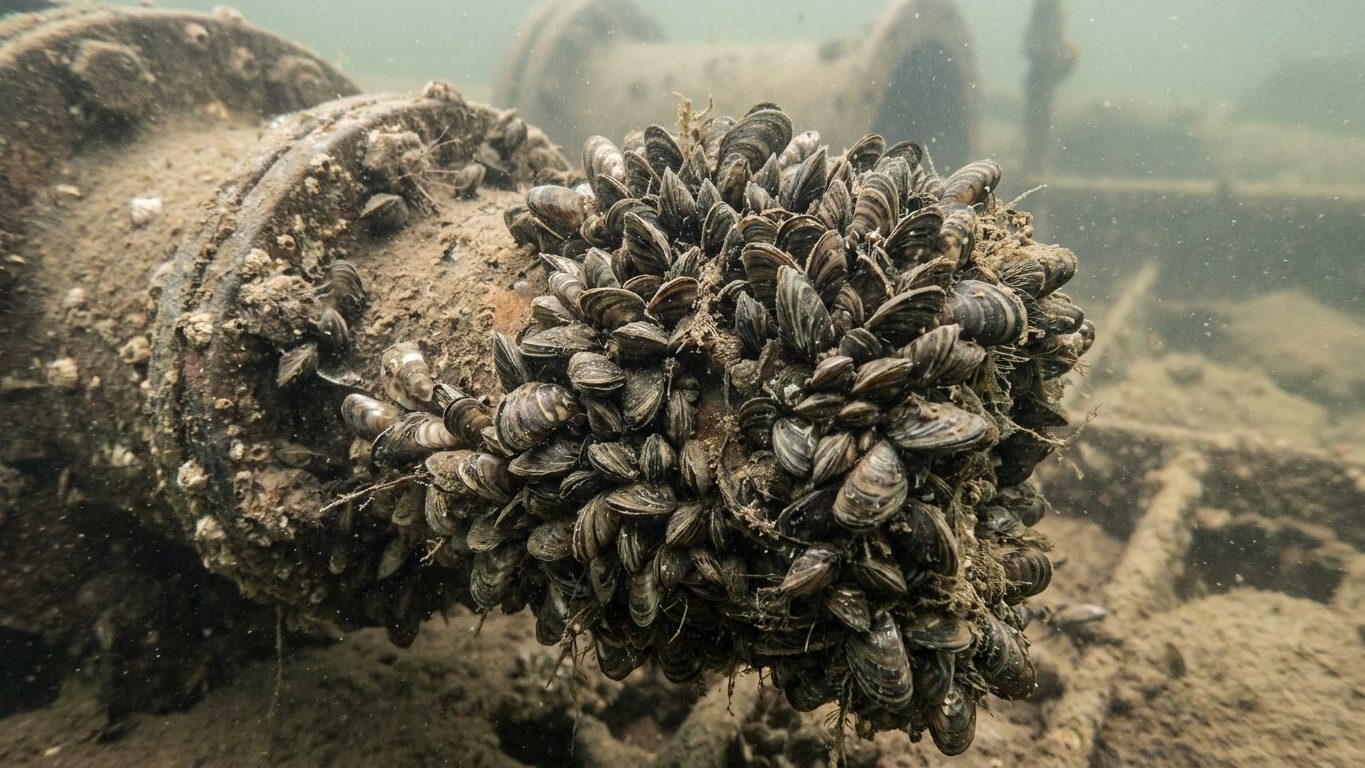
By dumping ballast water into the Great Lakes in the late 1980s, cargo ships literally clogged the continent’s drinking-water pipes.
Two centimeters. That’s the average size of an adult zebra mussel, barely larger than a thumbnail. And yet, this mollusk from Eastern Europe managed to insinuate itself into the industrial arteries of a whole region, from water treatment plants to power stations.
- Zebra mussels arrived in the Great Lakes in 1988 via ballast water from transoceanic ships.
- A single female can produce up to a million larvae per year, creating dense colonies of 30,000 individuals per square meter.
- Blocked pipes have cost hundreds of millions of dollars in maintenance and cleaning to infrastructure managers.
- The zebra mussel has never been eradicated and has become a permanent resident in 32 American states.
A Hidden Invasion in the Cisterns of Cargo Ship Ballast
The zebra mussel is native to the Black Sea and the Caspian Sea, where it had lived peacefully for millennia. It is believed to have reached North America in the early 1980s and was officially recorded in the Great Lakes in 1988, followed by the quagga mussel in 1989.
The vector of this invasion lay in a simple ship’s ballast tank.
In a landmark 1985 study, biologist Jim Carlton of Williams College described how ballast-water discharges served as a powerful vehicle for biological invasions. Transoceanic cargo ships fill their holds with water to stay stable during the crossing, then release it at the destination along with everything it contained: larvae, eggs, microscopic organisms invisible to the naked eye. No one at the time imagined that a routine maritime action would redraw the ecology of an entire watershed.
The Shell That Shrinks the Pipes
Thanks to filaments called byssus, the mussel possesses threads it uses to cling to solid surfaces. The colonies then multiplied at a frightening pace, with some reports noting densities exceeding 30,000 mussels per square meter, i.e., carpets of shells covering every available centimeter. Zebra mussels clogged the intake pipes of drinking-water treatment plants, power plants, fire hydrants, and nuclear reactors, dangerously reducing water pressure and necessitating costly repairs. Each pipe that became infested gradually lost its usable diameter, until operators were forced to intervene in an emergency.
A single female can produce up to a million larvae per year.
These microscopic larvae float in the water and, if they cannot find a hard surface to attach to, they die quickly. But in a lake rich with concrete, steel, and metal pipes, opportunities for survival are plentiful. It is this capacity for massive reproduction, combined with near-universal adhesion, that transformed a few individuals escaped from a ballast tank into a continent-scale colonization.
Clearer Water, but an Unbalanced Ecosystem
Each mussel filters water continuously to feed on plankton. Multiplied by billions of individuals, this activity makes a lake visibly clearer, a phenomenon observed in the Great Lakes and later in Europe with the quagga mussel. This increasing clarity of the water is not a sign of a healthy ecosystem, but one of a threat that disrupts the food chain and complicates drinking-water supply.
Clearer water is therefore not good news.
The Bill for the Great Lakes Management Agencies
Faced with the scale of the damage, the Great Lakes management agencies eventually acted. After extensive studies, the United States and Canada required in 2006 that ships rinse their sediment-laden tanks with seawater. A 2019 assessment showed that only three new species had established themselves in the Great Lakes between 2006 and 2018, and none through this route. The measure thus slowed the arrival of new invaders, without erasing the damage already caused by the zebra mussel.
On the ground, maintenance costs run into hundreds of millions of dollars: repeated cleanings of water intakes, addition of filters, replacement of portions of pipelines. On the Canadian side, a single Ontario electricity company spent up to 10 million dollars solely on chlorine to keep mollusks away from the intake pipes of its plants. A solitary figure, but telling of the scale of sums poured yearly by infrastructure managers around the Great Lakes.
Nearly four decades after the invasion, the zebra mussel has never been eradicated from the Great Lakes; it has become a permanent resident with which to live daily. The species is now recorded in the waterways of 32 American states, and its quagga mussel cousin in 19 others.
Sources: image-ppubs.uspto.gov | theconversation.com | rse-magazine.com
