
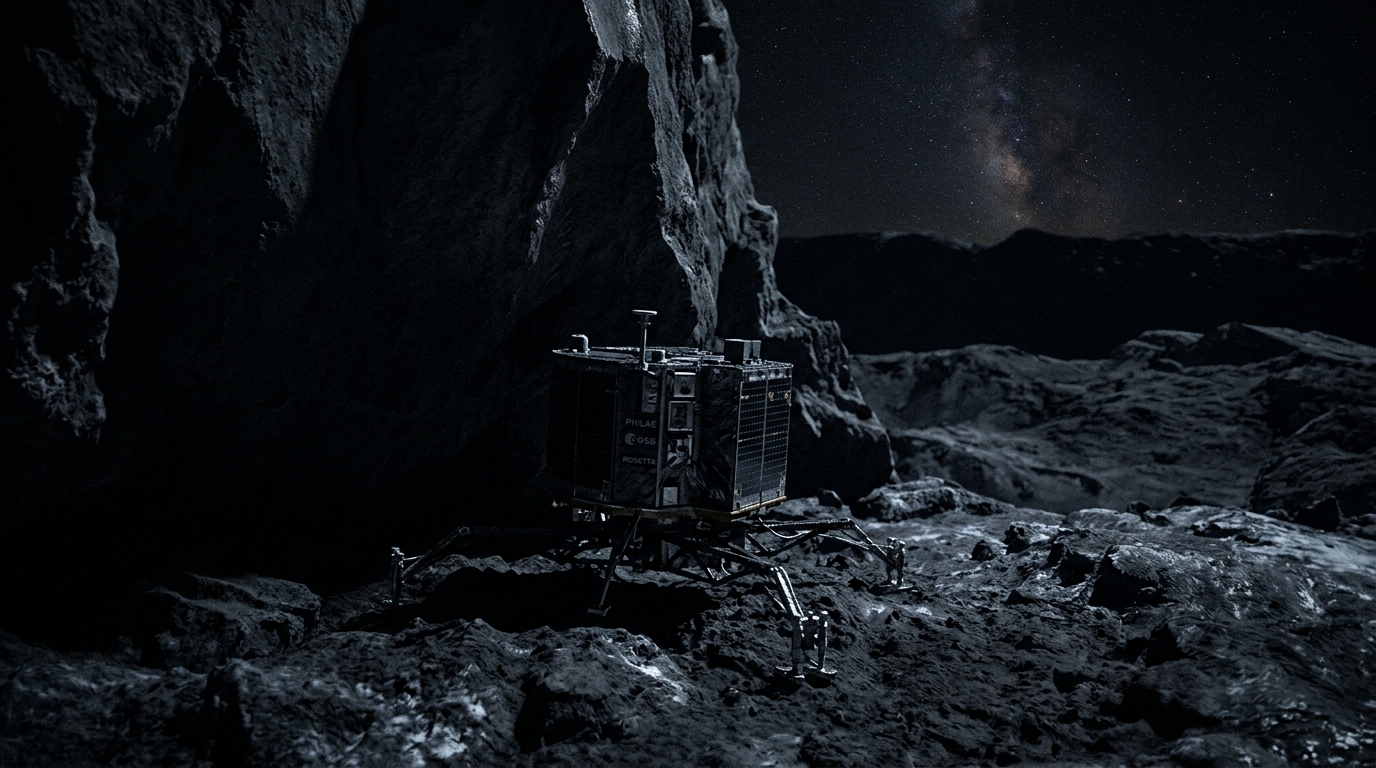
Imagine the scene from space: a tiny laboratory craft, no larger than a washing machine, drifting hundreds of millions of kilometers from Earth, immersed in total silence for more than a decade. Not a definitive failure, not a destruction, just an obstinate quiet that defies logic. This robot really exists, it is named Philae, and its story resembles that of an explorer who tumbled into a ravine on his first expedition, left without news while everyone continues to hope for a sign of life that will probably never arrive.
- Philae touched down on comet 67P on November 12, 2014 but bounced twice before coming to rest in the shadow of a cliff, deprived of sunlight
- After around 60 hours of battery life, the lander transmitted drilling data and then shut down, followed by a brief two-minute wake-up on June 13, 2015, with no subsequent signal
- The Rosetta mission ended in September 2016 with a deliberate crash onto the comet, definitively severing any relay with Philae, now silent and beyond rescue.
- On 67P/Churyumov-Gerasimenko, a 100-kilogram robot sleeps since 2015, mute despite all calls from Earth
- A failed landing that doomed Philae on the very first rebound
- Sixty hours of glory before the batteries fade
- June 2015, the unexpected surge that made many believe in a miracle
- Rosetta crash-lands intentionally, Philae still waits for an impossible awakening
This small European lander, placed on the icy core of comet 67P/Churyumov-Gerasimenko, embodies at once one of the most remarkable technical achievements of space exploration and one of its most frustrating sagas. A look back at an adventure where every twist, literal as well as figurative, ended up sealing the fate of a 100-kilogram machine now drifting about 500 million kilometers from our world.
On 67P/Churyumov-Gerasimenko, a 100-kilogram robot sleeps since 2015, mute despite all calls from Earth
Since its last breath of communication, no engineer, no radio telescope, no probe has ever managed to coax Philae to speak again. The robot lies somewhere on the duck-shaped comet, trapped in a rugged region of the nucleus that ESA teams managed to locate only after careful, multi-instrument searching. A remote, almost archaeological hunt to trace a craft that has become as silent as a stone.
This silence is not the product of a mere technical whim. It stems directly from a succession of unfortunate circumstances that began in the very first seconds of contact with the comet’s surface, a scenario that no one had truly anticipated despite years of preparation.
A failed landing that doomed Philae from the first bounce
On November 12, 2014, after more than a decade aboard the Rosetta spacecraft, Philae separated from its mother ship to attempt an unprecedented maneuver: a soft landing on the comet’s nucleus, an object whose gravity is so weak that one could almost lift off with a strong jump. The plan involved harpoons meant to anchor the lander to the surface and a propulsion system designed to press the craft against the surface, preventing it from rebounding back into space like a ping-pong ball.
But nothing unfolded as planned. The harpoons failed to fire, the propulsion system never kicked in, and Philae literally bounced twice before finally coming to rest far from its intended landing spot. The final position of this chaotic descent left the lander in the shadow of a cliff, a location far too shaded to recharge its solar batteries. A seemingly small detail that, in hindsight, would prove decisive.
Sixty hours of glory before the batteries fade
Despite this awkward positioning, Philae didn’t surrender immediately. Its initial autonomy, estimated at around 60 hours on primary batteries, allowed it to carry out a portion of its scientific mission. On November 14, 2014, contact could be briefly re-established, enough to transmit valuable data from a drill performed directly into the comet’s nucleus — a first in-situ analysis in the history of cometary science.
Ground teams even attempted a bold repositioning maneuver: a small lift of a few centimeters, followed by a rotation, in hopes of exposing more of the solar panels to sunlight. Unfortunately, this adjustment proved insufficient to pull the lander out of its forced hibernation. The batteries eventually drained, and Philae fell asleep, with no clear answer to whether this slumber would be temporary or permanent.
June 2015, the unexpected surge that made many believe in a miracle
And then, just when hope appeared to be fading, a signal emerged from nowhere. On June 13, 2015, as the comet 67P approached its perihelion — the point in its orbit where it comes closest to the Sun — Philae woke up. For roughly two minutes, the lander communicated with Rosetta, which was skimming the area about twenty kilometers away. Those two minutes were enough to rekindle the euphoria in mission control, everyone sensing that the small robot might finally break free from its long sleep.
That sudden, fleeting resurgence, as brief as it was hopeful, would become the last. Since that mid-2015 flare, no further signal has ever been picked up, despite Rosetta’s repeated attempts to re-establish contact during subsequent flybys. The silence returned, and this time it stayed.
Rosetta s’écrasée volontairement, Philae attend toujours son réveil impossible
The Rosetta mission itself came to a close in September 2016, in a gesture that was almost symbolic: rather than letting the probe drift aimlessly after years of service, the European Space Agency chose to land it gently on the surface of the very comet it had accompanied for so long. A controlled crash that definitively ended any possibility of reestablishing contact with Philae, now stripped of its sole link to Earth.
Since then, the little 100-kilogram robot continues its strange voyage, motionless on a glacial rock that streaks through the solar system hundreds of millions of kilometers away. No rescue mission is planned, no signal will ever rekindle the hope of dialogue. Philae remains frozen in its last moment of electronic consciousness, like a time capsule abandoned in the heart of an expedition.
There is something profoundly touching in this tale of a machine hurled into a grand venture, betrayed by a simple lack of solar light. Philae never truly failed; it was undone by a setting too dark. A lingering question remains, almost poetic: how many other mechanical explorers, sent to the far reaches of the solar system, will share this fate of eternal dormancy, silent witnesses to a human adventure that continues to be written?
