
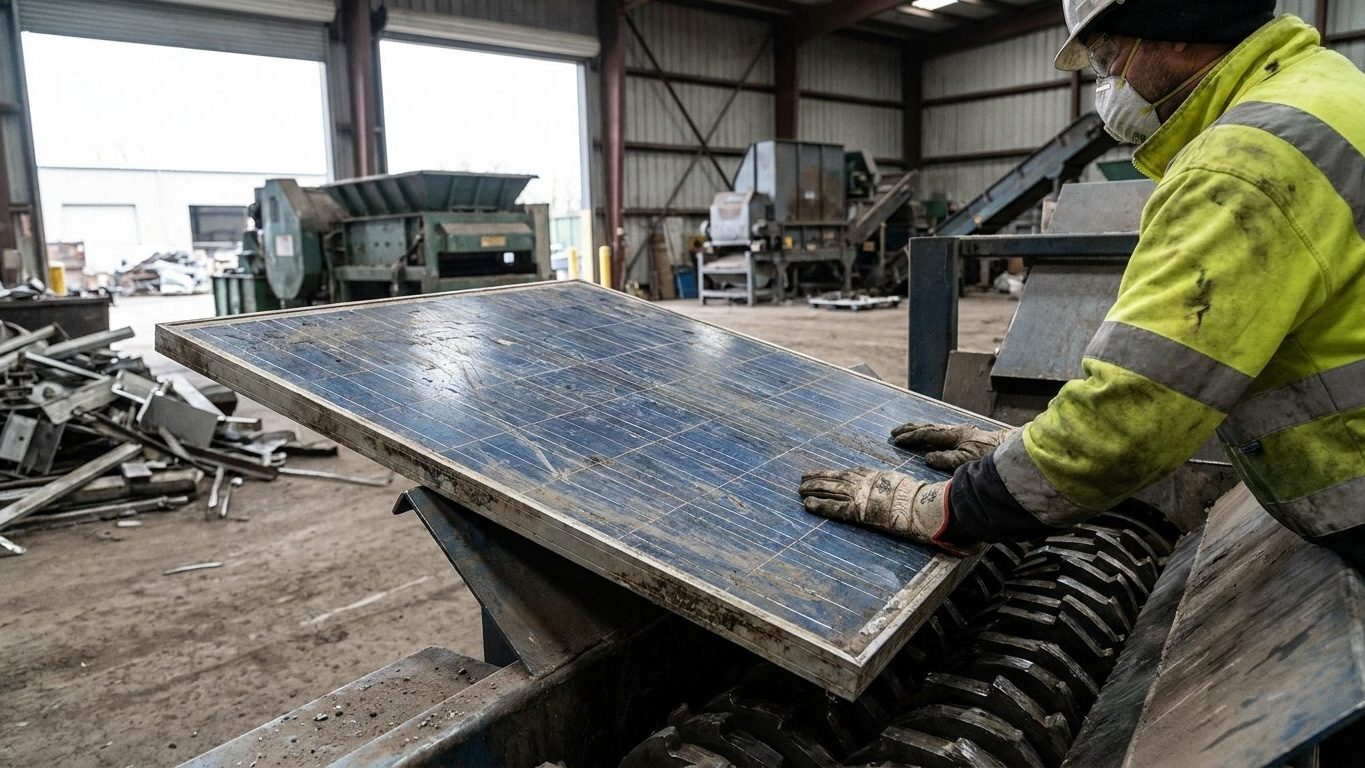
Thirty years of turning sunlight into electricity, and then one day, dismantling. The reflex is almost automatic: envisioning this old photovoltaic panel ending its life in a bin, heading to the dump or the incinerator. That’s not true, and the figures from the European sector have shown it for several years already.
A solar panel can be recycled, and much more than people think.
- Glass and aluminium, which account for about 80% of a panel’s mass, are recycled in industrial streams that have proven themselves for decades
- The French eco-organization Soren reaches a recovery rate of 94% through mechanical grinding and separation of materials
- Recovering silver from the contacts and the encapsulation polymers remains the main technical challenge of photovoltaic recycling
Glass and aluminium, the simplest part
A crystalline silicon photovoltaic module is not a mysterious object to decompose. It is predominantly made of glass, which represents about 70% of the mass, of aluminium for the frame at around 10%, of encapsulating polymers, of silicon, and of metals with smaller volumes such as copper and silver. Two materials, glass and aluminium, therefore form the vast majority of a panel’s weight. These are also two materials that industrial streams have known how to process for decades, long before the solar boom.
The existing streams already allow for mass valorization rates above 90%. Some analyses go further still, with a global valorization rate rising to 92–94% depending on the methods used.
The silver in the contacts, the real point of friction
The difficulty does not hide where one might expect. Glass and aluminium readily enter traditional streams, but the minor fractions pose a problem of a different kind. The silver used in the electrical contacts of the cells is present in tiny quantities, dispersed throughout each module, which makes its industrial extraction far more complex than that of a bulk metal like aluminium.
Recovering this silver at scale remains an open challenge.
Silver recovery is not industrialized at the scale of ore deposits, and four European programs currently in progress confirm this. The encapsulation polymers, the plastics that protect the photovoltaic cells and bind them to the glass, pose a similar challenge. The most coherent reading with the described processes points to the encapsulation polymers, which the sector has not yet learned how to recycle into material. These minor mass fractions concentrate the bulk of photovoltaic recycling’s technical complexity.
What the industry’s eco-organization is doing
In France, the eco-organization Soren oversees the collection and processing of end-of-life panels. Soren, formerly PV Cycle France, has received authorization from the Ministry of Ecological Transition since 2015 to organize the collection and recycling of photovoltaic panels in France. On its own site, the organization claims an average valorization rate of 94% for a photovoltaic panel, based on recycling techniques by shredding or by delamination.
The collection pace is clearly accelerating. In 2025, 13,760 tonnes of used panels were recovered, i.e., 40% more than in 2024, according to Soren’s latest report. The majority of this tonnage comes directly from installers and plant operators, with the remainder dropped off at voluntary collection points spread across the country.
Concretely, dismantling follows a precise sequence of steps. The process includes initial mechanical grinding, the separation of glass and metals via vibratory tables, the gentle thermal dissolution of EVA at 130°C, the extraction of silicon with rinsing and powder recovery, and the final granulometric sorting. Each separated material then returns to its own industrial stream, from glass toward making new containers to aluminium for new frames or other metallic objects.
The real challenge now lies in scaling up. The volumes of end-of-life panels will mechanically rise in the coming years as the first large installations of the French solar fleet reach the thirty-year mark. The question is no longer whether a panel can be recycled, but whether industrial processing capacities will keep pace with this collective aging.
Sources: ats-photovoltaique.com | travail-industrie.com | soren.eco
