
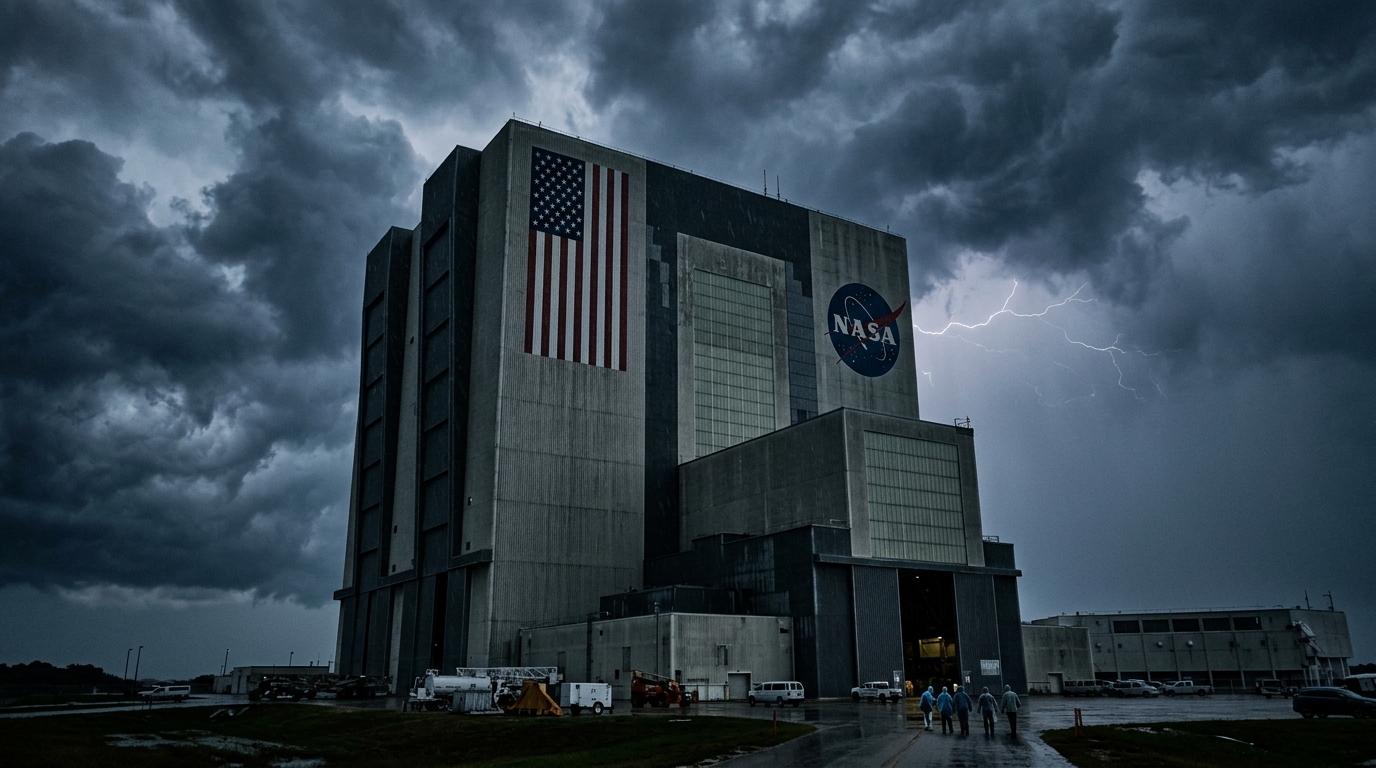
Imagine a door so tall that it could let a whole office building roll past on its side. This isn’t science fiction, but a very real feat that has stood for decades at the heart of Florida, a short sail from the Atlantic Ocean. Since the mid-1960s, this architectural colossus continues to impress the few fortunate enough to view it up close. For behind this engineering marvel lies a captivating story, that of a nation that decided, one day, to build bigger than anything that had existed before simply to reach the Moon.
- Each of the four doors of the Vehicle Assembly Building stands 139 meters tall, the equivalent height of a 35-story office building.
- This structure, erected in 1966 for the Apollo program, enables fully assembled rockets to roll out vertically from the hangar to their launch pads.
- After hosting 14 Saturn V rockets, the VAB was repurposed for the Space Shuttle program and later for the Space Launch System, notably used during Artemis I in 2022.
- A 35-story building designed for a single mission
- Why did NASA need doors this oversized
- The Vehicle Assembly Building, a colossus at the service of the stars
- From Apollo to the shuttles: what these doors have seen pass
A 35-story building designed for a single mission
Hard to believe, yet it is verified and confirmed by the Guinness World Records: the doors of the Vehicle Assembly Building, NASA’s iconic structure near Cape Canaveral, stand at 139 meters tall each. To put this considerable reach into perspective, it equates to roughly a 35-story office building, a height that would place these doors among the tallest urban structures if they were nestled in the middle of a city. Except that here, they are not portals for morning foot traffic but gateways for vehicles capable of leaving Earth’s atmosphere.
The facility actually houses four such doors, each mounted on a different face of the building. Their role is as straightforward as it is awe-inspiring: to permit fully assembled rockets, standing vertical, to roll out of the hangar and onto their launch positions. It’s hard to imagine an equivalent in France, given the scale—our industrial heritage doesn’t typically produce structures of this magnitude, even in the largest aerospace factories.
Why did NASA need doors this oversized
To understand the origin of this architectural extravagance, we must go back to 1961, when President John F. Kennedy declared a goal to land humans on the Moon before the decade was out. That bold, political aim immediately imposed colossal technical constraints. How could one assemble, transport, and launch a rocket as tall as a skyscraper without ever disassembling or weakening it?
The answer rested on a single word: verticality. Rather than assembling the rocket horizontally and then lifting it into an upright position—an approach that would have subjected the structure to dangerous mechanical stresses—NASA chose to build the Saturn rockets upright, inside a sealed facility, and then move them out as complete entities. This technical choice, logical in hindsight, required doors capable of opening to unprecedented heights. Thus was born the concept of these colossal doors, custom-made to accommodate a single giant: the lunar rocket.
The Vehicle Assembly Building, a colossus at the service of the stars
The Vehicle Assembly Building, commonly known as the VAB, was erected in 1966 on the Kennedy Space Center site. Its mission is clear: to house the complete assembly of the Apollo/Saturn V rocket for lunar missions. Even today, visitors are struck by the fact that the VAB remains the tallest single-story structure in the world, reaching 160 meters in height. It is essentially a vast hangar, with no intermediate floors to support such vertiginous height.
There is, among locals and visitors alike, an urban legend about an internal weather phenomenon within the VAB. The tale goes that Florida’s humidity, combined with the doors’ vast opening, causes condensation to form on the steel beams and creates a microclimate, even small clouds beneath the ceiling. While this story leans more toward folklore than science, it illustrates how this place continues to spark fascination and mystery, even for those who have worked nearby for years.
From Apollo to the shuttles: what these doors have seen pass
Between 1966 and 1972, the VAB hosted the assembly of 14 Saturn V rockets, of which 13 actually reached space. Today, this building remains the only facility in the world to have housed the assembly of a rocket capable of carrying humans to the Moon, bestowing it with a nearly sacred status in the annals of space exploration.
But the VAB’s story does not end with the Apollo program. Once lunar missions concluded, the building was repurposed to support Space Shuttle operations, before undergoing another transformation with the advent of the Space Launch System, a heavy launcher designed to push the Orion spacecraft far beyond low-Earth orbit. It is precisely in this frame that the VAB recently hosted the assembly of the Orion spacecraft used for the Artemis I mission, launched in November 2022 and returning to Earth in the following month. This serves as yet another testament that this structure, conceived nearly six decades ago, continues to shape contemporary space history.
From the race to the Moon to today’s ambitions toward Mars, these 139-meter doors have never ceased to fulfill their unique function: to let the planet’s largest spacecraft exit the hangar and depart our world. A remarkable architectural achievement that, more than sixty years after its construction, continues to captivate as much as it intrigues. So next time you watch a rocket streak toward the heavens, remember these gigantic doors that, mere hours earlier, had already borne it beyond the threshold toward infinity.
