
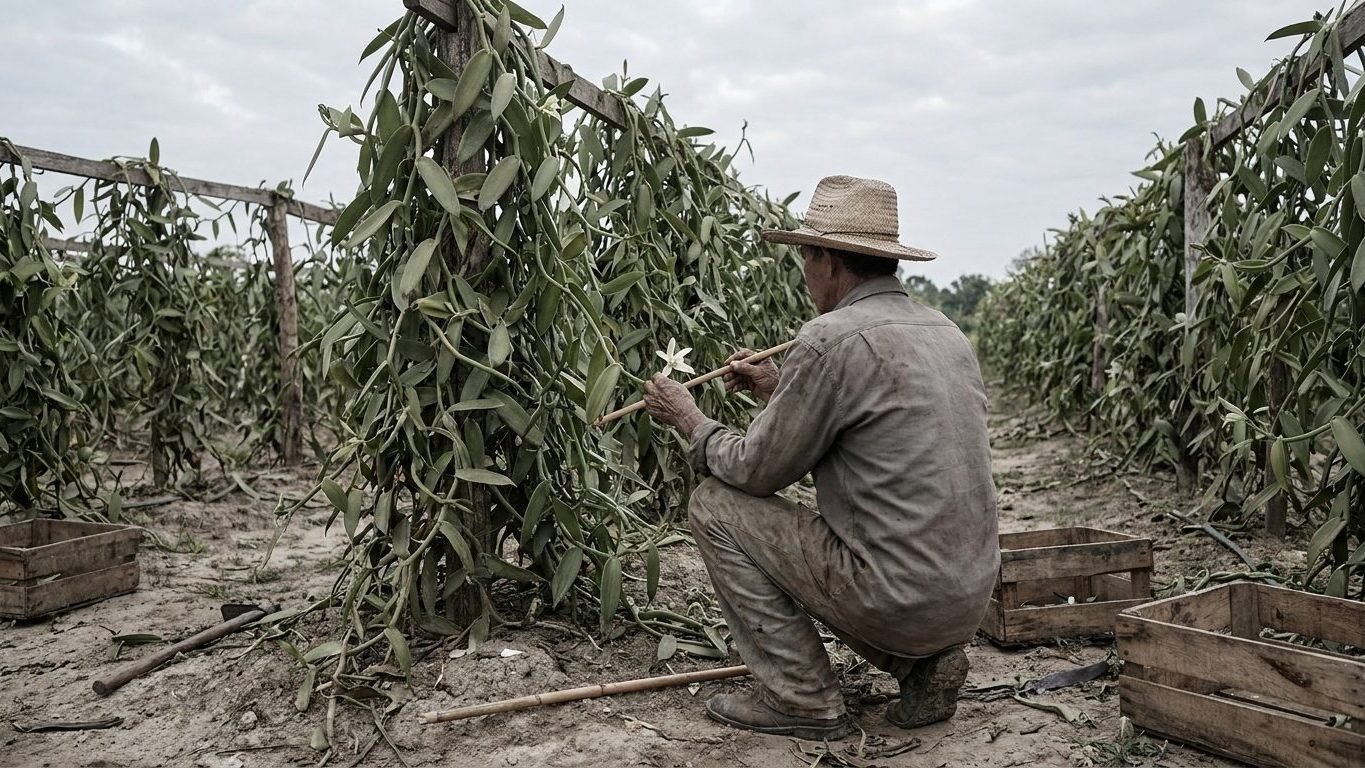
A vanilla flower lives only one morning. After this brief moment, it closes and falls away, sterile, unless someone steps in in time. This extremely short window, often estimated at about four hours, compels tens of thousands of agricultural workers to repeat, flower after flower, a meticulous gesture that has hardly changed since its invention nearly two centuries ago.
Outside of Mexico, no insect naturally pollinates this orchid.
- Vanilla flowers open for only one morning and require manual pollination within a maximum of four hours.
- The fertilization gesture invented by Edmond Albius in 1841 remains the only viable method for commercial vanilla production.
- Malagasy growers engrave or tattoo a number on each green pod to deter thieves during the 18 months of maturation.
A Flower That Leaves Only One Morning
Vanilla originates from the orchid Vanilla planifolia, whose hermaphroditic flower hides an anatomical trap. Moreover, its bloom is designed so that a membrane separates the male and female organs, preventing spontaneous self-pollination. In its native range, Mexico, a small wild native bee from the Melipona genus handles this task, sometimes aided by a few hummingbirds.
When transplanted far from Mexico, the orchid finds itself without its natural pollinator, whether in Madagascar, Réunion, Indonesia, or Tahiti. Without human intervention, no bean would form.
Each morning during the flowering season, workers traverse the vines with a pointed piece of bamboo or a slender thorn in hand. They lift the membrane, bring the pollen into contact with the stigma, then move to the next flower before it closes for good. The most experienced can reach, according to generally cited industry estimates, several hundred flowers per day, a figure that can rise to a thousand, or even 1,500, depending on the size of the plantation and the pollinator’s skill.
The Edmond Albius Gesture, Unchanged Since 1841
This gesture has a name, that of a child. Edmond Albius was a Réunionese slave who discovered in 1841 the method for fertilizing vanilla, while he worked as a gardener for his master, Ferréol Bellier-Beaumont, a botanist by passion. According to the Foundation for the Memory of Slavery, it was Edmond Albius who invented, through curiosity and close observation of nature, the manual pollination technique for vanilla—know-how that is still used today around the world. The news spread quickly through the island’s producing regions and then far beyond, reaching the Comoros and Madagascar.
He never profited from his discovery.
That same gesture, nicknamed the wedding of the flower, is practiced today in exactly the same way, even in Sambava’s plantations. To date, no mechanical or automated pollination method has managed to replace the precision and delicacy of Edmond Albius’s manual gesture for commercial, high-quality production.
Eighteen Months Before the First Pod, Under Surveillance
A fertilized flower takes about nine months to become a green pod, still lacking aroma or color. Then comes post-harvest transformation: scalding, drying, alternating sun and shade, daily manual massaging of the pods to distribute the seeds, sorting and calibrating. This maturation stage lasts several more months before the black, pliable pod is considered ready for sale.
In total, there are about eighteen months from flower to pod.
It is this wait that exposes each pod to theft, for nearly nine months during which the fruit remains attached to the vine. In the SAVA region, the world’s cradle of Bourbon vanilla, farmers carve with a knife or tattoo with a needle a number on each green pod even before maturity. This practice is widespread in Madagascar, especially in SAVA, though it depends on regions, farms, and the pressure of theft. During the season, plots must be watched day and night against theft, a scourge that has never ceased, even when prices were high.
During the most sensitive weeks, it is not unusual for producers to spend nights in the fields, near their vines, to deter thieves. A stolen pod can wipe out a year and a half of work in mere minutes.
This vigilance comes at a cost, even as incomes have collapsed. After all this work, the price of green vanilla per kilogram now brings in less than 5 euros for the Malagasy producer, a level that no longer covers cultivation costs. On the export market, prices plunged after the removal of the floor price of 250 dollars that had artificially protected prices since 2020, dropping to a range of fifty to seventy dollars per kilogram within a few months.
Some producers burn their stocks as a sign of protest.
The Paradox: 97% of Vanilla Flavor Comes from a Chemical Reactor
Vanilla is considered the second-most expensive spice in the world. Despite this economy of scarcity, the vast majority of vanilla flavor consumed worldwide has never seen a vanilla bean. Only 3% of the world’s most-used vanilla aroma actually comes from real vanilla.
Sources: foodandsens.com | ornoirvanilla.fr
