
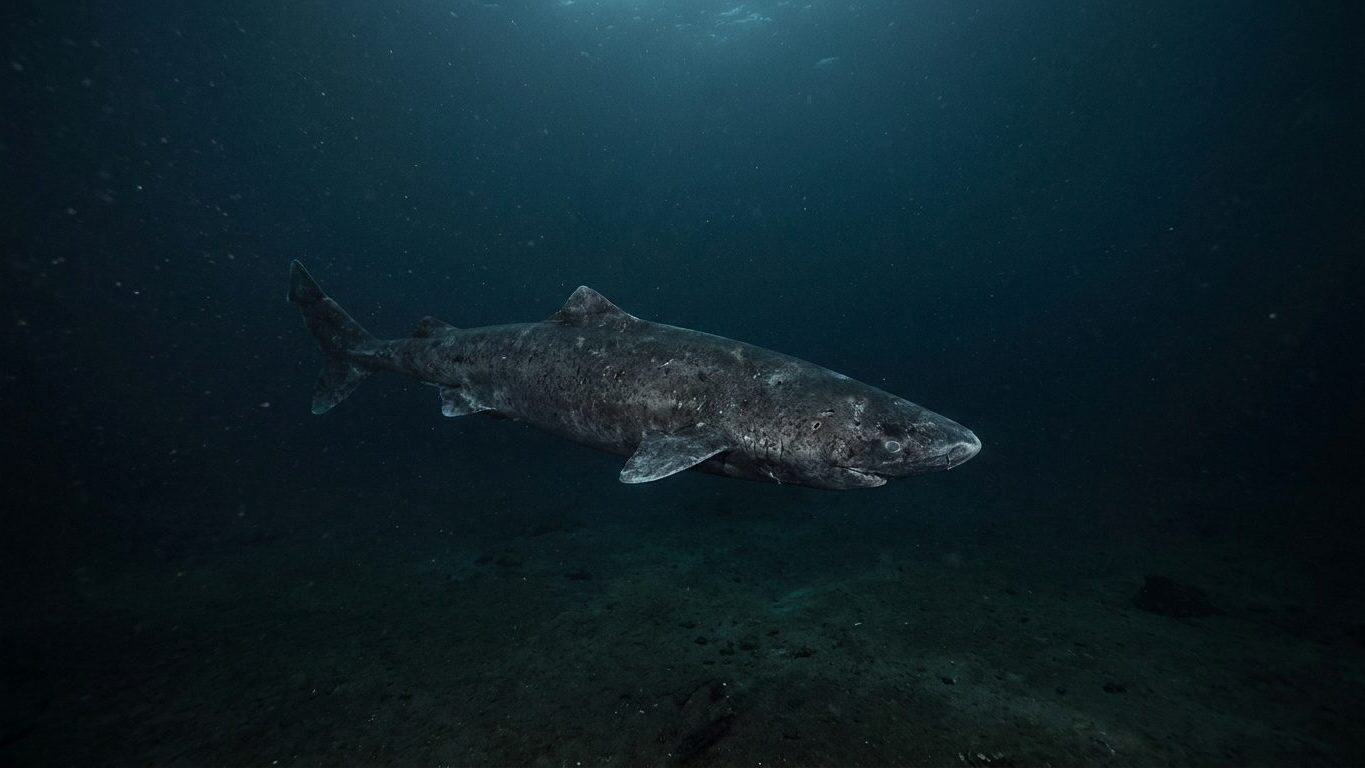
The Greenland shark could have lived longer than any other known vertebrate on Earth.
This gray, unassuming, slow-moving shark measures between 4 and 5 meters in length and prowls at depths of 200 to 600 meters, in waters near 0 to 4 degrees Celsius. The animal can exceed 5 meters, grows by barely a centimeter per year, and traverses the icy Arctic seas at a cruising speed of about one kilometer per hour. For a long time confined to the depths of the North Atlantic and the Arctic Ocean, it remained one of the planet’s most little-known apex predators.
- The Greenland shark can live for more than 390 years, setting a longevity record among terrestrial and marine vertebrates.
- The species reaches sexual maturity at around 150 years or more, the longest documented reproductive delay in a marine animal.
- The eye’s crystalline lens, which never regenerates after birth, has allowed scientists to date these creatures precisely using carbon-14.
A crystalline lens that never ages
The challenge in dating a shark lies in its lack of bones. Sharks possess no bones, no otoliths, and no usual growth rings; their skeleton is cartilage. A Danish team eventually found a solution outside the skeleton: a physicist from Aarhus University proposed using the eye’s crystalline lens. This tiny core forms before birth, in the mother’s womb, and is never renewed afterward, making it an intact time capsule.
The team led by Julius Nielsen studied this nucleus in 28 females caught between 2010 and 2013 in Greenlandic waters, and published their results in Science in 2016. The levels of carbon-14 trapped in the tissue allowed reconstructing, for each shark, an approximate birth year.
The largest individual examined had an estimated age of 392 years, with an uncertainty of plus or minus 120 years.
A slowness that has long puzzled scientists
Its cruising speed is about one kilometer per hour, the slowest ever measured for a shark of this size. This detail has long seemed at odds with a troubling fact: remains of seals are regularly found in its stomach. It is suspected that Greenland sharks hunt marine mammals that are asleep or weakened, rather than actively chasing them through the water.
Its diet isn’t limited to seals. It is both a scavenger and an active predator, feeding on a wide range of bony or cartilaginous fish, squids, and various marine mammals such as seals or the common porpoise.
Its flesh poses another problem: it contains trimethylamine oxide, a compound toxic to the human body in its raw form. In Iceland, it must be fermented and then dried for several months to produce hákarl, a traditional delicacy with a strong odor. On the cornea of most individuals adheres a small crustacean—a copepod (Ommatokoita elongata)—that latches onto the cornea. This ocular parasite, nearly universal in the species, partly explains why this shark is often described as half-blind.
A species at the mercy of a simple net
Sexual maturity occurs when it reaches at least 4 meters in length, corresponding to roughly 150 years of age, with an estimated window of 156 plus or minus 22 years. Globally, the Greenland shark is listed as Vulnerable by the International Union for Conservation of Nature. A species that may require more than 150 years to reach sexual maturity cannot recover quickly after an increase in mortality, and the loss of only a few breeding adults can have repercussions for several generations.
A female caught in a trawl can represent a century and a half of growth lost in one go.
Once maturity is reached, the female can still produce a notably large litter: up to 200 to 324 pups, depending on estimates, with a birth size of 35 to 45 centimeters. This substantial reproductive potential does not compensate for the wait of more than a century before the first giving birth, a delay unmatched by any other documented marine species to date.
Sources: trustmyscience.com | futura-sciences.com
