
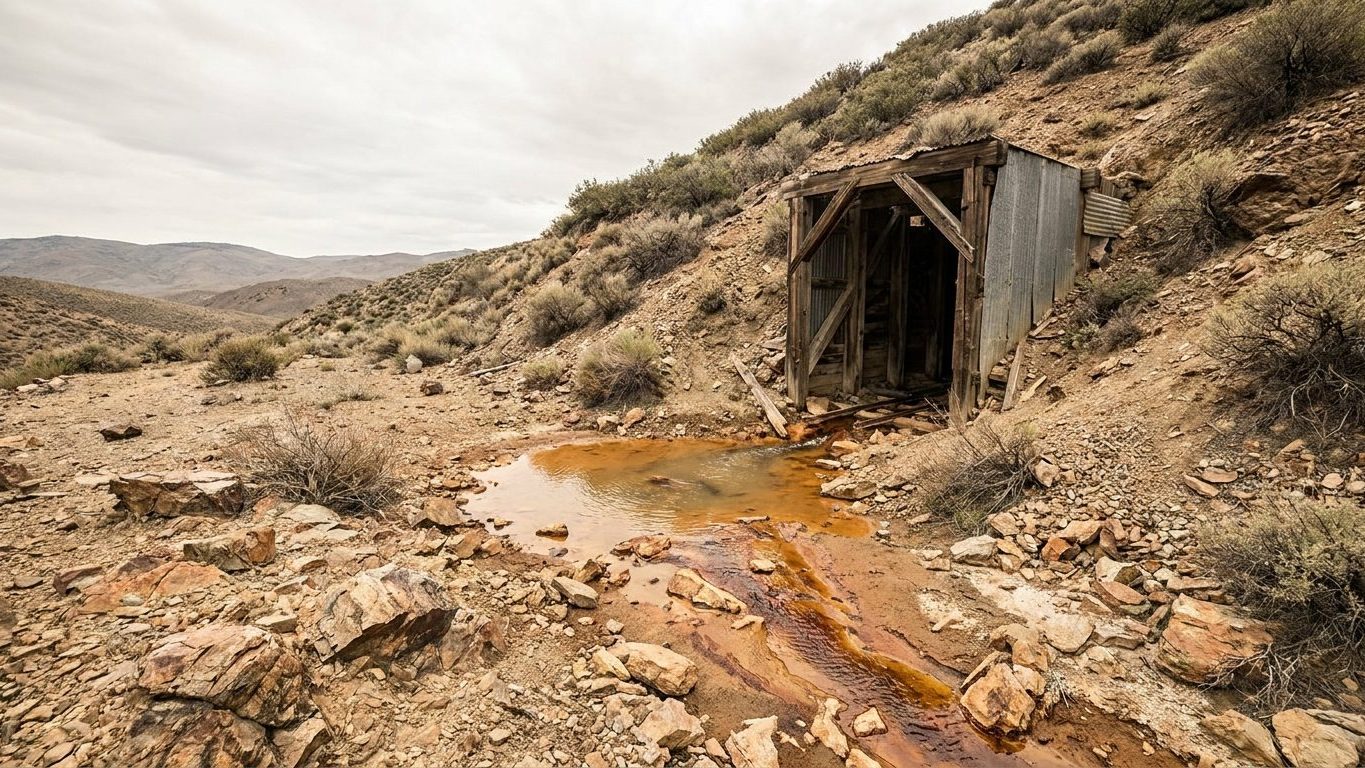
At Iron Mountain, in Shasta County, California, the machines fell silent in 1963. The site had been operated from the 1860s until 1963 for copper, gold, pyrite, silver and zinc. More than six decades after mining ceased, the mountain continues to spew, day and night, some of the most corrosive water ever measured on Earth. Researchers affiliated with the United States Environmental Protection Agency (EPA) estimate that this phenomenon could endure for roughly 2,500 to 3,000 more years, a projection that remains scientific rather than a guaranteed end date: acid water production will continue for about 3,000 years unless the sulfide ore is completely extracted.
The techniques used at the time explain the scale of the damage. The operations included open-pit mining, underground galleries and work sites, ore grinding, rail and cable car transport, a cyanide leaching plant, cementation workshops, ore-sieving zones and a foundry.
The massive sulfide deposit was composed of about 95% pyrite.
- The Iron Mountain site has, for 60 years, produced extremely acidic water with a pH below -3.6 and metal concentrations reaching 200 grams per liter.
- Naturally occurring bacteria accelerate pyrite oxidation, while the reaction releases enough heat to generate its own air currents within the massif.
- A treatment plant built in 1994 removes 99.99% of the metals and costs between $5 and $7 million per year, but it does not solve the long-term problem.
A self-sustaining chemical reaction
The mechanism at play has a technical name, acid mine drainage. It is water rich in metals and acidity, produced when rainwater or runoff travels through rocks containing pyrite, a sulfide mineral, which reacts with air to form sulfuric acid and dissolved iron. In the Richmond Mine drift at Iron Mountain, the pH has fallen to as low as 3.6, with metal concentrations reaching 200 grams per liter and sulfate up to 760 grams per liter. Naturally occurring bacteria further speed up the process: bacteria that oxidize iron and sulfur, notably Thiobacillus ferrooxidans, catalyze these reactions at low pH and multiply their rate by several orders of magnitude. The reaction generates so much heat that it eventually drives its own air flow inside the massif: the oxidation of pyrite releases energy so intense that it drives a air current, entering through the main gallery, warming the mine, then rising to the surface through the chimneys and shafts.
The downstream consequences have left a mark on local memory. Dozens of mass fish die-offs in the Sacramento River have been attributed to the acidic drainage from the mine’s main sector. A former EPA project manager recalls that a shovel forgotten in the greenish liquid seeping from one of the galleries was already being gnawed away the next day.
The site ranked third on the list of California’s most dangerous places.
The treatment that buys time, without erasing the deadline
Facing this ongoing pollution, the EPA mandated the construction of a neutralization plant. A system built in 1994 removes 99.99% of the metals present in the polluted water sent to the facility. Gravitation pipelines convey the acidic drainage from four main sources to this plant, which treats an average of 400 million gallons of water each year before discharging the treated water into Lower Spring Creek, a Sacramento River tributary. The by-product of this treatment, a metal-laden sludge, does not disappear: this by-product is routed to one of four drying ponds. That is the essential difference between the still-seeping raw water from the galleries, which remains extremely acidic, and the water that exits the plant, brought back to compliant levels before joining the watershed.
The challenge extends beyond protecting the immediate waterways. The city of Redding draws its drinking water from the Sacramento River downstream of the Iron Mountain site, meaning that uncontrolled releases of acidic drainage could threaten the quality of the water supply. Thanks to successive interventions, copper and zinc discharges have been reduced by 95% compared with the pre-cleanup situation. However, this site should not be confused with the Berkeley Pit in Butte, Montana, another vast mined pit that is also flooded and infamous for its acidic water: the two sites share a similar type of pollution, but result from different geological and mining configurations.
A project with no end date
The system costs between $5 million and $7 million per year to operate.
That bill is not about to ease. The sludge storage area will reach its maximum capacity by 2030, forcing engineers to consider where to house the next rounds of residues. The project leaders acknowledge themselves that a perpetual treatment is not a definitive solution, and a new, improved treatment system will be necessary, which means continuing to develop new technologies. Iron Mountain will therefore remain, for generations well beyond our own, a site to monitor rather than a problem to close.
Sources: cumulis.epa.gov | projects.itrcweb.org
