
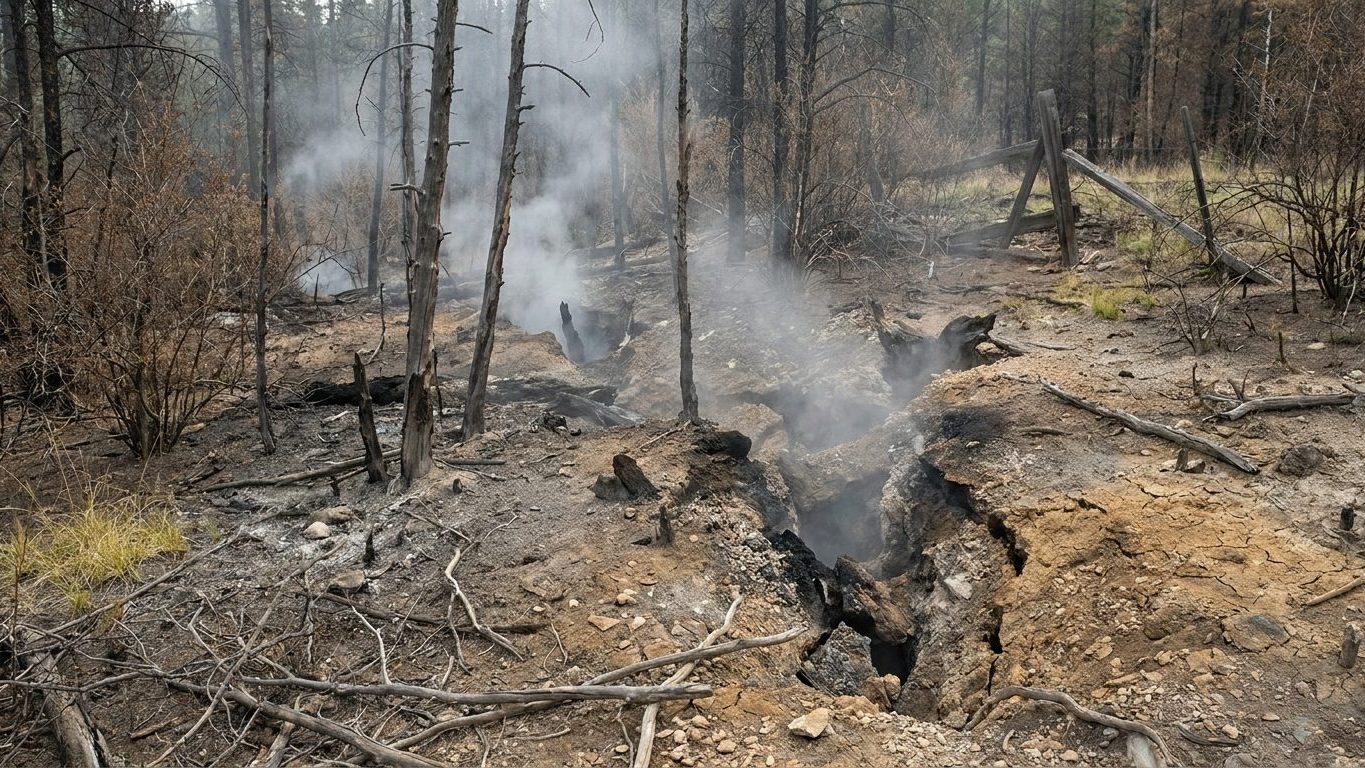
Since May 1962, a coal seam has burned beneath Centralia, Pennsylvania, and no effort has managed to halt it. The fire has gnawed the town from the inside, forced its residents to leave, and fissured Route 61, which is now diverted due to the fumes and ground subsidence. Six decades on, it continues to advance, a few meters each year, beneath a forest that has reclaimed the ruins.
- A waste-fire in 1962 penetrated a coal seam beneath Centralia and has burned continuously ever since.
- Trenches, material injections, and excavations failed to halt the fire as it moved through old mining galleries.
- Nearly the entire population of about 1,000 people left the town between the 1980s and 2002; the ZIP code was removed.
- The fire now burns at about 90 meters depth along 13 kilometers, with estimates suggesting enough coal to sustain combustion for around 250 years.
An Uncontrolled Landfill Fire
On May 27, 1962, the municipality of Centralia set fire to the garbage amassed in an old open pit, a practice already repeated in the preceding years, with firefighters stationed nearby to prevent the blaze from spiraling. Two days later, the fire appeared to have burned out on its own. But flames found a gap: the pit, left open since its excavation around 1935, measured about 23 meters in width and 15 meters in depth—a true shaft to the subsoil. The fire then slid into the Buck Mountain coal seam, and into the network of abandoned tunnels that punctuate the basin of anthracite.
That day, no one imagined that the fire would never go out again.
Twenty Years of Trenches, Injections and Excavations That Fail
During the 1960s and 1970s, authorities intervened little, as the fire progressed slowly and did not yet threaten many residents. Twenty-three active mines in the area were closed due to the danger posed by combustion gases beginning to migrate underground. Engineers and firefighters dug cut trenches, injected inert materials, and attempted excavations in spots: nothing durably halted a burning front that slithered through cracks and old tunnels where oxygen could still reach it, while water poured on the surface simply escaped through the fractured rock.
Two decades later, no method had worked.
A Child Sucked Into the Ground, a Town Erased from the Map
It was a gas-station attendant who first understood the scale of the danger: in 1979, he measured the temperature of his underground fuel tanks at 172 degrees, a hundred degrees higher than normal. A few years later, a sinkhole opened under a child’s feet, and he escaped by a narrow margin. This incident, the rising number of illnesses among residents, and the climbing levels of carbon monoxide sealed Centralia’s fate. Congress eventually released federal funds to buy out properties: nearly the entire thousand-strong population accepted compensation and left, their abandoned homes being demolished one after another.
The post office closed and the town’s ZIP code was erased in 2002, a rare incident in the United States. The abandoned stretch of Route 61, once covered in graffiti, was buried under tons of earth by private owners weary of vandalism and visitors.
A Front That Still Advances, a Few Meters per Year
Today, the fire burns at depths reaching around 90 meters, along a swath of roughly 13 kilometers that would cover nearly 1,500 hectares according to the most frequently cited measurements. The Commonwealth of Pennsylvania continues to monitor the site: monthly surface checks, and annual temperature readings from boreholes. Readings vary widely from one point to another along the front and from year to year.
Fumaroles still emerge from the ground among the trees.
The figure most often cited, popularized by a 2010 article in the Christian Science Monitor, suggests there remains enough coal beneath the town to fuel the blaze for about 250 years. This projection remains debated: some say almost nothing remains to burn and that the fire is dying slowly, while others speak of centuries of possible combustion. No comprehensive measurement of the remaining coal beneath Centralia has ever been published. The fire, for its part, continues to advance, with no known timetable to stop.
Centralia Is Not an Isolated Case
Thousands of underground coal seam fires are burning around the world today. In China, the leading global coal producer, estimates range from 10 to 200 million tonnes of reserves consumed or rendered inaccessible each year by these fires. Indonesia, a major exporter to the Asia-Pacific region, also hosts several thousand active foci, though no precise tally has ever been made.
In India, the Jharia coalfield has burned since 1916: nearly 70 active foci have already consumed at least 37 million tonnes of coal, with temperatures reaching up to 731 degrees Celsius. Taken together, these subterranean fires could account for up to 3% of the world’s annual CO2 emissions, and release about 40 tonnes of mercury into the atmosphere each year.
In the Centralia region, the heat from mining even produced an unexpected phenomenon: the Big Mine Run Geyser, at Ashland, erupts when heavy rains meet the overpressure created by the underground fire. Considered the only geyser in Pennsylvania, it is now kept open to limit flood risks. The fire, however, needs no rain to keep spreading, beneath a road that no one uses.
Sources: files.dep.state.pa.us | wpst.com
