
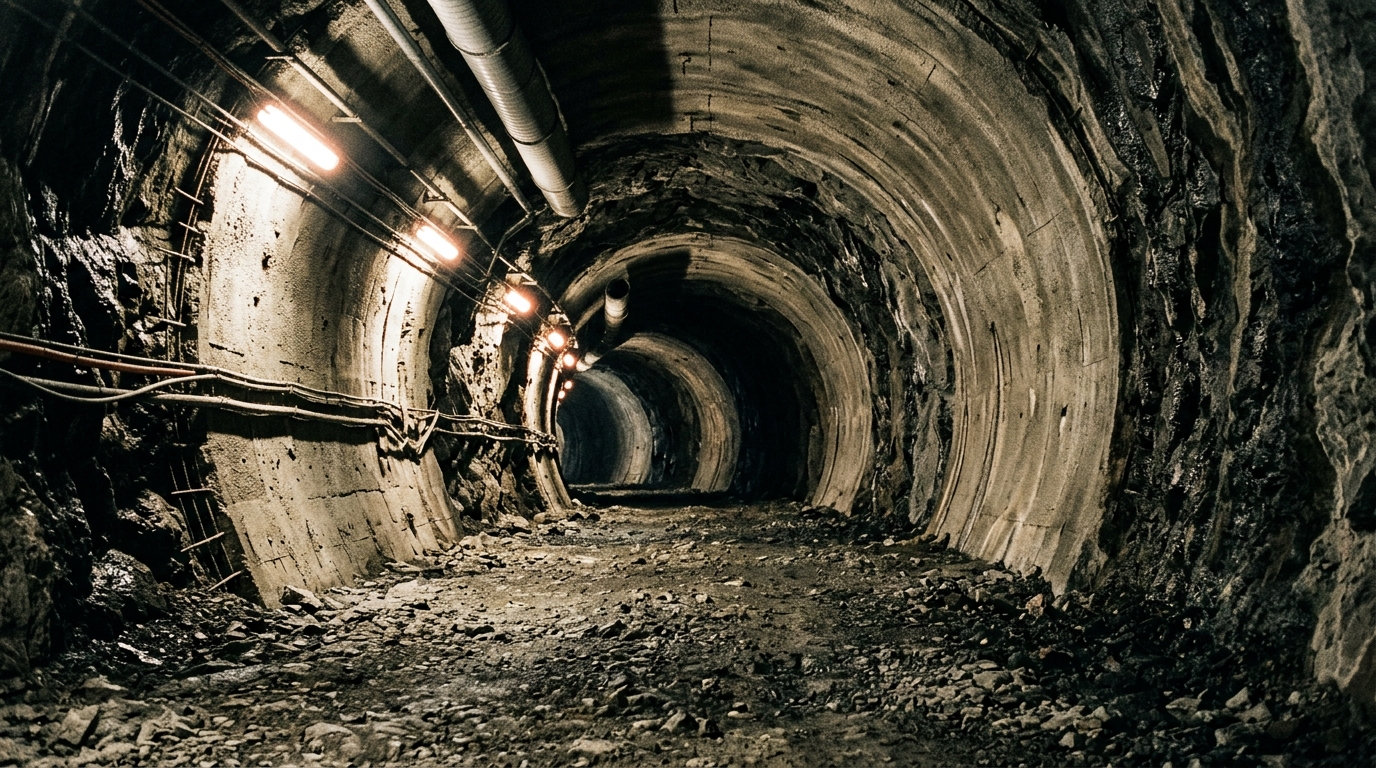
On one side, giant tunnel boring machines swallowing Alpine rock meter by meter for more than two decades. On the other, not a trace of a freight train on this future line. This is the paradox surrounding the Lyon-Turin project, the rail link meant to revolutionize freight transport between France and Italy. As work continues beneath the Mont Cenis Massif, one question inevitably returns: how can we explain that a project launched at the very start of the 2000s has still not seen a single convoy pass?
- As of January 31, 2026, 46.6 km of galleries had been dug out of the planned 164 km, including 19.8 km for the base tunnel
- A giant 334-meter tunnel boring machine is due to descend in 2027 to drill nearly 10 km to Susa, marking the shift toward the final tunnel
- The full commissioning of the line, primarily dedicated to freight, is not envisaged until around 2033
- Under the mountains, a phantom construction site lasting twenty years
- Galleries dug at great cost, but no trains on the horizon
- The base tunnel, this promise repeatedly pushed back after 2030
- When public money sinks faster than the drills
- Lyon-Turin, symbol of a budget drift that goes unnamed
Under the mountains, a phantom construction site lasting twenty years
One must imagine tens of kilometers of galleries dug in the silence of the Alps, invisible from the surface, and yet very real. Since the 2000s, French and Italian teams have been active beneath the mountain to prepare what would someday become the Mont Cenis base tunnel. This titanic undertaking long consisted of reconnaissance galleries, meant to study the massif’s geology before starting the final excavation. Over the years, these preparatory works have evolved into a true underground work of art, without the general public really noticing.
On the French side, the tunneling machines progress steadily beneath the rock, while on the Italian side the phase of preparatory works is nearing completion before the main digging begins. At Chiomonte, a new construction interchange and a mobile yard at San Didero have been completed, freeing the areas around Susa for surface interventions. A ballet of ancillary infrastructures, discreet but indispensable, accompanies the progress of this extraordinary project.
Galleries dug at great cost, but no trains on the horizon
The numbers are dizzying. As of January 31, 2026, excavations had reached 46.6 km out of the 164 km of galleries planned in total, including 19.8 km for the base tunnel. Two months later, in April, progress rose to 47.6 km, with 20.5 km for the base tunnel. And by mid-2026, the counter showed 48.5 km drilled, including 21.1 km for the Mont d’Ambin tunnel, another name given to this work. A real progression, but still far from the overall scale of the project.
On the ground, several excavation fronts operate simultaneously. At Saint-Martin-la-Porte and La Praz, the TBM Viviana resumed its progress in early March 2026 after a phase of technical cabling. Thanks to a double bore made within the galleries of the La Praz safety site, the twin tube of the base tunnel is now fully excavated over more than 12 km. At Saint-Julien-Montdenis, the final lining of one of the two galleries has even surpassed 1,000 meters in June 2026. Such technical milestones testify to a living project, but it remains invisible to rail users.
The base tunnel, this promise repeatedly pushed back after 2030
That is where the Lyon-Turin paradox lies: what is being dug today is still largely the preparation for a much larger structure. The real base tunnel, the one that will someday allow freight trains to cross the Alps unhindered, still has a decisive step to pass. On the Italian side, at Chiomonte, a tunnel boring machine has been assembled and tested in a factory before being transported to drill 18 km of one of the two tubes. But the most spectacular event remains to come: a giant TBM, 334 meters long and equipped with a 10.4-meter-diameter cutter head, is due to descend in 2027 to drill nearly 10 km to Susa. This step will mark the true shift from reconnaissance galleries to the main tunnel construction.
The full commissioning of the line, however, is only envisaged by around 2033. In other words, more than three decades separate the start of the first works from the actual circulation of the first trains. A delay that, in itself, sums up the difficulty of carrying out a cross-border project of this scale, as geological, administrative and diplomatic constraints pile up year after year.
When public money sinks faster than the tunnel boring machines
Behind every meter of rock excavated lies a colossal investment. While the exact amount spent on this binational project is hard to pin down precisely, the scale of resources deployed gives a sense of the project’s enormity: giant tunnel boring machines tailored to the project, ancillary infrastructures such as the San Didero autoport or the Chiomonte interchange, teams deployed on both sides of the border for more than twenty years. So many expenses piling up, year after year, without a train yet coming forward to justify, in the eyes of the public, the magnitude of this financial undertaking.
This gap between the investment made and the tangible result inevitably fuels questions. A project of this size, carried out over such a long period, illustrates how European infrastructure projects sometimes struggle to meet initial timelines, requiring continual postponements of their completion horizon.
Lyon-Turin, symbol of a budget drift that goes unnamed
Beyond the raw numbers, Lyon-Turin has become, almost despite itself, the symbol of a certain way of running major public works in Europe. A project initially designed to relieve Alpine roads of heavy truck traffic by integrating into the broad Southern Europe rail corridor connecting the Iberian Peninsula to Eastern Europe, but whose timeline stretches far beyond initial forecasts. It should be noted that this link is not designed for passenger high-speed travel: it is primarily dedicated to freight, with the aim of taking a significant number of trucks off mountain roads.
Such a project, where digging continues for years without any users benefiting yet, raises a broader question about how large cross-border infrastructure projects are steered. Between ecological ambitions, economic necessity and the reality of long timelines for underground work, Lyon-Turin crystallizes, in its own way, the tensions inherent in very large-scale public investments.
Yet beneath the Alps, the rock continues to yield ground, meter by meter, TBM after TBM. By 2027, the shift toward intensive digging of the base tunnel will mark a decisive milestone, ahead of a hoped-for opening in 2033. The timetable remains distant, prompting the question: at what point does such a long project stop being a promise and become a tangible reality for rail users?
