
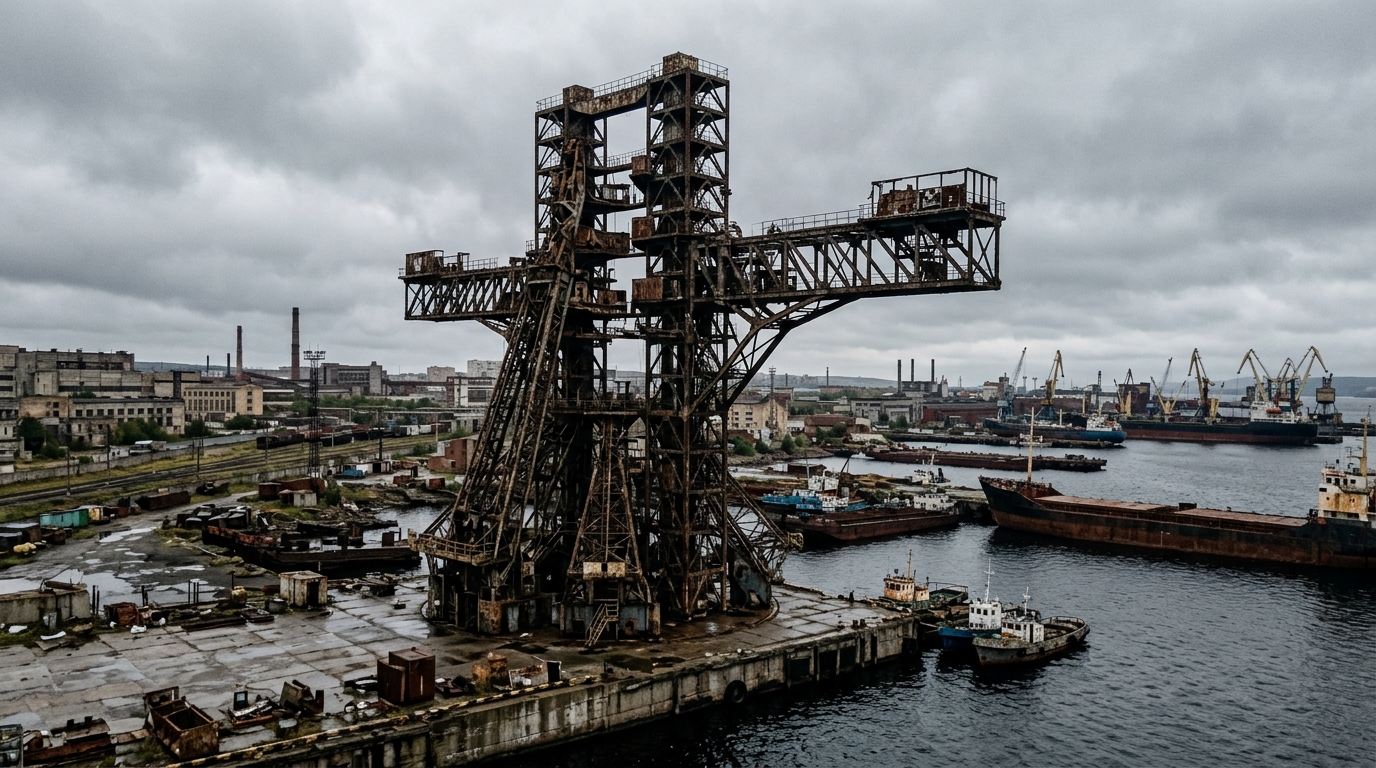
For years, a Russian industrial empire has owned the world’s largest floating launch platform. It has never fired a rocket under this new flag. Docked at Slavianka port, in Russia’s far east, Sea Launch rusts under rain and snow, the victim of a commercial bet that went wrong. A look back at the story of a technological giant turned wreck, caught between fallen space ambitions and geopolitical tensions.
- The Odyssey platform, a former oil platform repurposed, carried out 32 successful commercial launches between 1999 and 2014 as part of the international Sea Launch consortium
- Purchased in 2018 by the S7 Group for $109 million, it joined Slavianka port in February 2020 without ever being reactivated
- In the absence of new launch contracts and amid tensions with Ukraine, the Zenit rocket manufacturer associated with the project, the platform remains idle and gradually worsens due to corrosion
- When Ukraine, Russia and the United States launched rockets together
- S7 Group buys the Soviet space dream for a bargain
- Sanctions, war and paperwork: why the engine never restarts
- A 46,000-tonne carcass that costs a fortune to do nothing
- Sea Launch, a symbol of a space ambition sacrificed on the altar of geopolitics
Hard to imagine, by looking at this inert mass of steel, that it once embodied one of the boldest space projects of the late 20th century. This platform, named Odyssey, is not a mere ship: it is an old 1980s oil platform, fully repurposed to launch rockets from the equator. A strategic choice far from trivial, since launching from this zone takes advantage of the Earth’s rotation to save propellant. Today, this 46,000-ton monster moves not a single inch, a quiet witness to an industrial dream frozen in time.
When Ukraine, Russia and the United States launched rockets together
The Sea Launch project was born in a context one would hardly believe today: an international space cooperation bringing together Ukraine, Russia, the United States and Norway. The idea was simple on paper, but spectacular in its execution: transform an offshore oil platform into a mobile launch pad that could sail to the equator to launch Zenit rockets of Ukrainian origin, powered by Russian engines.
Between 1999 and 2014, this unlikely alliance bore fruit. The Odyssey platform completed 32 successful commercial launches, sending telecommunications satellites into orbit for international clients. A technical and diplomatic feat that long stood as a showcase of what space cooperation could achieve, even among nations with sometimes divergent interests. But this impressive mechanism began to stall: financially strained, the Sea Launch consortium ceased operations in 2014 as geopolitical tensions between Russia and Ukraine started to weigh heavily on the project.
S7 Group buys the Soviet space dream for a bargain
After several years of uncertainty, it was the Russian giant S7 Group, best known for its airline activities, that took up the mantle. In April 2018, the company completed the purchase of Sea Launch for $109 million, a sum small compared with the technological complexity of the whole undertaking. The entity was revived as SL Aerospace, with the stated aim of reviving commercial operations from the equator.
But before the platform could leave American soil, U.S. authorities removed the most sensitive equipment, notably GPS-based positioning gear. A strategic precaution that speaks volumes about the mistrust surrounding this transfer to Russia. In February 2020, Odyssey finally crossed the ocean to the Russian shipyard at Slavianka, accompanied by the command ship Sea Launch Commander. The two vessels have not moved since.
Sanctions, war and paperwork: why the engine never restarts
On paper, everything seemed ready for a revival. As early as 2020, the Russian Deputy Prime Minister Yury Borisov announced a broad restoration project for the site, estimated at around 35 billion rubles. These announcements suggested a comeback for this unique technology. But since then, little has moved on the ground.
The main obstacle remains commercial and diplomatic: S7 has never signed a single new launch contract for the Zenit rocket linked to the project. Without a firm order, it is difficult to justify the colossal investment required to restore such a complex infrastructure. Add to this the tense geopolitical context between Russia and Ukraine, which produced the Zenit rockets, and the equation becomes nearly unsolvable. The program remains frozen, with S7 admitting it does not have the means to restart it.
A 46,000-tonne carcass that costs a fortune to do nothing
Since its arrival at Slavianka, the Odyssey platform has had no launch activity. Yet immobilizing such a vessel is not free. Maintaining a metallic structure of this scale, exposed to sea spray and the extreme climate of Russia’s Far East, represents a substantial expense. Each passing winter accelerates the corrosion, gradually turning this engineering marvel into a rusting carcass.
The paradox is striking: the more time passes, the more technically complex and financially risky reactivation becomes, which in turn deters any new investment. A vicious circle in which this platform finds itself trapped, condemned to immobility even as it remains, on paper, one of the most capable tools ever designed for equatorial launches.
Sea Launch, symbol of a space ambition sacrificed on the altar of geopolitics
The story of Sea Launch perfectly illustrates the fragility of large-scale industrial projects when they rely on international cooperation. What was once a symbol of technical unity among several nations is today reduced to a floating wreck, held captive by geopolitical rivalries and economic calculations. The platform continues to exist physically, but its spirit, that of an ambitious and unifying space project, seems definitively extinguished.
What remains is a question hanging over Slavianka port: will this unique technology ever regain a second life, or will it be dismantled like so many other relics of the Soviet space era? For now, only rust continues its work, patiently, on this immobile giant that perhaps still dreams of reclaiming the equatorial horizon it once crossed so many times.
