
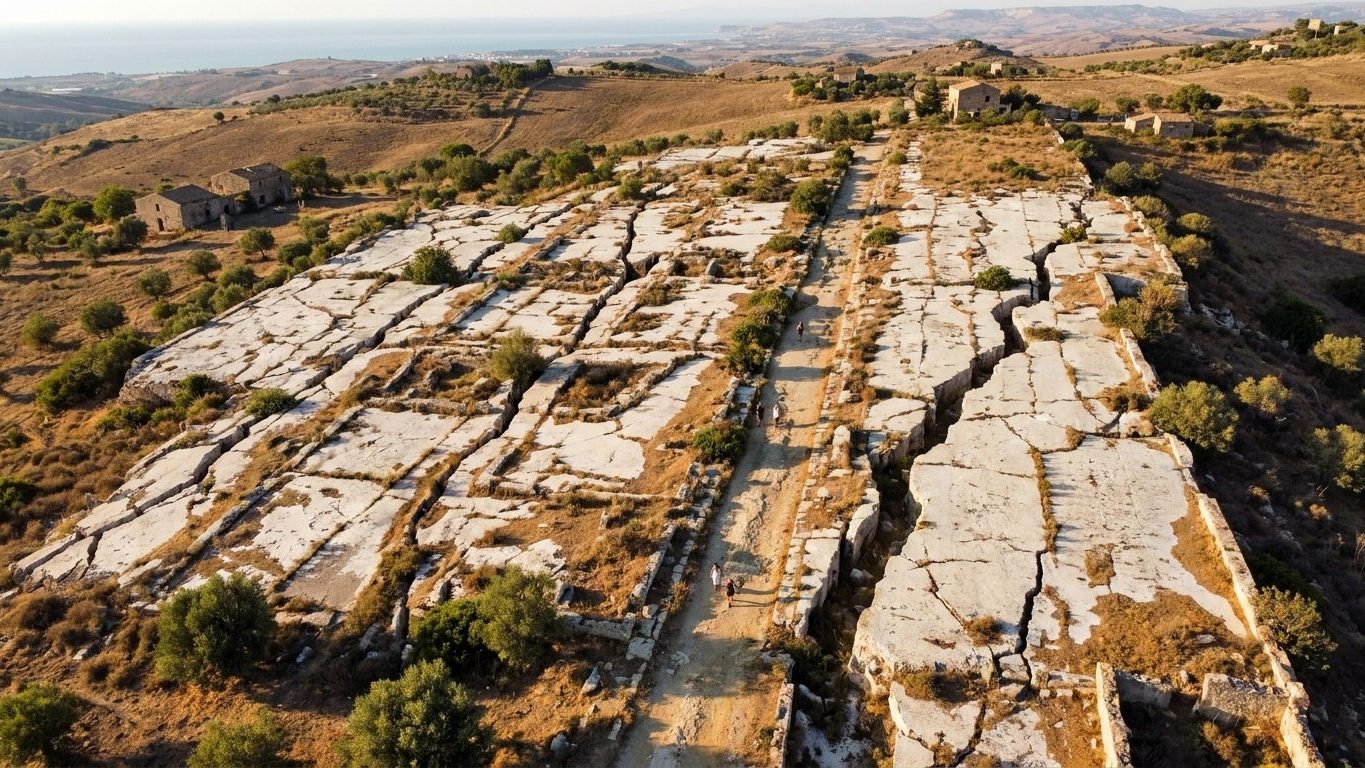
A sheet of white concrete has stretched since 1984 along the slope of a hill in the province of Trapani, covering about 85,000 m². The project began then but was not finished: the pour would be interrupted five years later, then resumed, and only completed in 2015. Beneath this cement, the foundations, furniture, and everyday objects of an entire village remained in their exact places.
This village was called Gibellina.
- The earthquake of January 15, 1968 destroys Gibellina and its neighboring villages in a matter of seconds, leaving tens of thousands of people homeless.
- The artist Alberto Burri covers the ruins with a white concrete slab 1.50 meters high, held up by a trellis, with the cracks reproducing the preexisting urban plan.
- The work stretches over 31 years: begun in 1984, halted in 1989, and only completed in 2015 after Burri’s death in 1995.
A quake that erases Gibellina in a few seconds
In the night between January 14 and 15, 1968, an earthquake measuring 6.5 on the Richter scale shakes the Belice valley in the southwest of Sicily. Gibellina, along with several neighboring villages, disappears in seconds beneath the rubble. The human toll that night remains debated depending on the sources consulted, but tens of thousands of inhabitants find themselves homeless overnight. The ruins, however, would neither be raised nor cleared: the ruins of the old town are left abandoned until the start of the Cretto works in 1984.
Because the ground proved unstable, Gibellina was not rebuilt on site; a new town, Gibellina Nuova, is built nearby. This new town is designed by renowned Italian artists and architects.
Thirty-one years to pour a single slab
In 1980, Alberto Burri and other internationally renowned artists are invited to Gibellina Nuova by Mayor Ludovico Corrao to create works for the new town. Yet the master accepts the invitation while preferring to intervene on the ruins of the old city, planning to cover the debris with a poured white concrete slab assembled in blocks and held by a trellis, leaving the cracks free to trace the route of the main streets of the preexisting urban plan. It is this idea, and this idea alone, that will occupy Burri until his death.
The first pour of cement falls in 1984.
Funds quickly run out. He begins pouring white cement over the rubble of the old town, but the project struggles to secure enough financing, and in 1989 the works halt with only about a third of the project completed. Burri dies in 1995, with the project still unfinished. It would take until a second phase of work, between 2011 and 2015, to culminate in the inauguration on October 17, 2015, marking Burri’s centenary.
The final result is captured in a few figures: a height of 1.50 meters on a rectangle measuring 350 by 280 meters. Seen from above, the whole forms a vast cracked puzzle laid along the hillside.
Walking in the streets of a village that no longer exists
The cracks between the blocks are not decorative: they are split by deep crevasses that create walkable paths roughly tracing the routes of the old town’s streets. Today they can be walked freely, following the same routes that residents used before 1968. The silence there is almost complete, only interrupted by the wind gliding over the white cement.
Underfoot, nothing has moved since 1968.
The Cretto did not clear anything away: beneath the slab, everything remained in place. Debris from buildings, but also furniture, utensils, and toys, stayed beneath the cement of the Cretto.
Gibellina Nuova, a new town beside silence
While the white blocks were spreading over the ruins, Gibellina was rebuilt about 20 kilometers from the original site of the old town. Renowned Italian artists and architects contributed to its design. Today, nearly two thousand works of contemporary art are scattered throughout its streets and squares.
The Cretto itself does not command universal accord among Sicilians who lived through the earthquake or inherited its memory: the evocative and commemorative scope of the monument remains limited by a lack of contextualization, and it is not fully acknowledged by the inhabitants, whether they experienced the quake or not.
Sources: westofsicily.com | fondazioneburri.org
