
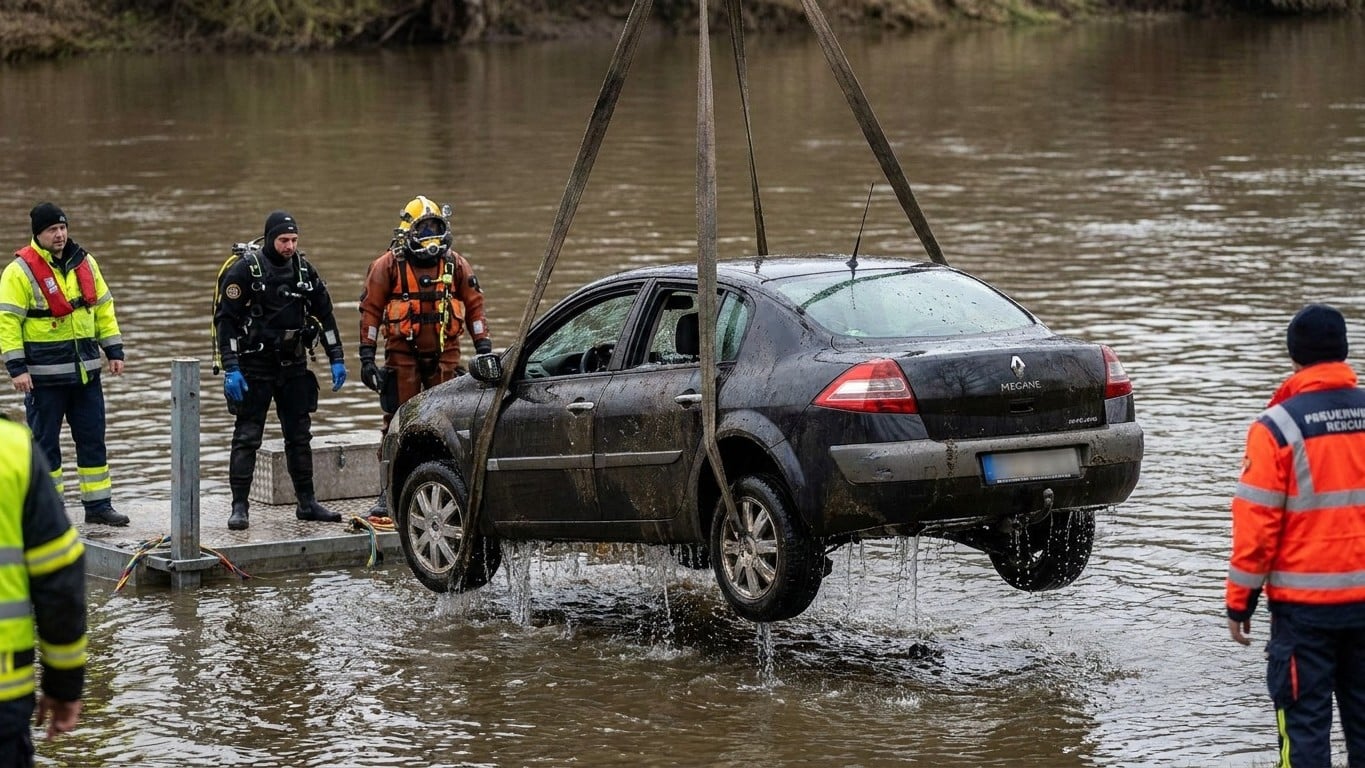
A black Renault Mégane emerged from the Adour’s murky waters on July 21, the exact eight-year anniversary of the disappearance of David Stévenin. What the gendarmerie, professional divers, and years of searches had never managed to locate, an American volunteer team found in just a few hours of sonar work. The next day, at the same spot, they hauled up a second wreck: that of Joëlle Pouy, who had gone missing in 2017. Two cases closed, two families left in uncertainty for nearly a decade, resolved in quick succession by strangers from across the Atlantic.
Key takeaways
- An American diving team locates two submerged vehicles in two days, where official searches had failed for eight years
- Bathymetric sonar technology delivers in hours what traditional methods had never revealed
- These discoveries raise troubling questions about how much effort is truly allocated to missing-person searches in France
A September 2018 Night That Turned into Mystery
David Stevenin, 30, disappeared in the night of September 25–26, 2018, in the commune of Urt. The young man, originally from Normandy, had come to the Basque Country in August of the same year. After a dispute with people he had met there, the thirty-something disappeared. He had planned to settle in the region: arriving from Normandy in 2018, a hiking enthusiast, he intended to establish himself in the Basque Country. David was accompanied by his dog and was traveling in a black Renault Mégane.
The searches conducted at the time yielded nothing. Despite extensive manhunts, investigations by the gendarmerie, and appeals for witnesses, he was not found. His family, however, refused to give up. An article in Tribunal du Net reported that his mother and sister carried this case for eight long years, insisting they would never give up. The file ultimately drifted into the category of cold cases that haunt relatives far longer than newspaper headlines.
Four Hours of Sonar Against Eight Years of Fruitless Searches
That is where the Americans from Adventures With Purpose stepped in. David Stevenin’s car, a 29-year-old who had been missing in the Basque Country since 2018, was found on July 21 submerged in the Adour at Urt, thanks to the American diving team Adventures With Purpose. The reaction of his sister, contacted by ICI Pays Basque, sums up the gap in resources: “They achieved in four hours what we couldn’t find in eight years.” The car was retrieved on Tuesday, July 21, in the presence of the gendarmes.
The most chilling part remains the discovery inside the vehicle. Local reports indicate that human remains were found in the cabin, bringing eight years of silence to an end for the family. The collective does not improvise: according to its official site, Adventures With Purpose combines side-scan sonar and bathymetric mapping to systematically scan kilometers of waterways—a methodical approach that neither the gendarmerie nor local divers had deployed on the Adour in eight years. Moreover, their method allowed, during this single campaign, the identification of several sunken vehicles at once: “by using a sonar, our team searched roughly 13 km of the Adour River, downstream of Urt toward Guiche,” the company notes, and three submerged vehicles were located during this one search campaign, a figure that speaks to the number of wrecks forgotten at the bottoms of French rivers.
It was not an improvised arrival on the families’ side either. David Stévenin’s sister said she had been contacted by a member of Adventures With Purpose a few weeks earlier, a man presenting himself as the head of an association that searches for missing people, notably in rivers and watercourses, explaining that they conduct several searches in Europe during the summer and wanted to attempt to locate David. Lacking trust, the family did not follow up: “My mother and I were quite wary, we were afraid it might be a scam. And with the language barrier we left it all on hold and did not respond.” It was ultimately a neighbor who alerted David’s sister to the operation’s success.
Twenty-four Hours Later, a Second Missing Person Located at the Same Site
The story could have stopped there. But the very next day, another discovery, just as dramatic, occurred a few meters from the first site. Joëlle Pouy’s car and body were found on Wednesday, July 22, in the Adour at Urt, not far from the location where David Stevenin’s car had been salvaged the day before. A journalist on the scene summed up the moment in one line: “It’s a case worthy of a crime thriller.”
Joëlle Pouy had disappeared well before David. This 68-year-old woman at the time, from Mouguerre, vanished on November 15, 2017 after an early-morning visit to a medical analysis laboratory in Saint-Pierre-d’Irube. According to La Semaine des Pyrénées, her car was found with her body inside nearly seven years and eight months after her disappearance. It was actually her son who triggered the second search: Sébastien Pouy, Joëlle’s son, contacted them after reading in the press that they had just found David’s car. The Americans were already on their way back to Italy when the message arrived: “They were having dinner in Toulouse, on their way to Italy; I sent them a photo of my mother’s van, they realized they had seen it on their radar when they were searching for traces of David’s car. They told me: we’re turning back. And they did.”
The husband of the missing woman, present during the retrieval of the licence plate, offered a reaction both moving and restrained: “On the one hand we are relieved; on the other hand… it’s over.” Her son spoke of relief tinged with sadness after nine years of waiting.
What this double ending reveals most of all is the scale of the groundwork carried out by this collective throughout the summer. In the summer of 2026, they had decided to traverse Europe to resolve eight different cases; Joëlle’s case, not planned, became their ninth. Two French cold cases closed in two days, with not a single cent demanded from the families: a prompt, fundamental reminder to reexamine the resources actually devoted in France to searches for missing people in rivers, when a sonar device and a handful of volunteers can sometimes pierce eight years of silence.
Sources: ici.fr | france3-regions.franceinfo.fr
