
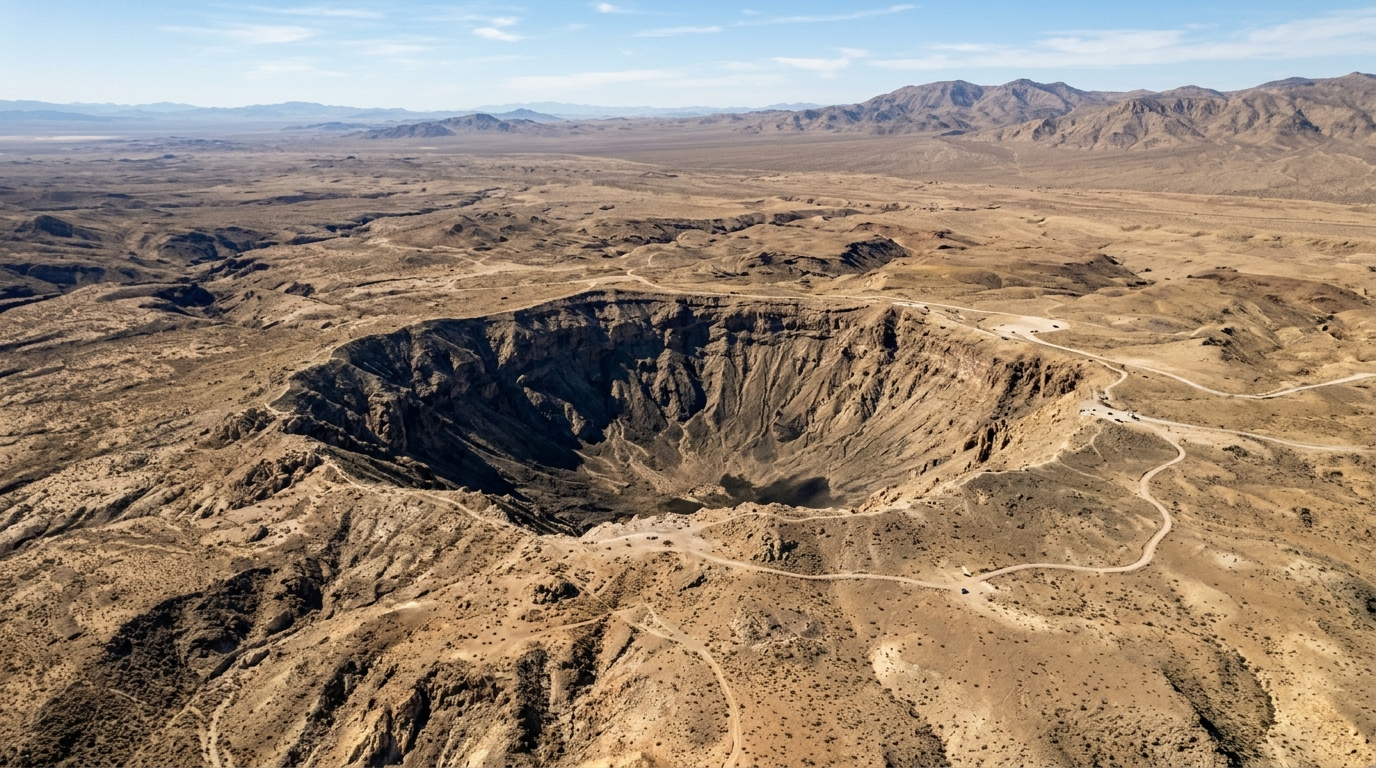
Hard to believe, but there is a place in the United States where the ground literally collapsed in on itself without a single bit of construction equipment touching it. No excavator, no improvised dynamite, no millennia of erosion either. Just a handful of seconds that were enough to turn a flat patch of desert into a sinkhole nearly 100 meters deep. For more than six decades, this yawning crater has stood in Nevada, like a scar frozen in time. And its origin, as vertiginous as its diameter, deserves a closer look.
- The Sedan Crater, formed in 1962 during a 104-kilotone nuclear test as part of the Plowshare program, measures 390 meters in diameter and about 100 meters deep.
- This program aimed to use controlled nuclear explosions for civil engineering, but the test contaminated more American residents than any other nuclear detonation on U.S. soil, leading to the project’s abandonment in the 1970s.
- Listed on the National Register of Historic Places in 1994, the site is today open to monthly guided tours under strict conditions.
- A 390-meter hole untouched by any machine
- Operation Plowshare: when America wanted to dig with the bomb
- The day Sedan shook Nevada
- Contamination, panic and the end of a nuclear dream
- Sedan today: a classified scar and a lesson in history
A 390-Meter Hole Untouched by Any Machine
Picture a crater wide enough to swallow several football stadiums side by side, and deep enough to swallow a thirty-story building. That’s exactly what lies in the heart of the Nevada test site, a desert expanse where the American military conducted decades of secret experiments. The crater measures roughly 390 meters in diameter and almost 100 meters in depth, making it the largest crater of nuclear origin ever formed on U.S. soil.
No excavator, no bulldozer, no human hand directly shaped this void. Its formation owes nothing to patient earthmoving, but everything to raw, instantaneous energy. And it’s precisely this lack of an obvious explanation that makes the place so captivating: how can a single point in the desert transform into a giant crater overnight, without any construction equipment ever laying a blade on the ground?
Operation Plowshare: when America wanted to dig with the bomb
The answer lies in a program now largely forgotten, called Plowshare. In the context of the Cold War, American scientists did not see the nuclear weapon solely as a tool of military deterrence. Some envisioned it as a powerful civil-engineering instrument. The idea, as audacious as it was ambitious, was to use controlled nuclear explosions to carve canals, deepen deep-water ports, or construct dams, at a scale and speed that no conventional technique could match.
On paper, the logic was nearly sound: why spend years digging with ordinary explosives when a single nuclear detonation could move millions of tons of earth in an instant? The Nevada desert, already a testing ground for numerous military experiments, became the ideal arena to test this theory in reality.
The Day Sedan Shook Nevada
Thus began what history will remember as the Sedan shot, a nuclear test with a yield of 104 kilotons, far surpassing the bombs dropped on Japan in 1945. The device was carefully placed at the bottom of a borehole drilled to more than 180 meters below the desert surface, before being detonated at the surface in a controlled manner.
The blast instantly hurled millions of tons of rock and sand into the air, before the ground collapsed to form this enormous funnel. In just a few seconds, the landscape was rewritten. The result exceeded all engineers’ expectations: never before had an explosion moved so much material in so little time. Sedan remains, to this day, the largest demonstration of nuclear excavation ever carried out for civil purposes.
Contamination, Panic and the End of a Nuclear Dream
But this technical feat concealed a far more troubling downside. The explosion produced a radioactive cloud that spread well beyond the site’s borders. According to available data, the fallout from Sedan contaminated more American residents than any other nuclear test conducted on U.S. soil. Radioactive particles traveled long distances, affecting populations that were never directly associated with military testing.
This finding, coupled with growing opposition to nuclear energy over the years in the 1970s, ultimately doomed the Plowshare program. Contrary to what one might think, it wasn’t a technical failure that ended these civil-excavation ambitions: Sedan had proven that the method worked. It was the health and environmental concerns deemed too risky that shut the project down in the mid-1970s.
Sedan Today: a Classified Scar and a Lesson in History
More than sixty years after the explosion, the Sedan crater remains, wide open and almost serene in its mineral stillness. Nature has begun to reclaim the site’s edges: tumbleweeds, those quintessential prickly balls of the American desert, have gradually recolonized the surroundings, visually softening a wound that remains very real beneath the surface.
The site was listed on the National Register of Historic Places in 1994, an official acknowledgment of its significance in the nation’s scientific and military history. Today, guided tours are still offered monthly at the Nevada test site, drawing thousands of curious visitors each year eager to witness this relic of the arms race with their own eyes. Access remains strictly controlled: visitors must follow precise rules, including the prohibition on photographing certain active military installations near the crater.
This silent abyss, set in the middle of the desert, encapsulates an era when science believed it could tame the atom even for public works. It also reminds us that some technical feats, impressive as they are, encounter limits that we only fully recognize in hindsight. Gazing at this crater today, now overgrown with brush, one cannot help but wonder how many other ambitious projects of that era were abandoned just in time.
