
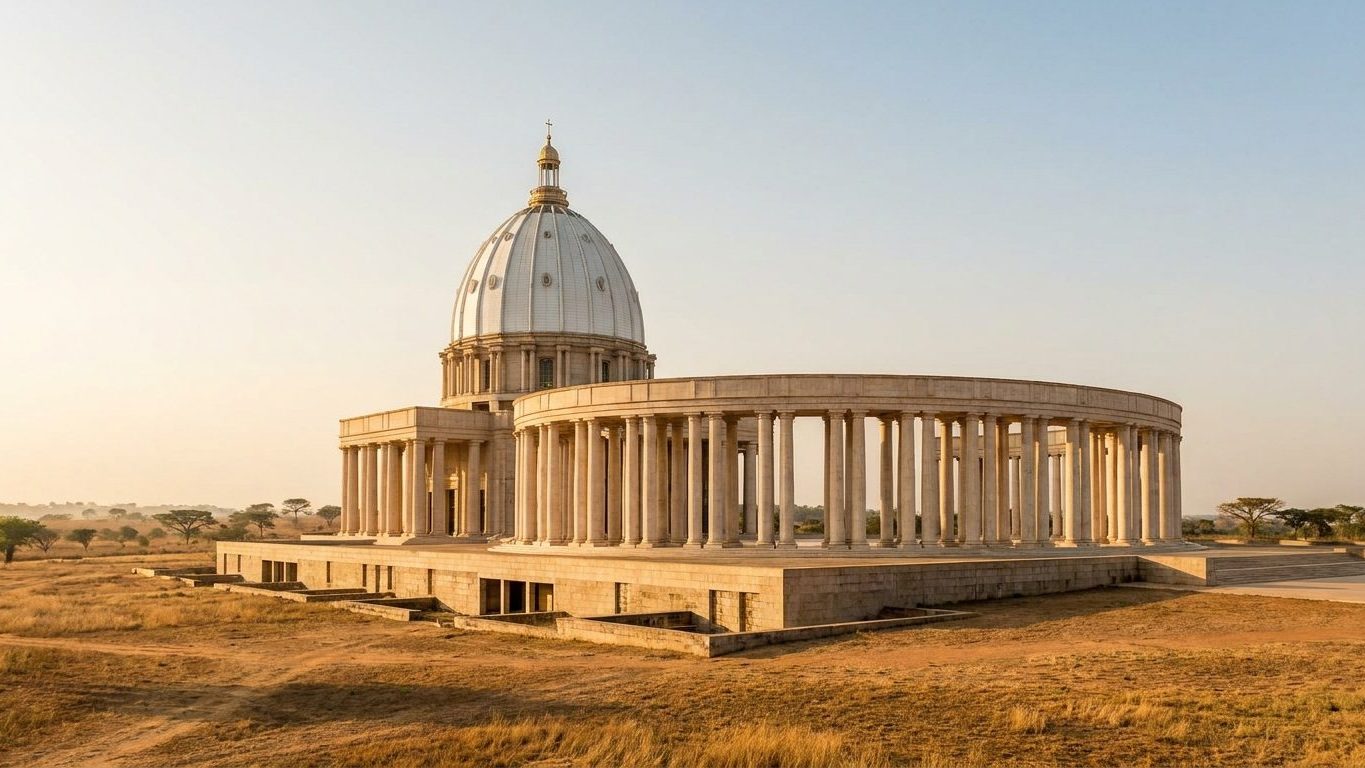
A 158-meter dome dominates the Ivorian savanna since its consecration on September 10, 1990. It reaches a height of 158 meters with its gigantic dome, perched atop a basilica capable of seating 18,000 worshippers and 11,000 standing. It is the largest Christian religious edifice in the world, ahead of Saint Peter’s Basilica in Rome, which it openly draws inspiration from.
Seven years earlier, Yamoussoukro wasn’t even the capital.
- Yamoussoukro’s dome stands 158 meters tall, 17 meters taller than Saint Peter’s in Rome.
- The basilica has 8,400 square meters of stained glass spread across 18,500 panels, the largest glazier surface in the world.
- Yamoussoukro became the capital in 1983, but only the basilica was truly completed among the major planned projects.
A rural village promoted to capital
Félix Houphouët-Boigny, the first president of Côte d’Ivoire, decided in 1983 to make Yamoussoukro, his birthplace, the capital of the country. The choice was far from a mere administrative move: it is the place where he was born, the site he aimed to elevate as the symbolic center of Ivorian power. Large-scale projects transformed this small village into a modern city, with an international airport, a polytechnic institute, and soon the largest church in the world.
The village was formerly called N’Gokro. It was renamed Yamoussoukro in homage to Yaa N’Sò, Houphouët-Boigny’s grandaunt, and the suffix “kro” means “village” in the Baoulé language.
The bet remained only partly fulfilled. Most political and administrative institutions were never relocated to Yamoussoukro, and few residents settled there. President Laurent Gbagbo had nonetheless revived the project by starting the construction of a Parliament and a massive presidential palace. Those works were not continued by his successor, Alassane Ouattara.
One structure, however, was indeed completed.
The Ivorian architect Pierre Fakhoury was chosen by Félix Houphouët-Boigny on February 4, 1986, following a competition launched two years earlier. The cornerstone was laid on August 10, 1985. About 1,500 African workers rotated through the site, supervised by twenty-four Ivorian and foreign companies.
The construction progressed at a record pace, driven by the urgency of an aging president who wanted to see the building completed in his lifetime. The consecration took place on September 10, 1990, five years after the laying of the foundation stone.
A dome wider than Saint Peter’s
Twice as wide, and yet taller.
On the ground, the building covers 30,000 square meters. Its dome has a diameter of 90 meters, compared with 41 meters for Saint Peter’s in Rome. It rises to 158 meters, 17 meters higher than the Roman basilica.
The second level and the dome are supported by a triple colonnade of 48 Doric columns identical to those on the esplanade, and 12 imposing Ionic columns representing the twelve apostles. Each climbs to more than 30 meters in height with a diameter of three meters.
The stained glass work represented a project in itself: 8,400 square meters of glass spread across 18,500 panels, ordered from France. The work was carried out in eighteen months, in Nanterre, by the France Vitrail International studio. The Basilica of Yamoussoukro has the largest surface of stained glass in the world. Each panel then journeyed to the Ivory Coast to be mounted on the dome’s metal framework.
The Guinness World Records recognized it as the largest Christian edifice in the world.
Ongoing maintenance, funding still contested
Officially, it is said that Houphouët-Boigny himself financed the construction with his personal funds, after donating his coconut plantation to host the monument. He would thus have initiated, from his private resources, the building of the basilica.
The exact cost of the project has never been officially disclosed, and the few estimates circulating never agree with one another. This version is contested by observers who doubt that a personal fortune, however substantial, could cover a project of such magnitude. The Vatican itself demanded that part of the money be used for social works.
The maintenance of the edifice costs about $1.5 million per year. Houphouët-Boigny left donations enabling maintenance to the present day, managed by a foundation based in Yamoussoukro. For thirty-five years, the basilica has been governed by the Pallottine priests, under the leadership of a rector. In January 2017, Father Franck Allatin became the first Ivorian rector of the basilica.
Its population is estimated at nearly 250,000 inhabitants, far from the major West African metropolises. Most political institutions have never left Abidjan, despite the official capital status granted to Yamoussoukro for more than forty years. Wide avenues, often sparsely used, traverse the city to the basilica, the sole real tourist attraction in the area.
The edifice remained the tallest basilica in the world since its construction, until the Sagrada Família in Barcelona surpassed it in 2026. Thirty-six years after its consecration, Yamoussoukro’s dome thus loses its altitude record by just a fraction, while preserving its place as the largest church in the world in the Guinness World Records.
Sources: sudquotidien.sn | originalfoundblog.com
