
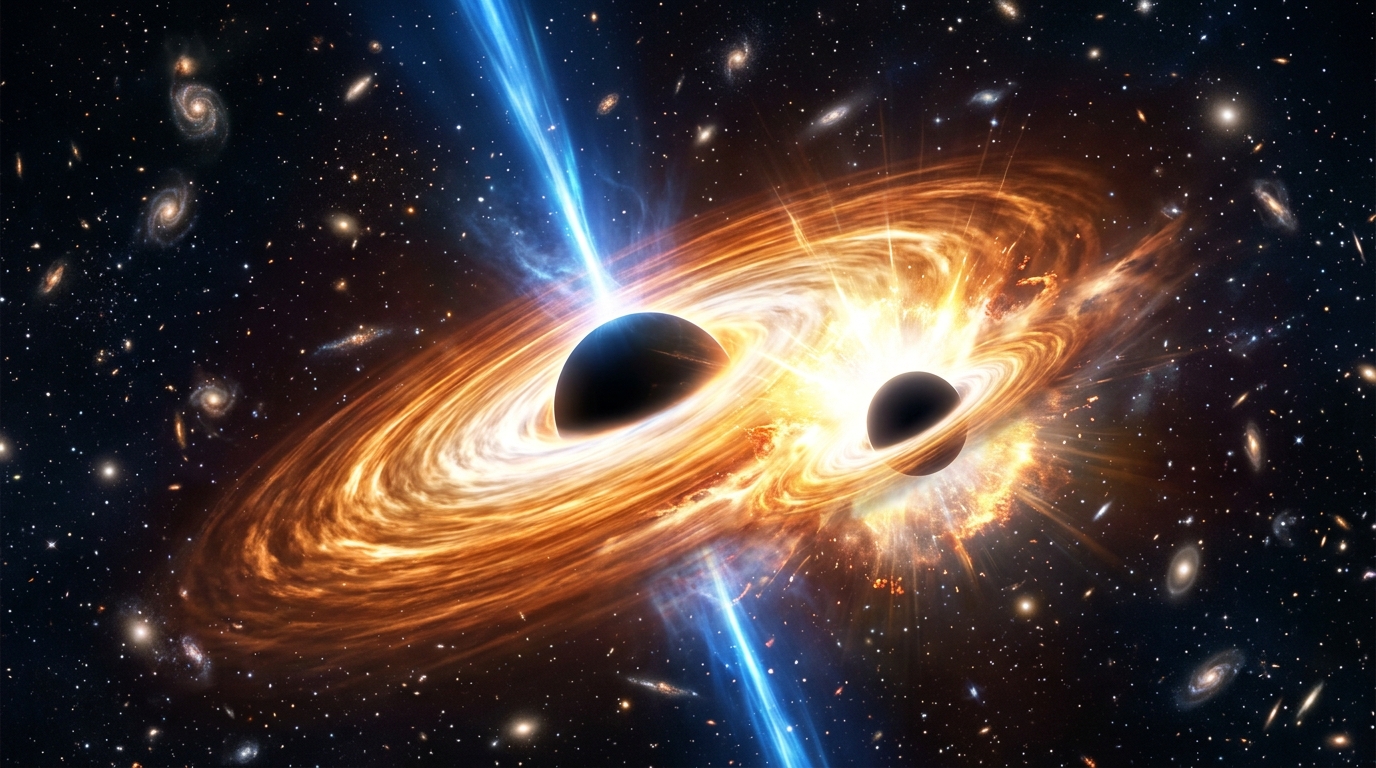
An astronomical object capable of shining as brilliantly as a billion stars, and with a regularity that is almost mechanical, is enough to induce vertigo even among the most seasoned astrophysicists. Nestled 3.5 billion light-years away, in the quiet Cancer constellation, a pair of black holes has been orchestrating a cosmic ballet of extraordinary violence for more than a century. In this season of renewed skywatching, the system dubbed OJ 287 returns to the scientific stage. Because what is at stake here is not mere astronomical curiosity: it is a true open-air laboratory for testing the most fundamental theories about gravity and the structure of the universe.
- The OJ 287 system hosts a supermassive black hole of about 18 billion solar masses and a companion of 150 million solar masses, whose luminous eruptions originate from the periodic passage of the smaller black hole through the accretion disk of the larger one.
- These eruptions follow a double periodicity, about 12 years and about 55 years, enabling astronomers to predict certain dates with precision, though an eruption expected in October 2022 did not occur.
- This system serves as a testbed for general relativity and the black hole no-hair theorem, with a new major milestone anticipated between 2026 and 2028.
- A sleeping giant in the Cancer constellation
- When one black hole perforates another through and through
- Twelve years, on the clock: the universe’s most precise cosmic clock
- What OJ 287 reveals about Einstein and the limits of current physics
A sleeping giant in the Cancer constellation
To grasp the scale of the phenomenon, one must first picture the mass at play. At the heart of OJ 287 sits a supermassive black hole with a mass of roughly 18 billion solar masses, making it one of the heaviest objects known in the observable universe. To give a sense of scale, this gravitational behemoth easily surpasses the mass of the Milky Way’s central black hole, Sagittarius A*, which is already regarded as a cosmic heavyweight.
This giant is not alone. It is accompanied by a second black hole, ten times smaller but far from negligible, with 150 million solar masses, i.e., several tens of times the mass of Sagittarius A*. The two bodies form what astronomers call a binary system, a configuration in which two massive objects orbit one another, bound by a colossal gravitational pull. It is this two-body dance, observed since 1888, that will give rise to one of the most spectacular luminous phenomena ever documented.
When one black hole perforates another through and through
Here lies the heart of the mystery, and its solution. The giant black hole is surrounded by an accretion disk, this enormous disk of gas and dust in orbit that gradually feeds the central object’s insatiable appetite. Yet, with every revolution of the small black hole around its massive companion, it literally traverses this disk, and this happens twice per orbit.
This passage is far from inconsequential. By piercing the accretion disk, the small black hole provokes a perturbation so violent that it releases a phenomenal amount of energy, in the form of a flash of light whose brightness outshines that of one billion stars. Picture a needle moving at high speed through a layer of superheated gas: the impact generates a shockwave that sets the surrounding matter ablaze. This is precisely the mechanism behind the article’s enigmatic title—the flash truly traverses the star, through and through, or more exactly through its incandescent disk of matter.
Twelve years, on the clock: the universe’s most precise cosmic clock
What sets OJ 287 apart from most violent cosmic phenomena is its regularity. More than forty years ago, Finnish astronomer Aimo Sillanpää uncovered a double periodicity in these eruptions: one of about 12 years, corresponding to the orbital period of the small black hole, and another longer one of about 55 years. This discovery turned OJ 287 into a kind of cosmic clock, whose ticks can be forecast with remarkable precision.
A team led by Mauri Valtonen of the University of Turku in Finland managed to predict with accuracy the dates of several of these periodic eruptions. Yet nature always retains an element of unpredictability: an eruption expected in October 2022 did not occur, forcing researchers to revise downward their estimates of the central black hole’s mass. This setback also prompted a new interpretation of the double-peak eruptions, with a major milestone now anticipated between 2026 and 2028, a window astronomers are watching very closely at present. More recently, in 2025, a network of radio telescopes larger than the Earth itself allowed the first radio images of this binary system, thanks to a virtual instrument whose resolution is equivalent to half the distance to the Moon—a technical feat that finally gives a face to this previously invisible ballet.
What OJ 287 reveals about Einstein and the limits of current physics
Beyond the spectacle it offers, OJ 287 provides a unique testing ground for general relativity. Astrophysicists use it, in particular, to test the famous no-hair theorem, a theory that posits a rotating black hole can be described by only three parameters: its mass, its charge, and its angular momentum—without any other distinctive characteristics. In other words, two black holes of the same mass and spin would be strictly identical, as bald as each other, lacking any distinctive signature.
Yet the precision with which OJ 287’s eruptions can be predicted provides an unprecedented way to test this hypothesis against real black holes. Each discrepancy between prediction and observation, such as the one observed in 2022, becomes a valuable opportunity to refine models and probe the limits of our current understanding of gravity. That is the core value of this binary system: it does not merely dazzle; it challenges the very foundations of modern physics.
Behind these flashes that travel across space for billions of years before reaching us lies far more than a mere cosmic fireworks display. OJ 287 embodies the tension between the universe’s raw unpredictability and our still-inchoate ability to decipher its inner workings. As the next major milestone looms between 2026 and 2028, one question remains: to what extent will this cosmic clock confirm Einstein’s predictions, and to what extent will it continue to surprise us?
