
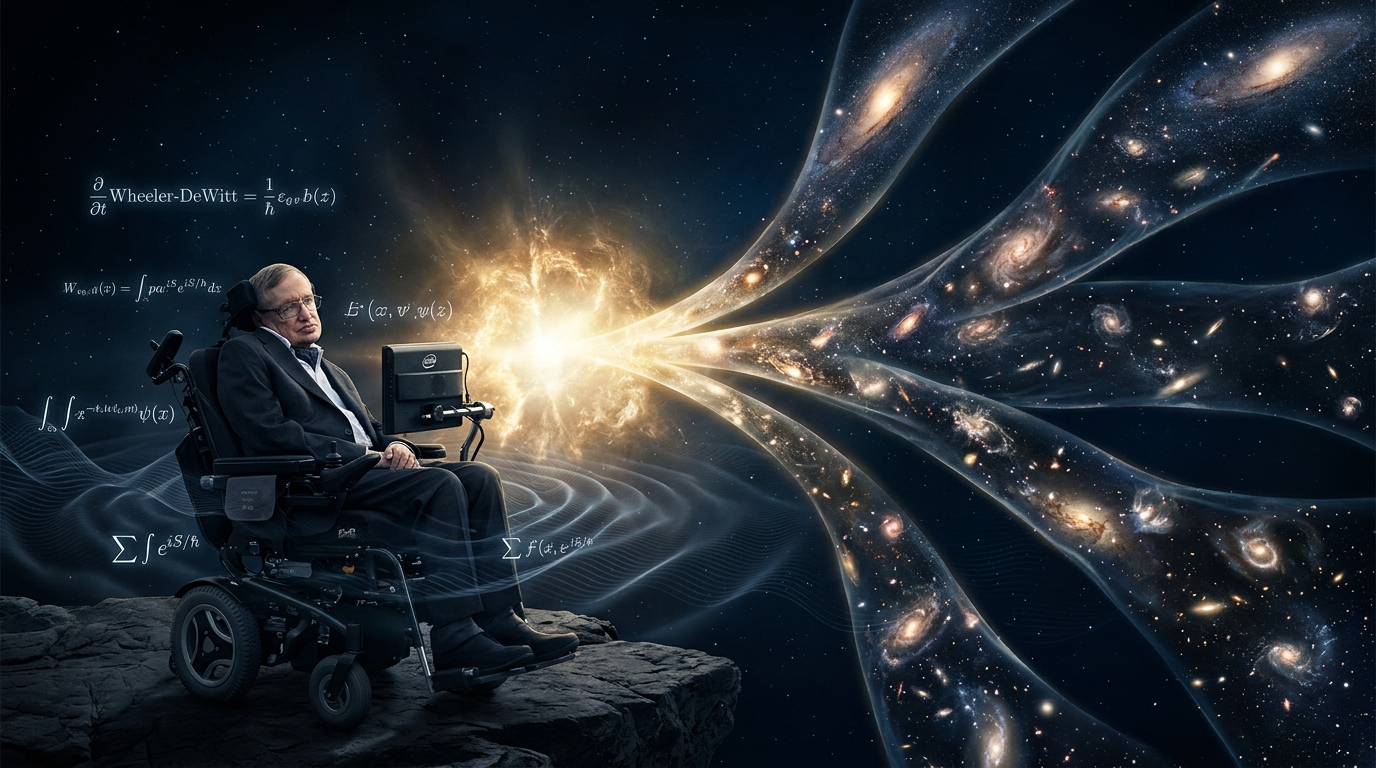
Imagine being able to rewind time to the exact moment when nothing existed yet—no matter, no space, not even the laws thought to govern either. This is the vertigo Stephen Hawking plunged into during the final years of his life, as his health faded while his mind pressed on with the most fundamental questions of physics. In this season when public curiosity leans toward grand scientific mysteries, it is compelling to revisit this lesser-known line of work, conducted with his longtime collaborator Thomas Hertog, which challenges the way we conceive the origin of the universe.
- Before his death, Stephen Hawking collaborated with Thomas Hertog on a theory in which multiple quantum histories of the universe, rather than a single scenario, could account for its present state
- Their final article, “A Smooth Exit from Eternal Inflation?”, proposes that the exit from eternal inflation yields a finite and smooth set of possibilities rather than an infinite multiverse
- This theory suggests that the laws of physics themselves emerged and evolved with the universe, a mathematical conjecture not yet experimentally confirmed.
- Could the universe have been born in thousands of different ways?
- The ultimate scientific bet of a dying physicist
- When the Big Bang is no longer a starting point but a probability
- The theory that erases the boundaries of time and space
- A multiverse without parallel: Hawking’s forgotten nuance
- What this idea changes about how we view the cosmos
Could the universe have been born in thousands of different ways?
The question may seem almost absurd, defying our most basic intuitions: might the cosmos we observe today not result from a single script but from the entwined outcomes of several possible stories that began in the very earliest moments? This deeply counterintuitive hypothesis is what Stephen Hawking explored with Thomas Hertog over nearly two decades of scientific collaboration. Their aim was not to tell a science-fiction tale, but to push the equations of quantum physics to their furthest limits—where the Big Bang ceases to be merely a starting point and becomes an object of study in its own right.
Their work builds on a long-standing idea, called top-down cosmology, which the two researchers had sketched out as early as 2006. Instead of starting from the Big Bang to predict what the universe should become, their method begins with the current state of the cosmos—the state we can observe—and traces back to initial conditions compatible with what we see today. A method that inverts the usual viewpoint, proposing that multiple quantum histories can contribute, together, to explain the universe present in our observations.
The ultimate scientific bet of a dying physicist
What makes this story especially poignant is the context in which it was written. Stephen Hawking, already weakened by a disease that had afflicted him for decades, persisted in tackling these questions until his final months. His last major scientific article, written with Thomas Hertog and published shortly after his death, bore a title nearly in the form of a question: A Smooth Exit from Eternal Inflation? A question mark that, in a way, encapsulates the researcher’s mindset: not to claim a definitive truth, but to propose a conjecture aimed at solving a problem that had resisted a satisfying explanation.
That problem is the issue of eternal inflation, a phenomenon in which the rapid expansion following the Big Bang would not have ceased everywhere at the same moment. Some regions of space would have stopped inflating to give birth to universes like ours, while others would continue to expand indefinitely, producing an infinity of distinct cosmic bubbles. A dizzying image, yet Hawking and Hertog judged it incomplete, even problematic, as the ultimate depiction of the Big Bang.
When the Big Bang is no longer a starting point but a probability
To grasp the contribution of this latest work, imagine a forensic scene of science. You uncover traces, clues, a precise snapshot: the universe we observe, with its galaxies, its cosmic microwave background, its large-scale structure. In theory, several different scenarios could have produced exactly these traces. In quantum cosmology, the question becomes: which possible histories of the universe are compatible with what we measure today?
This is where the Hawking–Hertog duo introduces a crucial nuance, often misunderstood. Their calculation does not conclude that the universe generates an infinite number of disparate cosmic bubbles. On the contrary, they argue that the exit from eternal inflation could yield a finite and relatively smooth set of possibilities, rather than an endlessly fractal multiverse. A conclusion almost opposite to what is commonly attributed to Hawking in popular imagination.
The theory that erases the boundaries of time and space
As the two researchers pushed their investigation toward the deepest origins of the cosmos, they identified a level of evolution where the laws of physics themselves seemed to transform and simplify, until particles, forces, and even time itself began to fade away. This idea resonates with another foundational pillar of their shared thinking: the famous no-boundary wave function, developed by Hawking with James Hartle in 1983, according to which the universe would have neither a true beginning nor a boundary in the conventional sense.
This discovery leads to a profoundly revolutionary notion: the laws of physics would not be carved in stone as immutable commandments, but would arise and evolve in tandem with the universe they govern, as that cosmos comes into being. Thomas Hertog characterizes this approach as a Darwinian perspective on the origins of the cosmos, where the physical laws emerge with the Big Bang and evolve alongside the expansion of the universe, much like species adapting to their environment rather than following a predefined plan.
A parallel-less multiverse: Hawking’s forgotten nuance
It is essential not to confuse this theory with the more popular but distinct notion of a classical multiverse, in which a multitude of universes would have coexisted immediately after the Big Bang, each governed by different physical laws, with only a handful meeting the conditions for life. Hertog emphasizes that this view itself raises serious conceptual paradoxes: in a context of random multiverses, nothing can really be explained; everything becomes a matter of chance, whereas a purely mathematical explanation would assume coherent, universal laws instead.
According to Hertog, Hawking spent many years seeking to understand the universe from immutable, transcendent laws, before turning to this evolutionary approach that makes the multiverse scenario far more limited and calculable. It is not a claim that every imaginable universe exists somewhere, nor that we live in one of several parallel realities: this theory remains a mathematical conjecture, published in the Journal of High Energy Physics, and has not yet been confirmed experimentally.
What this idea changes in how we view the cosmos
Far from being mere philosophical speculation, this work seeks potentially observable consequences. The two physicists examined the different geometries possible for the universe after inflation, along with their respective quantum amplitudes, concluding that some configurations are strongly favored while others are, conversely, heavily suppressed. Research from the University of Cambridge has highlighted the avenue of primordial gravitational waves as a concrete means to someday test these theoretical models against real observations.
These efforts fit squarely within Stephen Hawking’s scientific legacy, built on a lifetime spent trying to reconcile Einstein’s general theory of relativity with the puzzling tenets of quantum physics. His final contribution does not close the debate; it reframes it, suggesting that even the laws governing our reality may have arisen and evolved with it, rather than existing from all eternity.
Thus, behind this vertigo-inducing notion of a universe with multiple possible histories lies a more modest yet equally captivating lesson: science has not finished probing its own foundations. The question remains whether future observations, particularly those focusing on the universe’s oldest gravitational waves, will someday adjudicate between these different cosmic narratives, or whether this inquiry will continue to fuel our curiosity about the origins of the world for a long time to come.
