
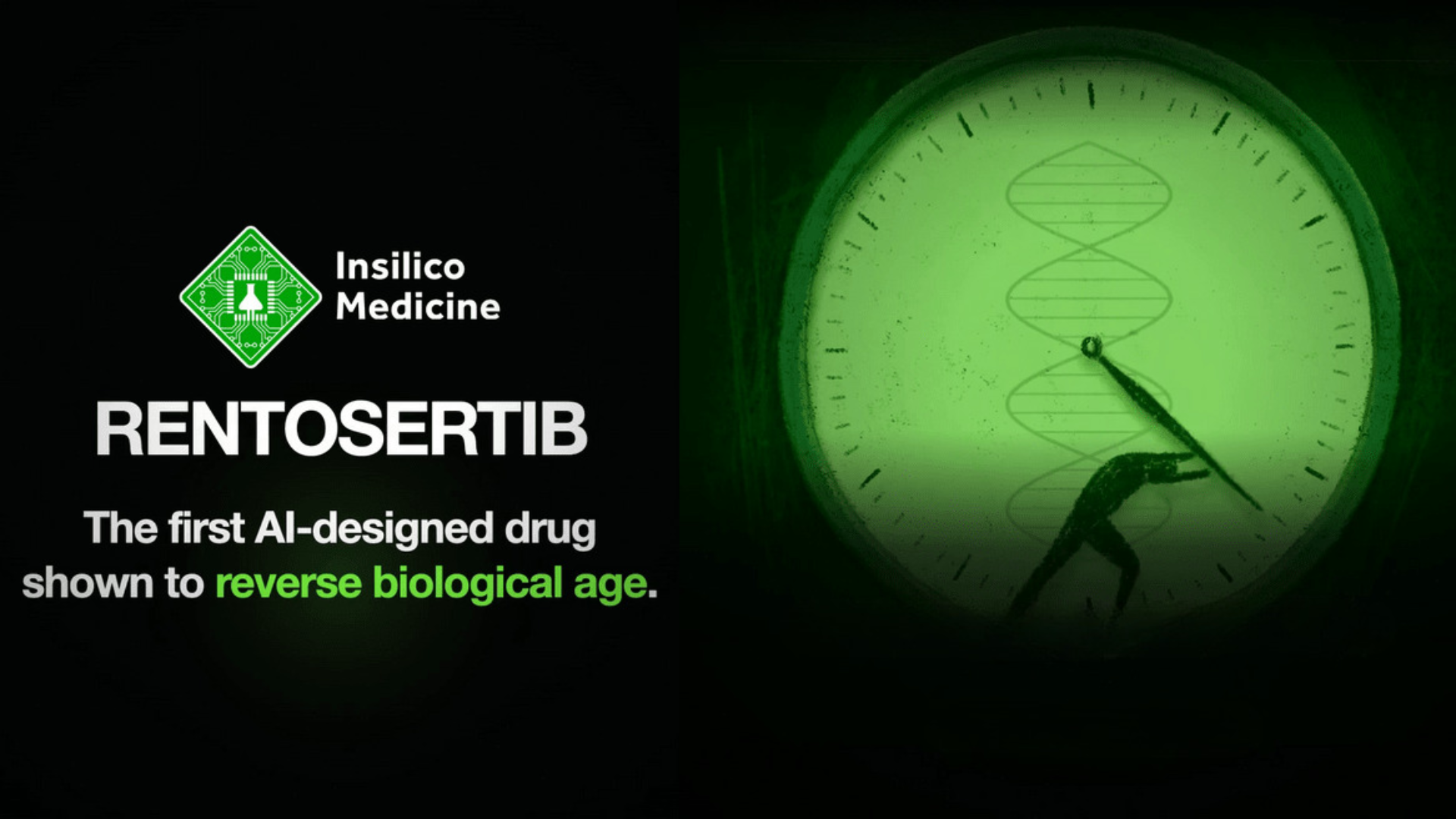
Recently, an American pharmaceutical company has developed a new molecule potentially capable of reversing aging. Yet, it was initially intended to treat a lung disease. Moreover, this marks the world’s first experimental drug whose biological target and molecular structure were entirely discovered and designed by a generative AI.
An R&D process spanning only 18 months
The U.S. biotech company Insilico Medicine is behind the “rentosertib” (formerly ISM001-055), a new molecule to treat idiopathic pulmonary fibrosis. This chronic and deadly lung disease is characterized by irreversible scarring of the lungs. However, the molecule in question aimed to inhibit the kinase TNIK (TRAF2- and NCK-interacting kinase), an anti-fibrotic target identified by AI. On September 7, 2026, researchers at Insilico Medicine published a full report of their work in Nature Biotechnology.
The document states that a clinical study (Phase II) in IPF patients demonstrated good tolerability of rentosertib and an absence of danger. Most notably, the group of patients receiving a 60 mg once-daily dose showed a significant improvement in forced vital capacity, a key measure of lung function.
According to the leaders, rentosertib is the first experimental drug in the world whose biological target as well as the molecular structure were entirely discovered and designed by a generative artificial intelligence. Moreover, the transition from identifying the biological target to nominating a preclinical candidate took only 18 months, whereas the R&D process typically requires at least a decade.
A platform operating over 30 AI models
Note that the company used its own generative AI software platform, specifically designed to craft entirely new molecules from scratch. Named Chemistry42, this platform engages more than thirty AI models in a networked operation, including GANs (Generative Adversarial Networks) and reinforcement learning models.
Initially, the platform analyzed millions of public and private data, including scientific publications, patents, and diseased-tissue sequencing, among others. Then, rather than testing millions of existing molecules in physical chemical libraries, the AI designed new molecular structures entirely virtually from 3D models.
The algorithm ultimately generated waves of successive molecules by instantly evaluating their effectiveness. Here, several criteria were considered, including their ability to bind to TNIK, their metabolic stability, their lack of toxicity, and their ease of laboratory synthesis.
An inversion of biological age in treated volunteers
Currently, the substance is in its third phase of clinical trials. Launched in mid-2026, the trial involves 320 patients across 47 sites in China and is expected to span a year. Yet, the research is not limited to treating idiopathic pulmonary fibrosis. Indeed, the Phase II work revealed a “surprise effect,” more precisely a potential action against aging.
After analyzing blood samples from study participants, researchers observed an inversion of biological age ranging from 3 to 6 years. This reversal appears to be the direct result of the molecule’s ability to modulate the phenotype of senescent cells (or “zombie cells”). These are aging or damaged cells that have permanently stopped dividing but refuse to die.
According to Insilico Medicine, there is hope that rentosertib could slow down, or even reverse certain molecular mechanisms of aging. Finally, if Phase III trials proceed as planned, the company hopes to obtain market authorization and begin commercializing the product by 2030.
