
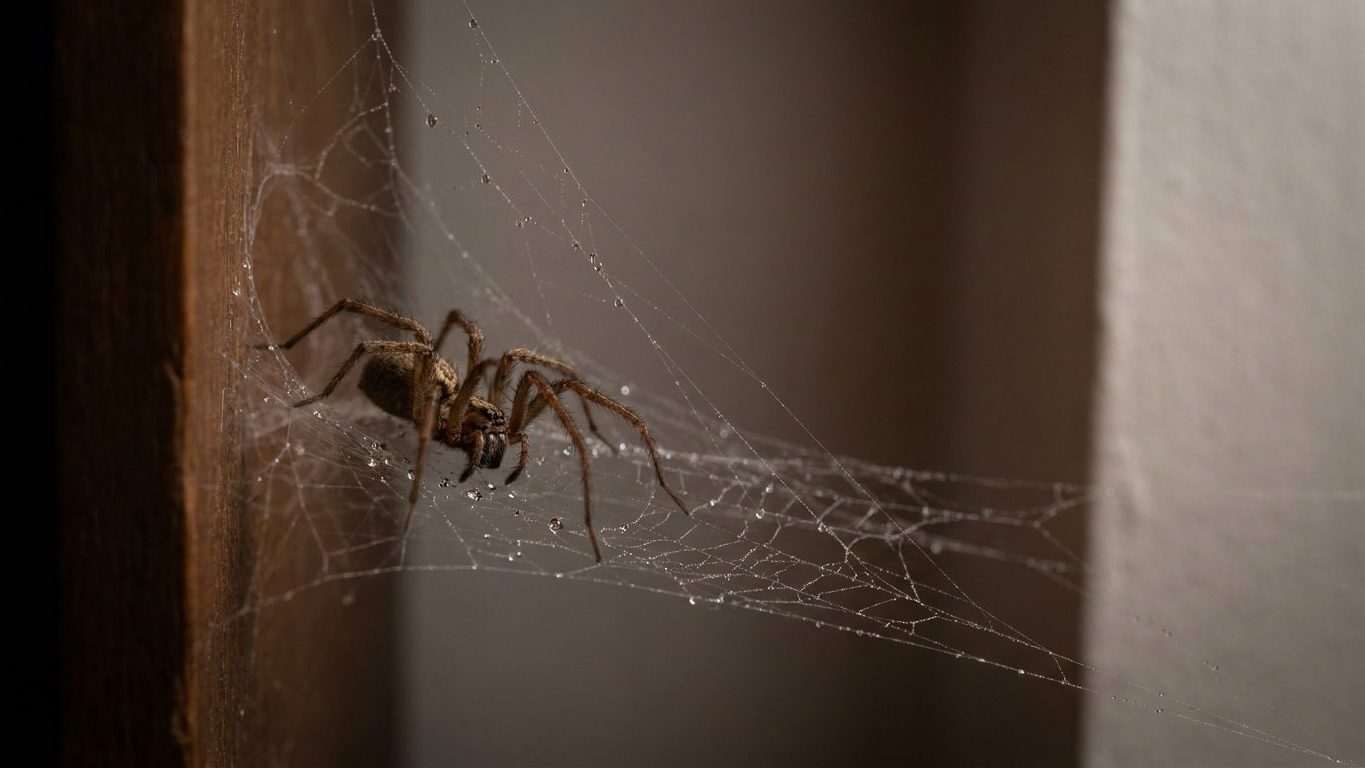
A male spider streaks across the living room in a straight line, without hesitation or weaving. It is no accident: unlike the female, he no longer spins a hunting web once he reaches maturity. He roams, literally, in search of a mate, and this nighttime crossing you take for an intrusion is, in reality, a very precise quest.
The scene repeats each year at the same time, from the end of summer to the heart of autumn. A brown form emerges from under the sofa, runs along the baseboard, and disappears under the radiator. The reflex is to think of a sudden invasion from the garden. That is false.
- The female funnel-web spider lives for several years in her web, never venturing far from her shelter.
- The males leave their web in autumn to seek a partner, wandering for several weeks.
- House spiders naturally eliminate flies, mosquitos, moths and other unwanted insects every night.
The female, on the other hand, will never move
While the male traverses meters of floor, the female remains motionless in her lair. The funnel-web spider inhabits a large web that looks seemingly chaotic because its threads are tangled. This sheet-like web, extended by a funnel-shaped tunnel, hides behind a piece of furniture, in a corner of the ceiling, at the back of a basement, or in the recess of a roller shutter box.
She has lived there for months, sometimes for years. The female can live several years, whereas the male’s life is much shorter once he leaves his shelter. She never leaves her retreat to explore the house: at best, she inches to the edge of her funnel to seize prey that touches her threads.
The male, by contrast, adopts a radically different behavior upon reaching maturity. In autumn, males abandon their web to seek a female; they roam and become more visible. This departure is definitive. He gives up his hunting territory to embark on a pursuit that may last weeks, with one goal in mind: locating a web that is already occupied.
The male searches for the web occupied by a female to mate, and then touches the web with one of his legs in a steady rhythm, signaling that he is not a prey. If the maneuver fails, the encounter can take a dangerous turn. If the female comes out, he runs away, but if she stays inside, he follows and lives with her until her final molt to maturity.
Distinguish the wandering male from the sedentary female
At a glance, a few details are enough to decide. Males can be distinguished from females by longer, more agile legs, swollen pedipalps, and a elongated abdomen. These swollen pedipalps, located at the front of the head, resemble two small balls and serve as the organ that transfers sperm during mating.
The female has a more robust silhouette. Her abdomen is broader and rounder, her legs relatively shorter than those of the male. The bodies of males typically measure about 6.0 to 9.0 mm in length, while females are longer, from 7.5 to 11.5 mm. The difference is most visible in the leg-to-body ratio: the male appears slimmer and quicker, the female more massive and stationary.
Once mating is complete, the male’s fate is sealed. After fertilization, males are most often politely asked to leave, that is, attacked by the females. A not-so-romantic behavior, but it confirms one thing: the female defends her territory to the end, even against the one who just fertilized her.
Why you should never put her outside
The classic reflex is to trap the intruder under a glass and release her into the garden. This is a mistake. Domestic spiders relish stable temperatures, absence of rain, and a steady supply of small prey, and they find in ceiling corners or the back of furniture ideal places to weave their webs.
These spiders belong to a particular category that specialists call migratory or commensal species. They have specialized in domestic life and developed a preference for more stable temperatures, drier air, and the kinds of prey available in our homes. Releasing a funnel-web spider into a garden means she never returns to her habitat; she has never truly had one.
The fate awaiting her outside is rarely enviable. This action exposes her to several dangers, because predators, pesticides, and bad weather make the outdoors a hostile environment for a species accustomed to the warm stability of a home. There is also a lesser-known risk: a wandering spider released in a garden can clash with local arachnids and upset the food chain.
What the female eats, discreetly, for months
Motionless in her funnel, the female still works every night. Her diet consists of small flying or crawling arthropods: house flies, midges, mosquitoes, moths, cockroaches, and silverfish. A list that nearly exactly matches the undesirable pests we try to eliminate with chemical means.
Removing this discreet tenant would mean removing a natural regulator that has long held court in the corners of the house. Summer mosquitoes, closet moths, and bathroom silverfish would continue their lives without the predator lurking in the shadows. The web we sweeping away with a flick of a duster is not mere dust: it is still a trap, set by a tenant who has never intended to leave.
Sources: futura-sciences.com | comment-economiser.fr
