
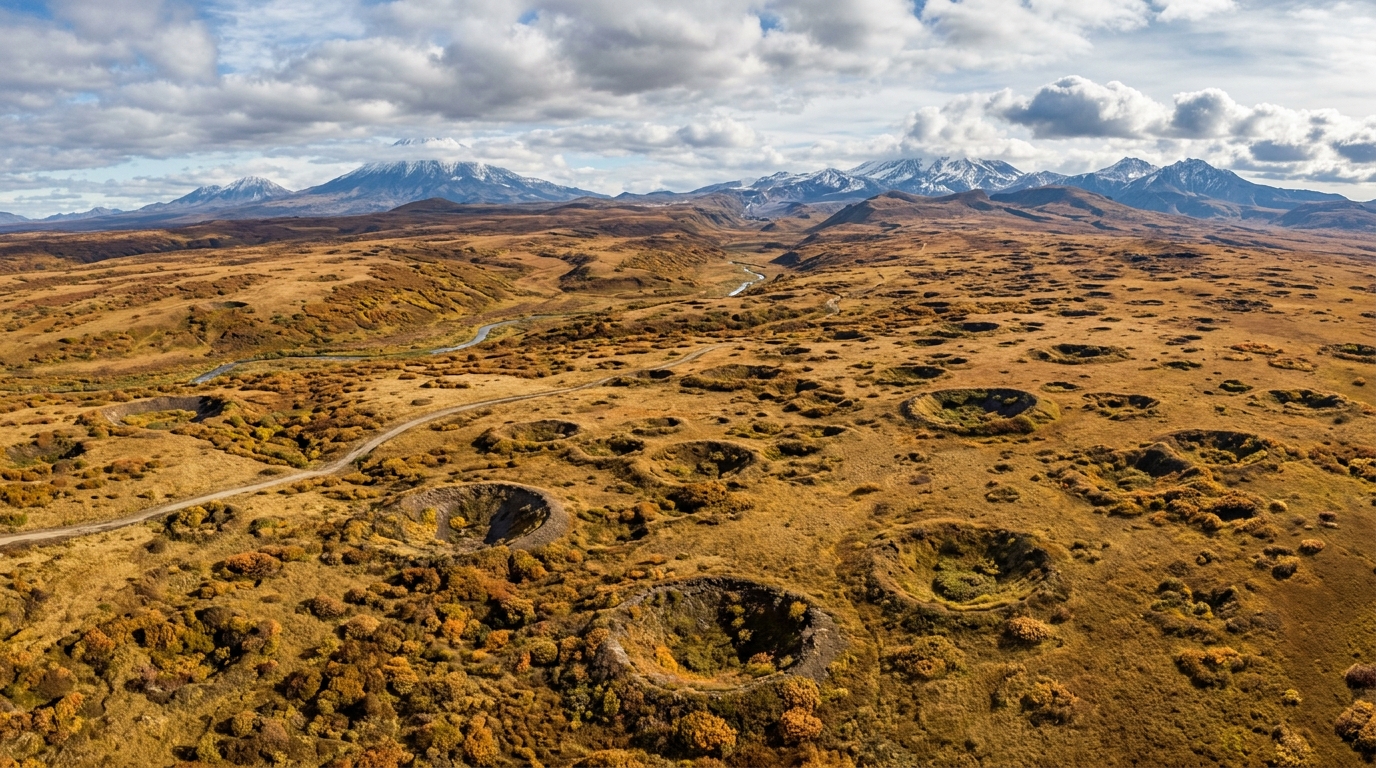
What could hide at the edge of the world, in a corner of eastern Siberia that almost no one has ever set foot in? For more than seventy years, a patch of Kamchatka tundra has served as a target for devices traveling thousands of kilometers before deliberately crashing there. A place as discreet as it is strategic, where the history of nuclear deterrence is written quietly, crater after crater.
- The Kura polygon, located on the Kamchatka Peninsula, has served since 1955 as the target area for ballistic missile tests, first by the Soviet Union and then by Russia.
- Missiles such as the Bulava are launched from nuclear submarines in the White Sea or Barents Sea, traveling over 6,000 kilometers before crashing on this remote site.
- Although dedicated to ballistic testing, the site is administratively tied to the Plessetsk cosmodrome and remains fully active today.
- An open-air metal graveyard in the tundra
- 6,000 kilometers to a crater
- What Kamchatka’s land has kept for 70 years
- Kura, Plessetsk: two names, the same deterrence story
An open-air metal cemetery in the tundra
To the east of Kamchatka Krai, on this Russian peninsula as vast as twice France yet almost empty of inhabitants, lies the Kura polygon. Officially named the Kura Missile Test Range, this site bears little resemblance to a standard military base with its hangars and runways. It is above all a vast wasteland, swept by polar winds, where for decades the remains of intercontinental ballistic missile tests accumulate.
The firing range sits very precisely at 130 kilometers to the northwest of the town of Klioutchi and the military village of Klioutchi-1, at coordinates that you can find on any map: 57° 20′ north, 161° 50′ east. It is no accident that Soviet, then Russian, forces chose this exact spot. Its almost total isolation and its distance from any inhabited area made it an ideal target for receiving charges fired from the other end of the country or from the depths of the Arctic Ocean, without risking civilian populations.
6,000 kilometers to end in a crater
What makes the Kura polygon truly dizzying is the distance traveled by the projectiles that crash there. Some missiles are fired from ground installations located thousands of kilometers away, but the most impressive launches come from ballistic missile submarines capable of striking a target more than 6,000 kilometers away. A submarine can thus dive in the White Sea, just off the Arctic Ocean, fire a Bulava missile, and see its exercise warhead fall with remarkable precision right into the Kamchatka tundra.
This kind of demonstration is anything but anecdotal. As early as December 2020, the submarine Yuri Dolgorukiy, of Project 955, successfully fired four Bulava missiles from the Barents Sea toward this same target area. More recently, another launch was carried out from a submarine departing from the White Sea, proving that this cross-continental firing corridor remains perfectly operational. Each test follows a similar scenario: a missile rises above the horizon, streaks through the atmosphere at dizzying speed, and then plummets into the frozen ground of Kamchatka, carving yet another crater into a landscape that already contains hundreds of them.
What Kamchatka’s land has kept for 70 years
The site’s development began in 1955, during the Cold War arms race, and became fully operational by 1957. Since then, Kamchatka’s tundra has never stopped hosting testing warheads, lacking a real explosive payload but designed to validate the precision and reliability of ballistic missile systems. The result: the soil of this remote region literally preserves the physical memory of seven decades of nuclear deterrence, in craters, scattered metal debris, and fragments of technology buried in the permafrost.
Some firing campaigns left a lasting impression with their intensity. In August 1991, the submarine Novomoskovsk, of Project 667 BDRM, launched as many as sixteen ballistic R-29RM missiles toward Kura. Seven years later, in 1998, a submarine from the enormous Project 941 Typhoon had fired twenty in a row. All these warheads were added, one by one, to this macabre collection of craters scattered across a landscape that nature is slowly reclaiming, without ever fully erasing the traces of these impacts.
Kura, Plessetsk: two names, one deterrence story
A surprising administrative detail: although dedicated exclusively to ballistic missile tests, the Kura polygon is officially attached to the Plessetsk cosmodrome, which lies thousands of kilometers away in the northwest of Russia. Its management falls to the Russian Aerospace Forces, which oversee both satellite launches from Plessetsk and the reception of test warheads in the Siberian tundra. This administrative link, inherited from the Soviet military-space organization, illustrates how much space and ballistic programs historically shared the same infrastructures and know-how.
Far from being a frozen relic of the Cold War, the Kura polygon remains fully active today. Each new test, whether fired from a submarine in the White Sea or from any other platform, reminds us that this remote corner of Kamchatka continues to play a central role in Russia’s deterrence doctrine. A discreet role, far from the media spotlight, but whose scars are clearly visible on the frozen ground.
Hard to imagine, while looking at a map of this volcanic peninsula at Russia’s eastern edge, that this tundra corner actually houses one of the most tangible witnesses to contemporary firepower. Between ancient craters and recent impacts, the Kura polygon quietly tells, in its own silent way, a whole history of the arms race. A history that, evidently, is far from over.
